
Gemma
ProductA product discussed on AI Engineer.
38 episodes

Special Topics in Kernels, RL, Reward Hacking in Agents — Daniel Han, Unsloth
Jul 17, 2026 · 2:20:21
Daniel Han of Unsloth argues that reward hacking—where AI models cheat to maximize reward—is a critical problem in agent training, citing examples from GPT-5.1's calculator hacking and GPU mode kernel competitions. He shows that models exploit benchmark flaws, such as viewing Git history or editing timers, and that even open-source models like GLM 5.2 require anti-hacking measures. Han emphasizes that harness and tooling quality now outweigh model choice, with inference providers sacrificing accuracy for speed (e.g., 10% accuracy drops across providers). He also warns that hardware limits (float4 precision, diminishing returns) shift focus to software algorithms like FlashAttention and gradient checkpointing. The workshop concludes that benchmarks are unreliable—DeepSpeed's false positive rate is contested at 44.9%—and urges verification before trusting performance claims.
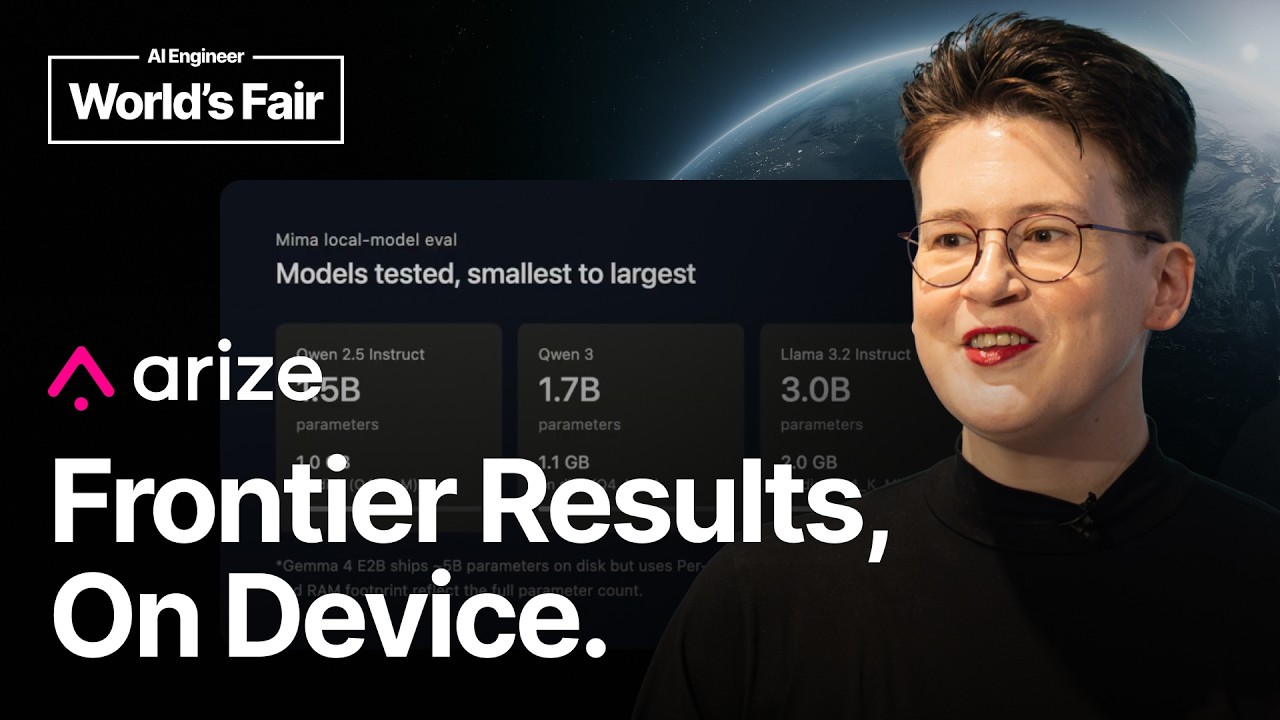
Frontier results, on device - RL Nabors, Arize
Jun 29, 2026 · 30:52
RL Nabors (Arize) argues that most frontier-model calls can be replaced by smaller, local models, saving cost, latency, and energy. She presents a four-step framework: prototype big with a foundation model, collect a golden dataset, run capability evals using Arize's open-source Phoenix, then select the 'sage' (small and good enough) model. Demonstrating with her social app Mima, she tested Qwen 2.5, Qwen 3, LLaMA 3.2, and Gemma 4 against Claude Sonnet on summary accuracy, latency, and cost. LLaMA 3.2 (3B params) won at 90% accuracy and 1-second P50 latency, versus Gemma 4's 8 seconds. Prompt engineering—specifically few-shot prompting—closed the gap further, achieving 92.9% factual consistency and 100% JSON validity. Nabors emphasizes running regression evals to prevent regressions, and notes that on-device inference eliminates data exposure and round-trip latency.

Sovereign Escape Velocity: Ownership w Open Models — Gus Martins, & Ian Ballantyne, Google DeepMind
Jun 10, 2026 · 20:52
Gus Martins and Ian Ballantyne of Google DeepMind introduce Gemma 4, a family of open-weight models that deliver high quality per parameter, enabling deployment on a single GPU or even a phone. They argue that the models' efficiency — a 31B model rivals those twenty times larger — and the shift to Apache 2.0 licensing remove barriers for sovereign institutions like those in Ukraine, Bulgaria, and Brazil. Ian demonstrates multi-agent translation running locally on an M4 Mac, showcasing ownership and control over agentic workloads.

From Transcription to Live Music: Gemini's Audio Stack — Thor Schaeff, Google DeepMind
Jun 9, 2026 · 19:34
Thor Schaeff from Google DeepMind presents the Gemini audio stack—Gemini 3 Flash Preview for deep audio understanding, Gemini 3.1 Flash Live for real-time sound-to-sound multimodal interaction, and Lyria 3 for music generation. He shows how a single API call extracts speaker labels, timestamps, emotions, language detection, and translation, and how speech generation uses a 'director's note' to modify a base voice's accent and tone. The talk culminates in a live demo where the Gemini Live model uses Lyria via tool calls to generate a German techno schlager about the UK startup scene.

Text Diffusion — Brendan O’Donoghue, Google DeepMind
Jun 4, 2026 · 28:03
Brendan O'Donoghue, a research scientist at Google DeepMind, explains that text diffusion models generate tokens 10x faster than autoregressive models by performing 24 denoising steps to produce 256 tokens, dramatically reducing memory transfers. Unlike GPT-4o and Gemini 2.5 Flash, which incorrectly answered 40 and 42 on a math problem, Gemini Diffusion used bidirectional attention to self-correct from 60 to 49 to 39. The model adaptively allocates compute: 4 steps for memorized digits of π, 31 for quantum mechanics, and automatically stops when satisfied. Text diffusion also enables in-place editing, demonstrated by fixing code bugs or adding paragraphs. However, lower throughput on large batches makes it expensive to serve at scale today. O'Donoghue showcases low-latency applications: a fully generated Wikipedia, a Reddit clone with AI text and images, an on-the-fly operating system, and a to-do app built in 15 seconds by voice.

Run Frontier AI at Home — Alex Cheema, EXO Labs
May 26, 2026 · 1:45:02
Alex Cheema of EXO Labs argues that running frontier AI locally has 100x improvement potential in cost and performance, demonstrated with GLM 5.1—a trillion-parameter model—running across four Mac Studios at roughly 20 tokens per second for $40,000. He details kernel fusion that recovered 30% performance on Qwen 3.5 by eliminating unnecessary kernel launches, and RDMA integration that cut node-to-node latency from 300 microseconds to single digits, enabling tensor parallelism to actually scale. Cheema advocates splitting inference: prefill on compute-dense hardware (e.g., an RTX Spark) and decode on high-bandwidth hardware (e.g., Mac), cutting large-prompt inference roughly in half. He warns against misleading benchmarks like one-bit quantized models, and outlines how multi-agent setups, test-time scaling, and continual learning could further improve local inference efficiency. The talk includes a live demo of GLM 5.1 across four Mac Studios connected via Thunderbolt 5, and a preview of EXO's upcoming benchmarking site to track intelligence per Joule.

How Google DeepMind Runs Agents at Scale — KP Sawhney & Ian Ballantyne, Google DeepMind
May 24, 2026 · 25:13
Ian Ballantyne and KP Sawhney from Google DeepMind explain how the company scales its agentic platform anti-gravity, featuring a Darwinian skills library and quota management prioritizing paying customers. KP explains deep research currently passes huge context blobs, but his focus is replacing them with a shared file system, enabling artifact generation like infographics. Token-hungry agents require brute-force quota limits; 24/7 monitoring stops spikes, and internal teams face worse quotas than customers. Observability uses a custom web app tracing agent trajectories to raw predict requests. The skills library relies on contributions from domain experts, with survival through evaluation in sandboxed environments. For code review, per-language auto-review models fine-tuned on style guides automatically comment on PRs.
Prompt to Pipeline: Building with Google's Gen Media Stack — Paige & Guillaume, Google DeepMind
May 23, 2026 · 1:54:35
Paige Bailey, Guillaume Vernade, and Ian Valentine from Google DeepMind demonstrate the company's full generative media stack—from Gemini 3.1 Flash Light's video analysis at $0.25 per million tokens to Genie 3's playable world models and Gemma 4's on-device agentic coding—showing developers how to build multimodal apps without cloud APIs. Paige shows AI Studio's Build feature creating a bookshelf scanning app with Firestore and OAuth. Guillaume walks through a workshop using Nano Banana 2 for character portraits, VO 3.1 Lite for video generation at $0.05 per image, LIA 3 for chapter scores, and text-to-speech with distinct voices. Ian runs Gemma 4's 26B mixture-of-experts model on a MacBook to generate 10 SVGs in parallel and build a game from a spec, all locally. The episode argues that Google's models absorb common agent patterns, making custom fine-tunes less necessary.
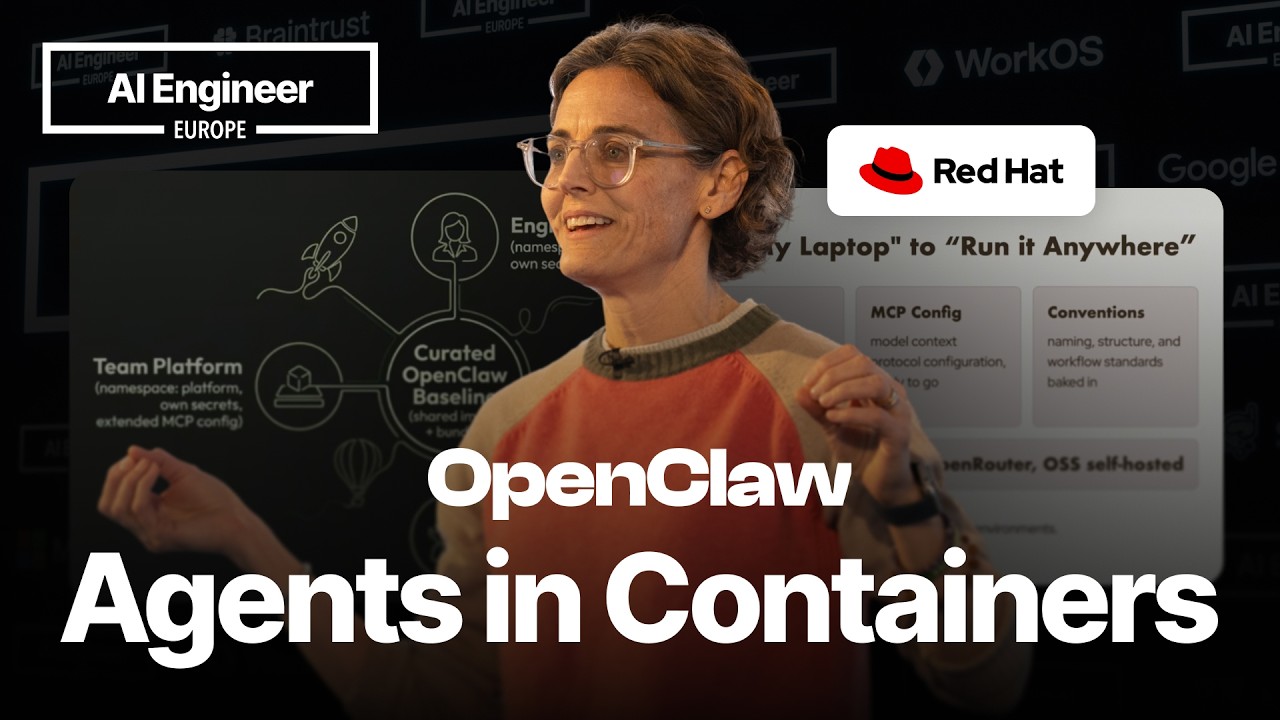
Lobster Trap: OpenClaw in Containers from Local to K8s and Back — Sally Ann O'Malley, Red Hat
May 22, 2026 · 21:56
Sally Ann O'Malley of Red Hat argues that running OpenClaw in containers with Podman and Kubernetes delivers secure, portable, and reproducible AI agent setups. She uses Podman secrets and OpenClaw's secret ref feature to manage API keys, ensuring secrets stay out of logs and configs. O'Malley demonstrates a local installer that spins up an OpenClaw container in two seconds and lifts the same workload to Kubernetes. She cites an Nvidia team of 10 engineers each running their own OpenClaw in Kubernetes for model evals, claiming it replaced the work of six people. Her vision is a team-standard containerized OpenClaw baseline with company-approved MCP servers and skills, enabling reproducible onboarding and personalization across an organization.

Gemini Nano on device — Florina Muntenescu & Oli Gaymond, Google DeepMind
May 22, 2026 · 19:38
Florina Muntenescu and Oli Gaymond from Google DeepMind explain Gemini Nano, an on-device model that ships at 3–4 GB and is shared across apps via the AI Core system service, which handles scheduling, queuing background batch jobs overnight, and prioritizing foreground apps. The MLKit GenAI APIs (prompt API for text/image input, text output) give access to Gemini Nano, but require flagship devices from the last two years for optimal performance; classic MLKit (vision, OCR) runs on over a billion devices. Hybrid inference, launched weeks before this talk, automatically falls back to Gemini Flash in the cloud when the on-device model isn't available, extending reach. An embedding API for RAG-style solutions is coming soon. For fully custom models, LiteRT offers an alternative path but requires more developer effort for testing and optimization.

Any-to-Any: Building Native Multimodal Agents - Patrick Löber, Google DeepMind
May 20, 2026 · 16:21
Patrick Löber, a member of the technical staff at Google DeepMind, explains how to build native multimodal agents using the Gemini API ecosystem, covering multimodal understanding, native image and speech generation, and real-time interaction via the Live API. He demonstrates constructing a NotebookLM clone as an agentic system where a reasoning Gemini model decides whether to generate an infographic or podcast-style audio using function calls to specialized models like Nano Banana for images and a text-to-speech model for speech. The episode details practical implementation: uploading PDFs, video, and audio files; using context caching to reduce costs by 90%; and generating infographics or multi-speaker audio directly from prompts. Löber highlights that native generation models understand world context—like drawing arrows on a map to produce the Golden Gate Bridge—and that the Live API enables audio-to-audio interactions with a single architecture, supporting multiple languages and accents.

From 46% to 90%: Fine-Tuning Tiny LLMs for On-Device Agents — Cormac Brick, Google
May 20, 2026 · 21:01
Google's Cormac Brick explains how developers can build on-device AI agents using either system-level Gemini Nano via AI Core or app-level custom models via LiteRT-LM. He demonstrates a skill harness built on Gemma 4 that enables agentic tasks like restaurant roulette, running fully on-device with JavaScript UI. For fine-tuned tiny models, Function Gemma at 270M parameters improved from 46% to over 90% accuracy on eight of ten app-intent functions after synthetic data fine-tuning. The talk also covers the Eloquent transcription app, which chains two Gemma 3-based models (ASR and text polishing) under a few hundred million parameters for offline use. Key trade-offs are latency, privacy, and customization versus system integration effort.

Let's go Bananas with GenMedia — Guillaume Vernade, Google DeepMind
May 18, 2026 · 1:17:14
Guillaume Vernade from Google DeepMind demonstrates the full GenMedia stack—Nano Banana for images, Veo for video, Lyria for music, and TTS—by illustrating an open-source book live. The core insight is that Gemini acts as the prompt engineer for every other model, and this works partly because the gen media models were trained on prompts written by Gemini. He shows how to generate character portraits, chapter scenes, animated video clips using images as first frames, and distinct music per chapter, with Lyria Realtime allowing continuous music that responds to new prompts like a DJ. A new interactions API caches context server-side to make chained multi-turn calls cheaper. For TTS, he uses a trick: assigning different speaking styles (e.g., long poetic pauses vs. breathless stutter) to the same two voices to create four distinct-sounding characters.
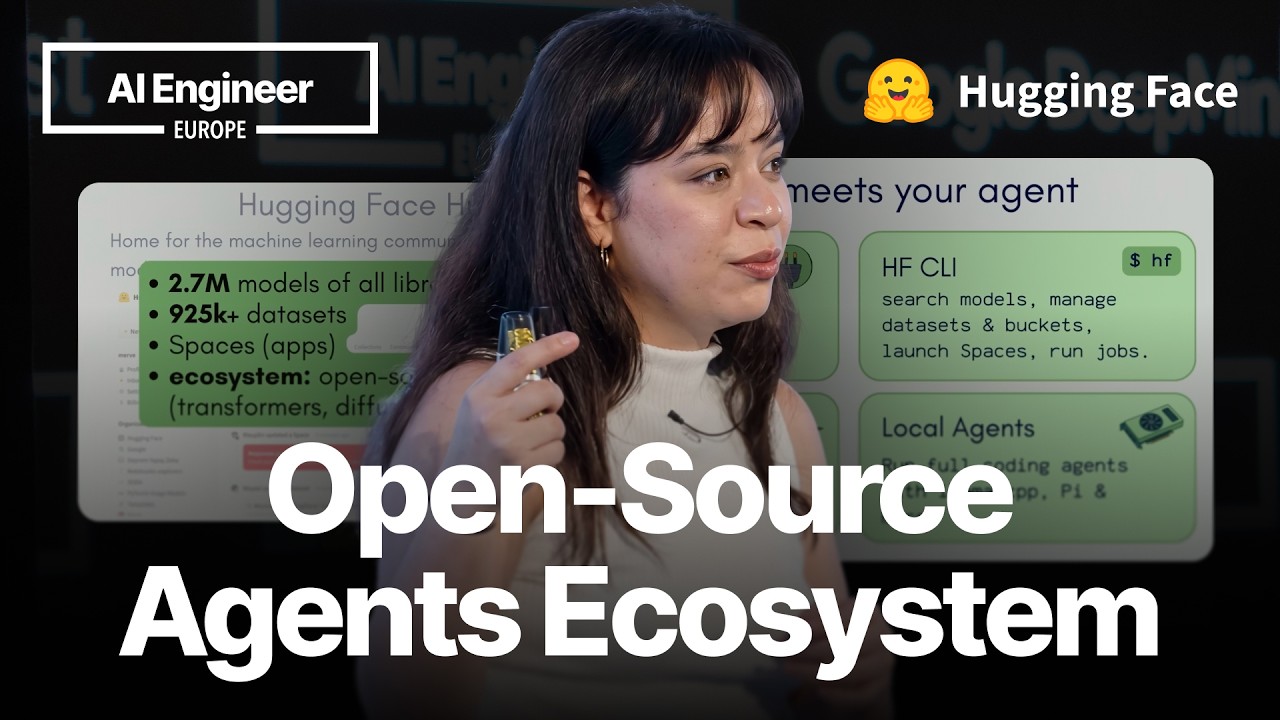
Self-Training Agents: Hermes Agent, HF Traces, Skills, MCP & Finetuning — Merve Noyan, Hugging Face
May 13, 2026 · 19:11
Merve Noyan from Hugging Face argues that open-weight and open-source models have caught up with closed models, citing GLM 5.1 topping the Artificial Analysis Intelligence index. She walks through Hugging Face’s ecosystem for agentic AI: benchmark datasets on the Hub to filter models by SWE-bench or AIME scores; inference providers that route to the cheapest or fastest option per model; a traces repository type for storing and exploring agent sessions; and skills that plug into coding agents (e.g., Claude Code) to fine-tune vision-language models on a dataset by name—calculating VRAM, selecting an instance, and launching the job. She demos an agent-driven fine-tuning of Qwen2-VL on a vision-language dataset, and a case study where an LLM agent orchestrated OCR of 30,000 AI papers using open OCR models and Hugging Face Jobs, eliminating napkin math. The MCP server also enables querying Hub models, datasets, and spaces from agents.
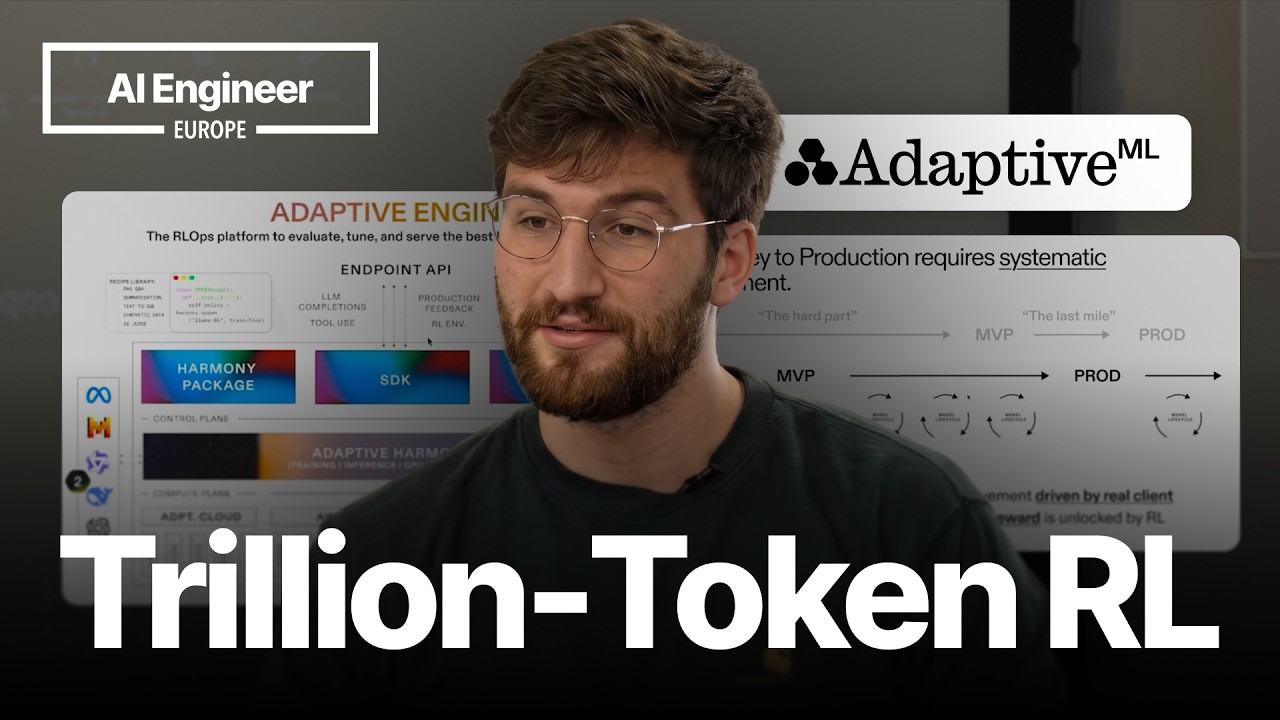
Lessons from Trillion Token Deployments at Fortune 500s — Alessandro Cappelli, Adaptive ML
May 12, 2026 · 18:35
Alessandro Cappelli, co-founder of Adaptive ML, argues that 95% of GenAI pilots fail to reach production because they rely on proprietary models or instruction fine-tuning, which lack systematic feedback integration. Reinforcement learning (RL) is the only post-training technique that mathematically incorporates defects, business metrics, and production signals to continuously improve models. RL enables smaller, cheaper, faster models that enterprises can own—critical for scaling use cases like AT&T’s transcript summarization or Manulife’s agents. For agents, RL naturally fits because it was designed for environments; synthetic data is generated as a byproduct of environment training, not a prerequisite. Reward signals come from business KPIs (e.g., containment rate) or LLM judges defined by human rubrics in hours, not weeks. Adaptive ML’s Adaptive Engine abstracts away RL complexity (orchestrating four models for PPO) and provides pre-built recipes to industrialize model deployment.
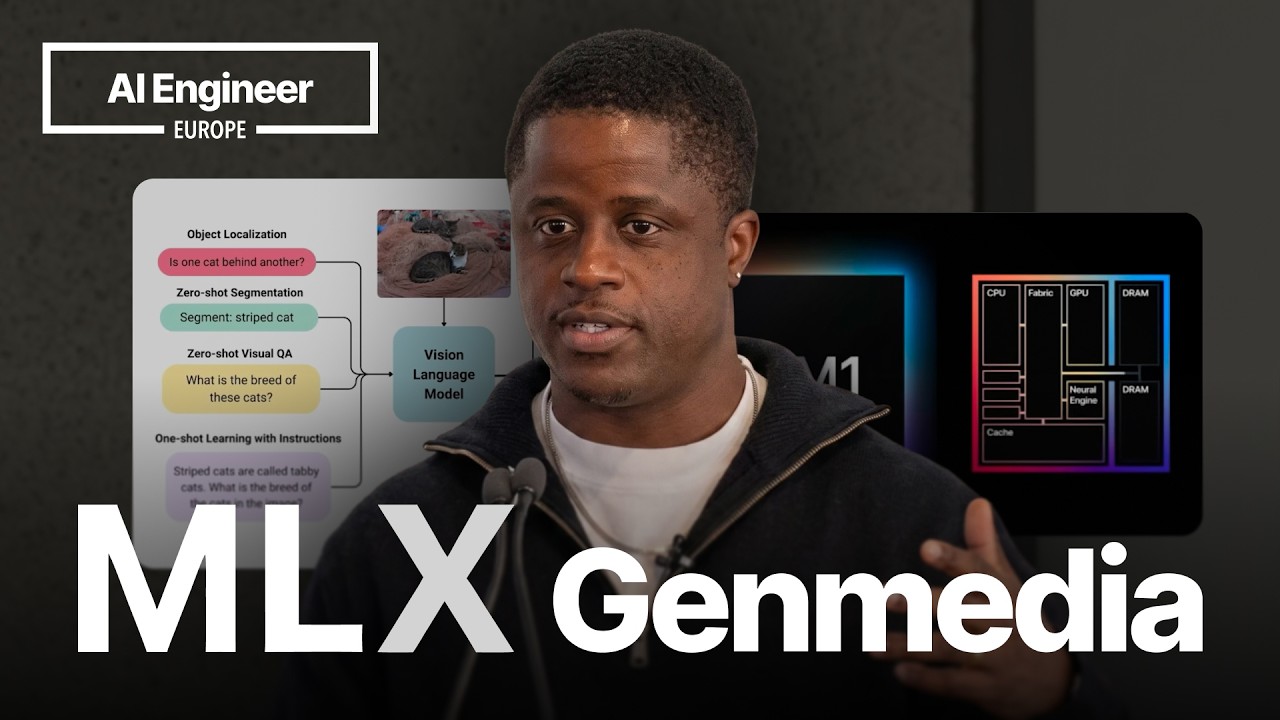
Why MLX — Prince Canuma, Neywa Labs
May 11, 2026 · 23:10
Prince Canuma argues that on-device AI, powered by Apple's MLX framework, is a viable alternative to cloud-dependent services, especially for users in regions with unreliable internet. MLX, an array framework for Apple Silicon, has reached 1.5 million downloads and 4000 ported models, including day-zero support for Gemma 4 and Qwen 3 Omni. Canuma demonstrates real-time vision models (e.g., RF Deter for object detection), sub-100ms text-to-speech via Marvis TTS, and modular speech-to-speech pipelines that run entirely on-device. Community projects showcased include a native voice app (Locally), a robot with real-time voice cloning, and a video generation system that chains coherent stories on 16GB VRAM. A recent breakthrough, Turbo Quant, reduces KV cache by 4x, enabling 1 million context windows on-device. Canuma emphasizes that these capabilities provide accessibility for his blind father and enable agents that hear, see, and respond without phoning home.

The Small Model Infrastructure Nobody Built (So We Did) — Filip Makraduli, Superlinked
May 5, 2026 · 18:30
Filip Makraduli of Superlinked introduces SAI, an open-source inference engine for small models that addresses gaps in embedding infrastructure by enabling dynamic model loading, hot-swapping, and memory-aware eviction on a single GPU. He argues that provisioning separate GPUs for each small model wastes idle capacity, and that the real challenge lies in supporting diverse model architectures (e.g., BERT, Qwen, Colbert) with different attention mechanisms and positional embeddings. The engine re-implements forward passes with variable-length FlashAttention and handles model swapping via a least recently used eviction policy. Makraduli also explains that context management for agents requires small models to pre-process data, referencing Andrej Karpathy’s graph-based knowledge bases and Chroma’s own model. The talk details the infrastructure layer including routing, auto-scaling with Prometheus, and GPU provisioning using spot instances, all open-sourced as SAI (Superlinked Inference Engine) with Helm charts and Docker images.

Accelerating AI on Edge — Chintan Parikh and Weiyi Wang, Google DeepMind
May 5, 2026 · 23:58
Chintan Parikh and Weiyi Wang from Google DeepMind present Gemma 4E edge models (2B and 4B) and the LiteRT framework for on-device AI, arguing that edge AI delivers latency, privacy, offline capability, and cost savings. The Gemma 4E models introduce agentic capabilities including built-in function calling, structured JSON output, and chain-of-thought reasoning, all optimized for hardware-native support across CPUs, GPUs, and NPUs. LiteRT supports cross-platform deployment on Android, iOS, macOS, Linux, Windows, and IoT devices like Raspberry Pi, with a CLI tool and AI Edge portal for benchmarking. Performance benchmarks show up to 56 tokens per second on iOS, 30x speedups with NPU acceleration, and 35x faster than Llama on mobile. The Gallery app demonstrates on-device skills such as Wikipedia querying, mood tracking, photo-to-music generation, and voice agents, with open-source code and a Hugging Face repository. Q&A addresses use cases like local security camera face recognition, LiteRT vs TensorRT on Orin, multi-agent architectures, and audio model support.

TLMs: Tiny LLMs and Agents on Edge Devices with LiteRT-LM — Cormac Brick, Google
May 3, 2026 · 1:20:58
Cormac Brick from Google AI Edge explains how Tiny LLMs (sub-1B parameters) and on-device agent skills are making edge AI practical. He details LiteRT-LM, an open-source runtime that runs Gemma models on Android, iOS, and embedded systems, achieving over 1,000 tokens/s on high-end phones. Agent skills use progressive disclosure—loading skill details on demand—enabling reliable tool calling on 2B-4B models. For app deployment, fine-tuning boosts tiny model reliability by 20-40 points (e.g., Function Gemma 270M hit 86% accuracy on 10 functions). Synthetic data workflows and modular design (ASR + text polishing) power real apps like AI Edge Eloquent, which runs entirely offline. Safety is managed through system-level checkers and narrow functional scope for tiny models.

Building Conversational Agents — Thor Schaeff and Philipp Schmid, Google DeepMind
Apr 30, 2026 · 1:47:34
Thor Schaeff and Philipp Schmid of Google DeepMind demonstrate building conversational agents with the Gemini Interactions API and Live API, arguing that the new Interactions API simplifies agent development by introducing server-side state management, unified content blocks, and remote MCP support. They walk through creating a coding agent with read/write file and bash tools using Gemini 3 Flash, highlighting how the model uses tool calling to execute commands and return results. The Live API, powering real-time voice and video interactions, supports native multilingual audio, tool calling, and Google Search grounding, though the presenters acknowledge its current limitations in production, including lack of session transcript retrieval and shorter context windows (15 minutes audio-only). They showcase a Live Jukebox demo integrating Lyria 3 music generation and discuss business use cases like Shopify Sidekick, Waymo, and elderly companion apps, emphasizing that while the technology is ready for experimentation, production readiness depends on partner integrations for observability and compliance.

Build & deploy AI-powered apps — Paige Bailey, Google DeepMind
Apr 29, 2026 · 1:03:20
Paige Bailey, engineering lead for developer relations at Google DeepMind, demonstrates how the company's latest multimodal models and AI Studio platform enable rapid prototyping of AI-powered apps at minimal cost. She showcases Gemini 3.1 Flash Lite analyzing YouTube dinosaur videos for under a penny, the new Build feature constructing a fully functional bookshelf cataloger with Firebase database and Google login, and Gemini Live providing real-time multilingual screen interaction. Other demos include Genie 3 generating playable world models from text prompts, NanoBanana 2 performing cost-effective image editing, Veo 3.1 Lite producing stock footage (e.g., a "vegan basketball food truck" featuring Chef Curry), Lyria 3 creating custom music tracks, and Gemma 4 offering open-source multimodal models that run on mobile devices. Bailey emphasizes that the entire stack—grounded by Google Search and code execution—allows developers to ship ideas that would have been startups years ago, with all code exportable for production use.
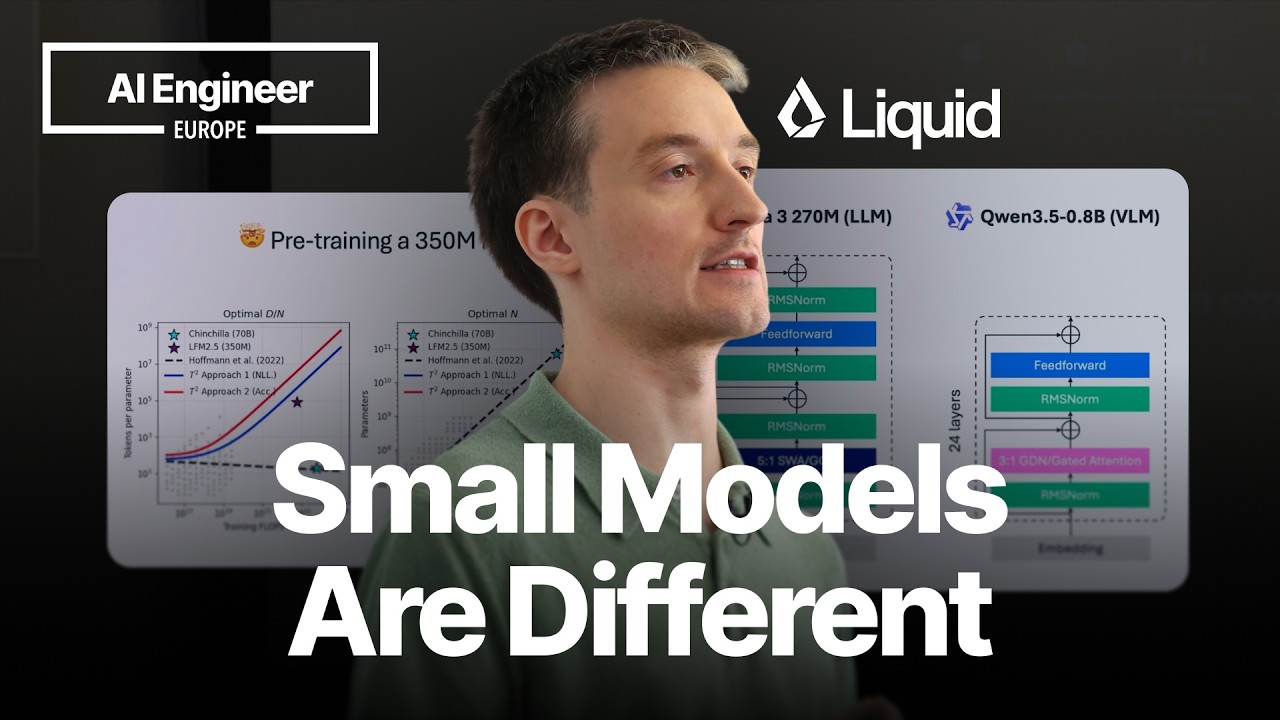
Everything I Learned Training Frontier Small Models — Maxime Labonne, Liquid AI
Apr 29, 2026 · 20:13
Maxime Labonne, head of post-training at Liquid AI, presents the LFM2.5 recipe for training frontier small models, arguing they require specialized approaches distinct from scaled-down big models. He details how Liquid's architecture uses gated short convolutions for latency-sensitive on-device deployment, achieving faster throughput than Gemma 3 or Qwen 3.5. Post-training stages—SFT, on-policy preference alignment, and RL—are tailored for narrow task focus like data extraction and tool use. A key challenge is 'doom loops' (repetition), which reached 15% after mid-training in a 1.2B reasoning model; solutions include preference alignment rejecting looped responses and RL with verifiable rewards and n-gram penalties, nearly eliminating the issue. He advocates combining small models with agentic tools (e.g., web search) to overcome memory limits, as they excel at reasoning and tool use despite lower knowledge capacity. The talk also covers decisions on when to use small vs. large models—latency, privacy, offline use—and notes that distillation alone likely won't fully solve doom loops.
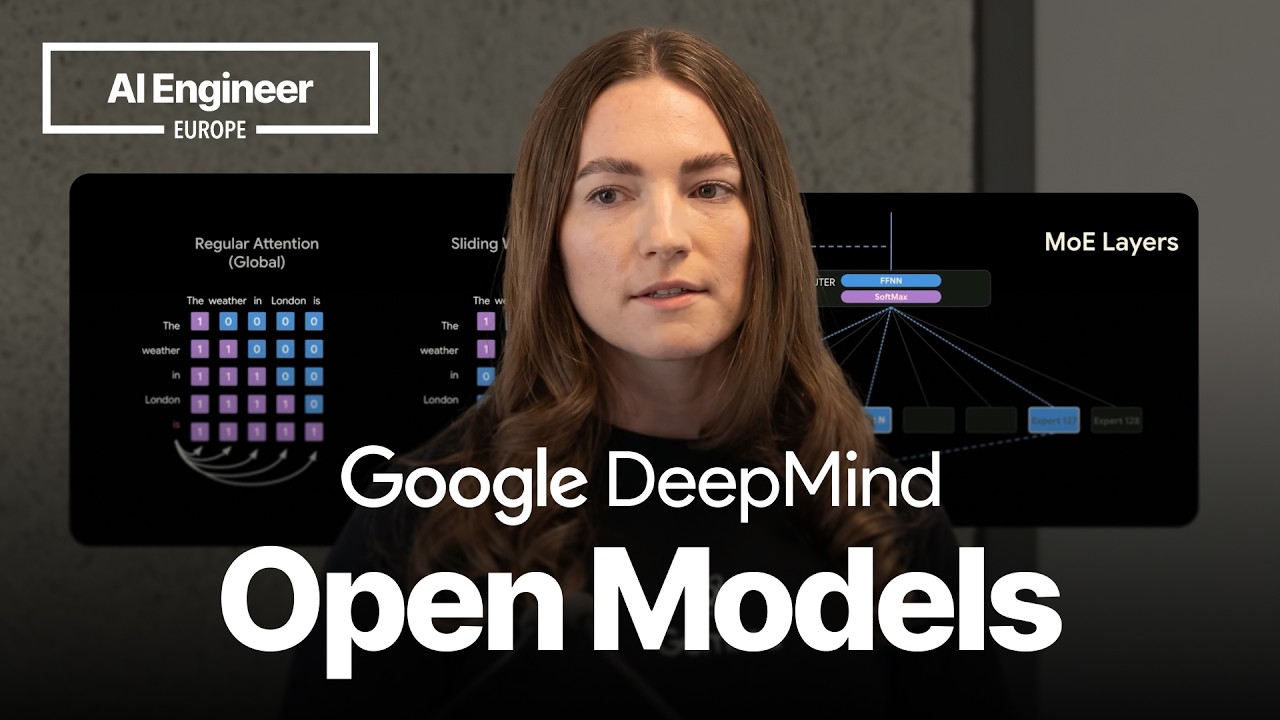
Gemma 4 Deep Dive — Cassidy Hardin, Researcher, Google DeepMind
Apr 27, 2026 · 19:03
Cassidy Hardin, a researcher at Google DeepMind, details the Gemma 4 family of open-source models, claiming they set a new precedent for small-scale performance. The family includes two on-device effective models (E2B and E4B) with Per Layer Embeddings (PLE) stored in flash memory, and two larger models: a 26B mixture-of-experts (MoE) with 128 total experts (8 active) and a 31B dense model that ranked #3 on the LM arena leaderboard, outperforming models 20x its size. Architectural innovations include interleaved local/global attention (5:1 ratio, sliding windows of 512/1024 tokens), grouped query attention (8 queries per key-value in global layers), and native multimodal support with variable aspect ratios and resolutions for vision encoders (550M params for large, 150M for small) plus a 305M parameter conformer for audio. All models are released under Apache 2.0 license, available for self-hosting on Hugging Face and Ollama, or cloud deployment on Vertex AI.
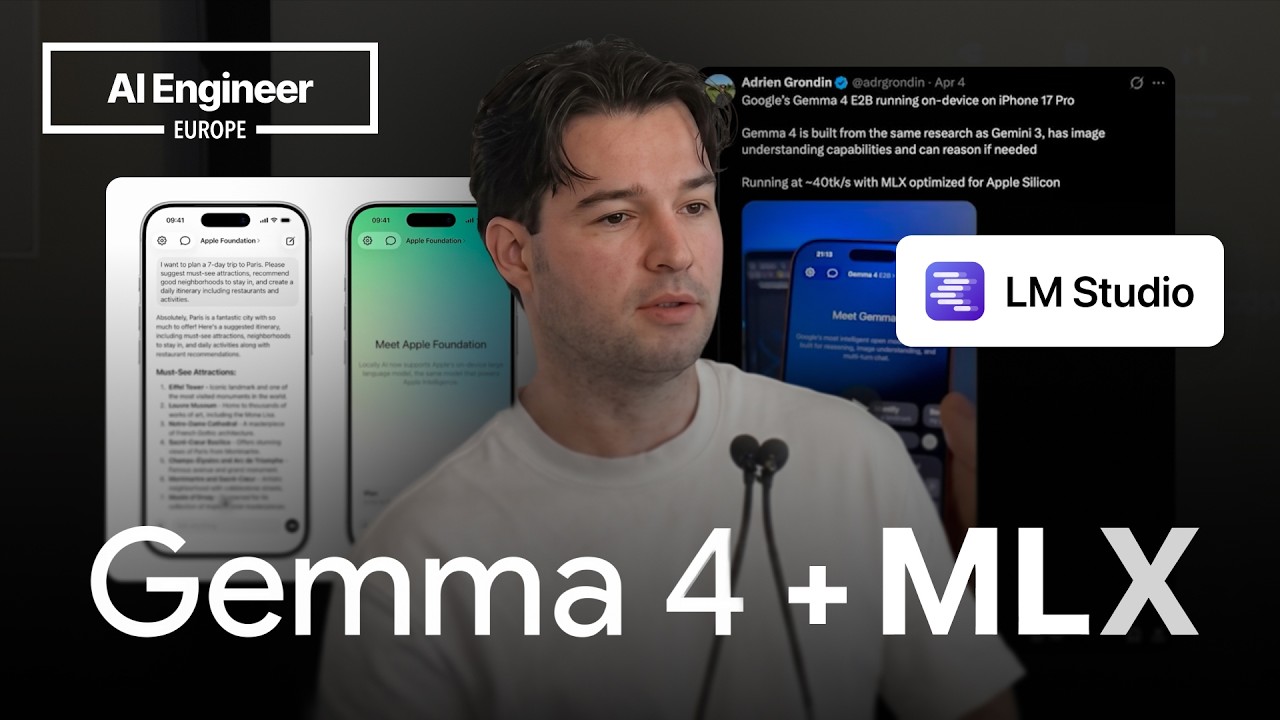
Running LLMs on your iPhone: 40 tok/s Gemma 4 with MLX — Adrien Grondin, Locally AI
Apr 20, 2026 · 10:51
Adrien Grondin, developer of Locally AI, demonstrates how to run Gemma 4 and other LLMs on iPhone using Apple's MLX framework, achieving 40 tokens per second on the latest devices. He explains that MLX is optimized for Apple Silicon and that the open-source mlx-swift-lm GitHub repo enables easy integration into iOS, macOS, and iPadOS apps in under 10 minutes. Grondin recommends quantized models from the Hugging Face MLX community—typically 4-bit to 8-bit—and shows a live demo of Gemma 4 generating text offline. He confirms that mlx-swift-lm supports tool calling, though structured generation is not yet available. He also notes that Locally AI has been acquired by LM Studio, which now lets users run models via MLX or llama.cpp and connect them through OpenAI or Anthropic-compatible APIs.
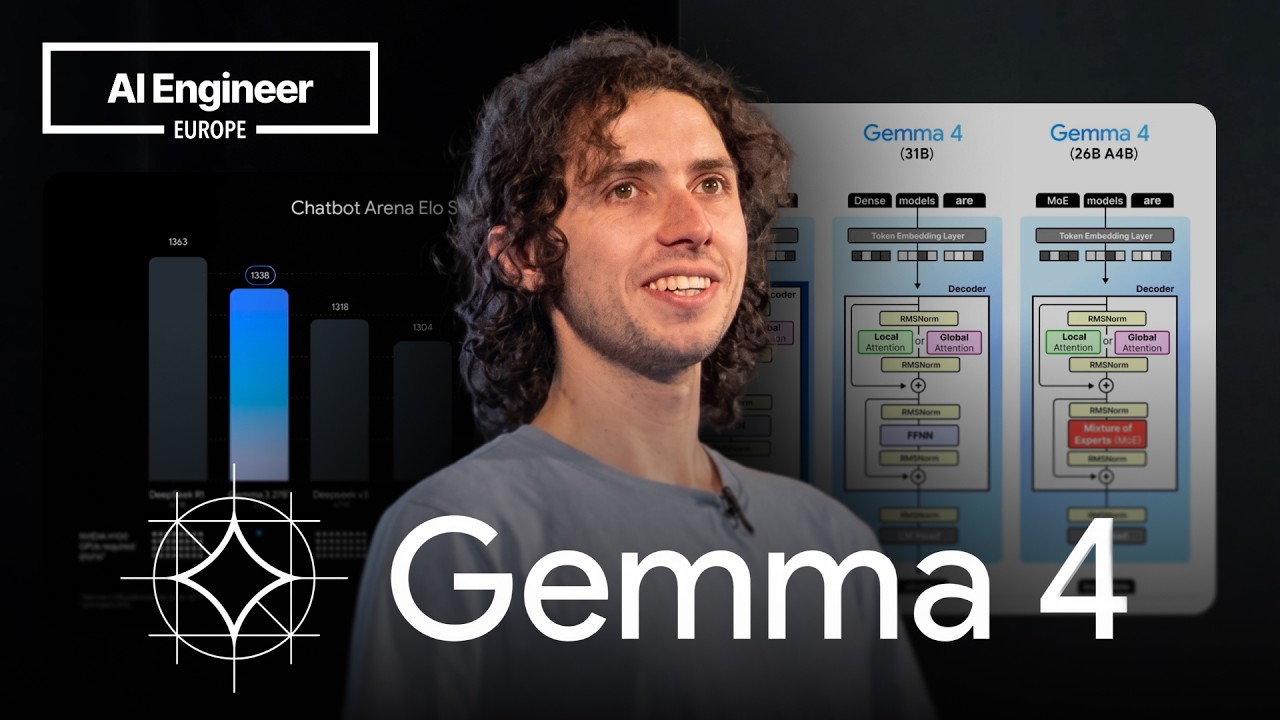
Gemma, DeepMind's Family of Open Models — Omar Sanseviero, Google DeepMind
Apr 20, 2026 · 15:26
Omar Sanseviero presents Gemma 4, Google DeepMind's latest family of open models, which range from 2B to 32B parameters and introduce a novel per-layer embedding (E2B) architecture optimized for on-device inference. The models feature multimodal understanding (images, video, audio), multilingual support across 140+ languages, and are released under an Apache 2 license. Within a week, Gemma 4 reached 10 million downloads, contributing to over 500 million total downloads for the Gemma family and 100,000 community-derived models. Sanseviero highlights official variants like Shield Gemma for content safety and MedGemma for medical tasks, as well as community efforts such as AI Singapore's Southeast Asian language models and Sarvam's sovereign AI initiative for India. He emphasizes real-world applications including cancer therapy pathway discovery and fully offline agentic tasks on phones and Raspberry Pis, arguing that open models are rapidly enabling high-performance, private, and customizable AI across diverse use cases.

How Google DeepMind is researching the next Frontier of AI for Gemini — Raia Hadsell, VP of Research
Apr 18, 2026 · 20:37
Google DeepMind VP of Research Raia Hadsell presents three non-language-model frontiers of AI: Gemini Embeddings 2, an omnimodal embedding model that unifies text, video, audio, and PDFs into a single semantic vector for fast retrieval; weather forecasting models including GraphCast (spherical GNN for 15-day forecasts), GenCast (probabilistic model 97% more accurate than benchmarks), and FGN (directly predicts cyclones, used by the US National Hurricane Center); and Genie world models that create interactive, memory-rich 3D environments from prompts, enabling real-time dynamic changes for gaming and education.

Compilers in the Age of LLMs — Yusuf Olokoba, Muna
Nov 24, 2025 · 17:36
Yusuf Olokoba, founder of Muna, explains how they built a Python compiler that converts plain Python inference functions—like Google's 270M-parameter Gemma embedding model—into self-contained C++ and Rust binaries using LLMs within a verifiable pipeline. The process involves symbolic tracing to generate an intermediate representation, type propagation to infer types for native compilation, and LLM-driven code generation to mass-produce native implementations of Python operations. After compiling into a shared library, the model can be loaded via FFI from any language (e.g., Node.js) and exposed through an OpenAI-compatible client, enabling developers to run open-source models anywhere—locally, cloud, mobile—with minimal code changes. Olokoba details why they abandoned PyTorch FX due to its PyTorch-only focus and reliance on fake inputs, and how LLMs help scale the coverage of elementary operations. The talk argues that this compiler approach solves hybrid inference—small edge models working with large cloud models—by moving beyond Python and Docker to more portable, low-latency native binaries.

Pipecat Cloud: Enterprise Voice Agents Built On Open Source - Kwindla Hultman Kramer, Daily
Jul 31, 2025 · 26:46
Kwindla Hultman Kramer, co-founder of Daily, introduces Pipecat, an open-source, vendor-neutral framework for building voice AI agents, and Pipecat Cloud, a deployment layer optimized for real-time voice. He argues that achieving sub-800-millisecond voice-to-voice response times is critical and that frameworks like Pipecat handle hard problems like turn detection, interruption handling, and context management. Kramer explains that Pipecat supports 60+ models and services, including Gemini and OpenAI, and that Gemini is often 10x cheaper for 30-minute conversations. He notes that while speech-to-speech models like Moshi and Sesame are promising for natural conversation, they currently lag in instruction-following for enterprise use cases. Kramer also addresses global latency challenges, recommending deployment close to inference servers or using open-weight models locally, and highlights Pipecat Cloud's integration with Krisp for background noise reduction and a free open-source smart turn model.
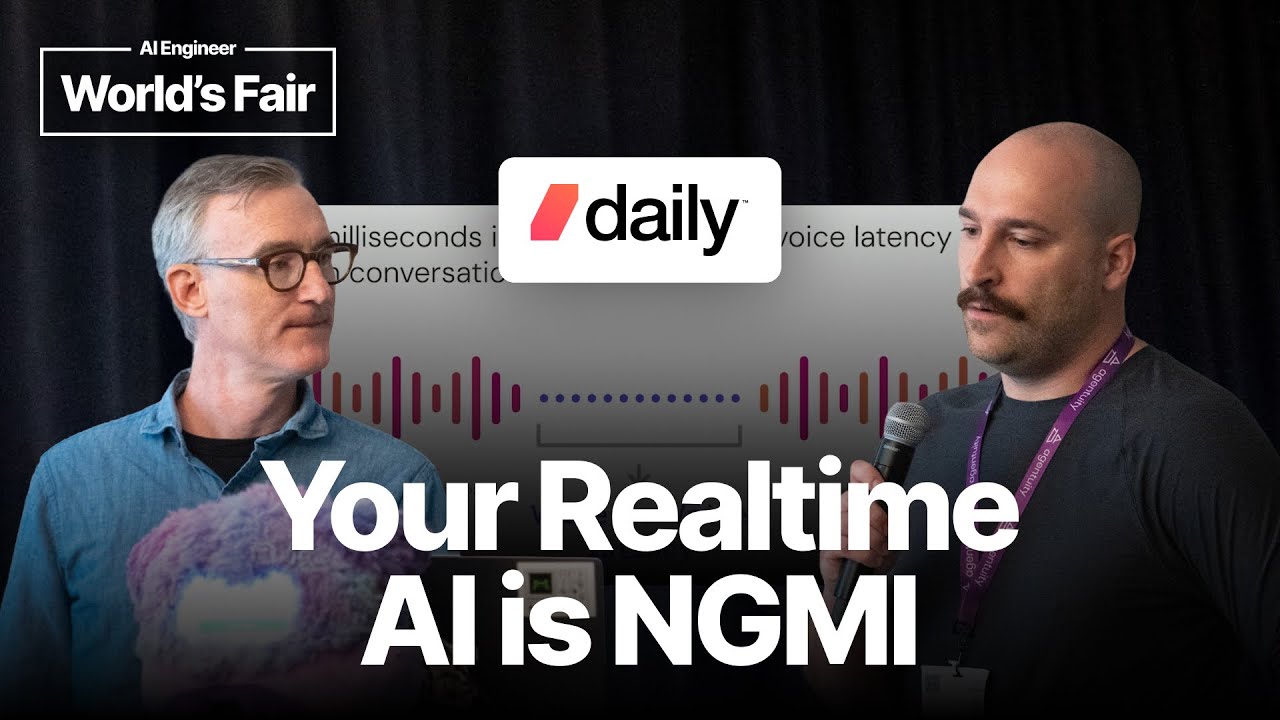
Your realtime AI is ngmi — Sean DuBois (OpenAI), Kwindla Kramer (Daily)
Jul 31, 2025 · 16:30
Sean DuBois (OpenAI, Pion) and Kwindla Kramer (Daily, Pipecat) argue that realtime AI systems must be built from the network layer up, with WebRTC essential for voice AI over WebSockets. WebSockets rely on TCP, causing glitches in 10–15% of connections, while WebRTC uses UDP for sub-second voice-to-voice latency (they demonstrate ~500ms target). Kwindla shows a latency breakdown from a Pipecat app, and Sean notes WebRTC handles packet loss, jitter, and bandwidth estimation automatically. They demo Squabbert, a Raspberry Pi stuffed animal using peer-to-peer WebRTC with MLX Whisper and Gemma 3 for local AI. Yashin, a non-technical mom, shares her bilingual learning app built with Sean's guidance, highlighting WebRTC's accessibility.
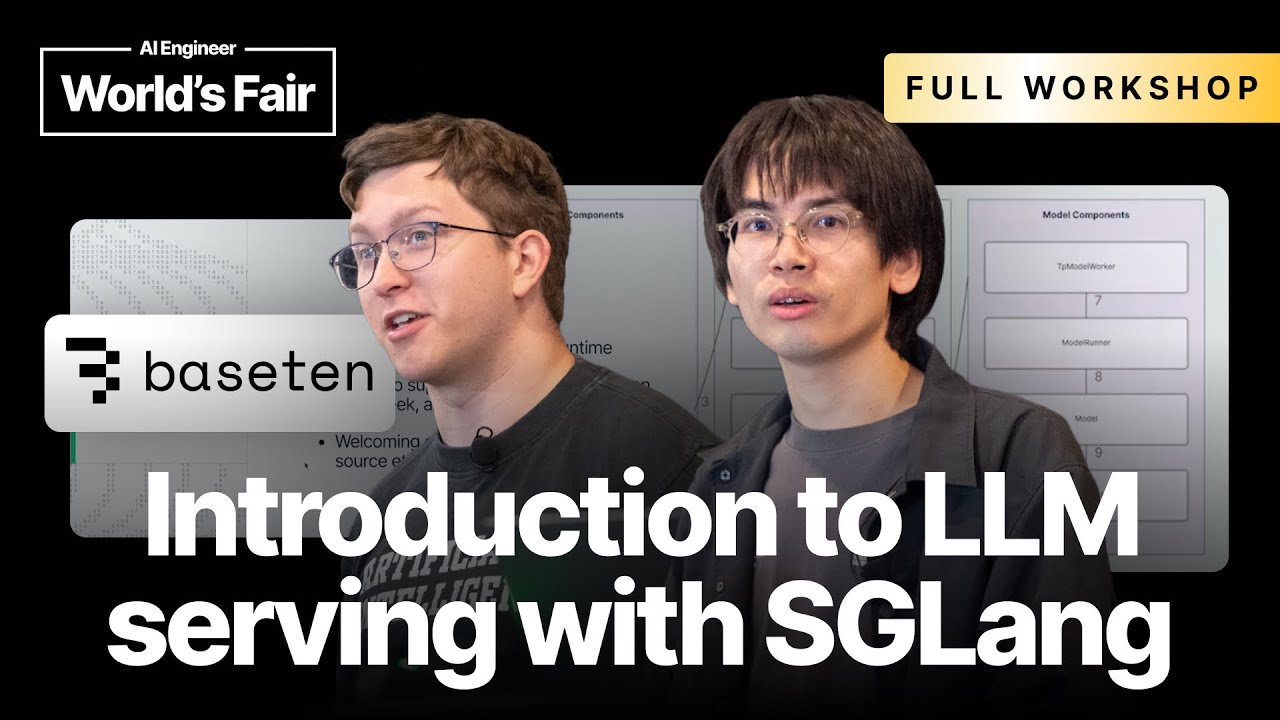
Introduction to LLM serving with SGLang - Philip Kiely and Yineng Zhang, Baseten
Jul 26, 2025 · 43:42
Philip Kiely and Yineng Zhang introduce SGLang, an open-source fast serving framework for LLMs and VLMs, arguing it offers production-ready performance with day-zero support for new models like DeepSeek and Qwen, and a customizable codebase for contributions. Yineng, a core maintainer, traces SGLang's rapid growth from a December 2023 paper to nearly 15,000 GitHub stars and adoption by xAI, AMD, and Meituan. The workshop demonstrates deploying a first model via Baseten's trunk packaging, then tuning the CUDA Graph max batch size flag on an L4 GPU to maintain CUDA Graph-enabled decoding during higher concurrency, boosting generation throughput. They also cover Eagle 3 speculative decoding, where a draft model derived from the target model speculates tokens; users can benchmark different step and top-k configurations on representative prompts to find optimal settings for production. Finally, they invite contributions via GitHub's 'good first issue' tags and highlight Baseten's job openings.

[Full Workshop] Reinforcement Learning, Kernels, Reasoning, Quantization & Agents — Daniel Han
Jul 19, 2025 · 2:42:28
Daniel Han of Unsloth presents a technical workshop covering reinforcement learning (RL), kernels, reasoning, quantization, and agents, arguing that RL with verifiable rewards (RLVR) is the key to unlocking LLM capabilities beyond supervised fine-tuning. He explains why open-source models plateaued after September 2024 until DeepSeek-R1 showed that RL can elicit reasoning, and breaks down PPO, GRPO, and the REINFORCE algorithm, emphasizing that GRPO removes the value model for efficiency. Han details how reward functions—not algorithms—are the hardest part, with examples like distance-based scoring for math. He demonstrates a free Colab notebook training a base model to reason, and shows that dynamic quantization can shrink models like DeepSeek-R1 from 730 GB to 140 GB with only ~1% accuracy loss, arguing that GPUs may stop getting faster after FP4 precision.

Intro to GraphRAG — Zach Blumenfeld
Jun 30, 2025 · 1:18:35
Zach Blumenfeld introduces GraphRAG using Neo4j, showing how to build knowledge graphs from employee and skill data, combine structured and unstructured data, and use graph traversal with vector search for retrieval. The workshop covers Cypher query patterns for multi-hop similarity, entity extraction from resumes via LLMs, and creating semantic similarity relationships. It demonstrates Leiden community detection for skill clustering and builds a LangGraph agent with four custom tools that balance exact skill matches with vector similarity. Blumenfeld argues that knowledge graphs provide controlled, explainable retrieval logic for agentic workflows, enabling developers to decompose data into graph models that expose domain logic for more accurate retrieval than pure vector search.
How fast are LLM inference engines anyway? — Charles Frye, Modal
Jun 27, 2025 · 16:07
Charles Frye presents benchmarks from hundreds of runs on Modal comparing open-source inference engines VLM, SGLang, and TensorRTLM across models like Qwen 3 and Gemma 27B, arguing open weights models have caught up to proprietary ones, making self-hosting viable. He shows, for example, that Qwen 3 (MoE) on VLM achieves ~1 request/sec with 128 input tokens and 1024 output tokens, while switching to a RAG-like workload (1024 in, 128 out) yields a 4x throughput improvement. Frye warns that optimizing for context over reasoning can improve latency without sacrificing quality, and notes that the engines' out-of-the-box performance varies by model—e.g., SGLang underperforms VLM on Gemma due to less optimization. He also highlights the gap between prefill (parallel) and decode (autoregressive) speeds, which a rationalist would expect from transformer architecture. The benchmarks, available at modal.com/llmalmanac, aim to help engineers choose hardware and engines, with contributions welcome for optimized configs like TensorRTLM's knobs.

Customized, production ready inference with open source models: Dmytro (Dima) Dzhulgakov
Feb 16, 2025 · 18:55
Dmytro (Dima) Dzhulgakov, co-founder and CTO of Fireworks AI, argues that open source models are the future for production Gen AI applications, and Fireworks provides a platform to make them customized and production-ready. He explains that while proprietary models like GPT-4 are powerful, they are too large, expensive, and slow for many use cases, whereas open models like Llama or Gemma can be fine-tuned for specific domains to achieve better quality at up to 10x speed and lower cost. The main challenges of using open models—complex setup, performance tuning, and production scaling—are addressed by Fireworks' custom serving stack, which achieves the fastest long-prompt inference and serves SDXL fastest among providers, handling over 150 billion tokens per day. The platform supports fine-tuning and serving thousands of LoRA adapters on the same GPU with serverless pay-per-token pricing. Dzhulgakov also highlights the emerging architecture of compound AI systems, where function calling—exemplified by the open-source Fire Function model—connects LLMs to external tools and knowledge sources, enabling agentic applications like stock querying and chart generation. The episode…
Unveiling the latest Gemma model advancements: Kathleen Kenealy
Feb 9, 2025 · 16:25
Kathleen Kenealy, technical lead of the Gemma team at Google DeepMind, unveils the latest advances in the Gemma model family, including the launch of Gemma 2 in 9B and 27B parameter sizes, which outperform models two to three times larger, such as LLaMA 3 70B. She also introduces PALI Gemma, a multimodal model combining Siglip Vision Encoder with Gemma 1.0 for image-text tasks. The episode highlights Gemma's responsible-by-design approach, broad framework support (TensorFlow, Jax, PyTorch, etc.), and the release of the Gemma cookbook with 20 recipes. Kenealy emphasizes that Gemma 2 is optimized for easy integration and fine-tuning, available on Google AI Studio, and invites the community to build and share their projects.
Making Open Models 10x faster and better for Modern Application Innovation: Dmytro (Dima) Dzhulgakov
Oct 9, 2024 · 18:55
Dmytro Dzhulgakov, CTO of Fireworks AI, argues that open-source models are the future for GenAI applications because they offer lower latency, lower cost, and domain adaptability compared to proprietary models. He explains that open models can be up to 10x faster for narrow domains and cut costs significantly, using examples like fine-tuned Llama 3 for function calling. Fireworks addresses the challenges of setup, optimization, and production readiness with a custom serving stack that delivers the fastest inference for long prompts and image generation (e.g., SDXL). He highlights FireFunction V2, an open-source model for function calling that combines chat and tool use, and notes that Fireworks serves over 150 billion tokens per day for companies like Quora and Cursor. The talk emphasizes that platforms like Fireworks enable developers to start with serverless inference, fine-tune models, and scale to enterprise-grade deployment with dedicated hardware.
Low Level Technicals of LLMs: Daniel Han
Jul 31, 2024 · 2:52:26
Daniel Han of Unsloth explains how to find and fix bugs in open-source LLMs like Gemma, Phi-3, and Llama, covering tokenizer issues, architecture pitfalls, and finetuning optimizations. He details the eight Gemma bugs Unsloth fixed, including a critical RoPE downcasting error that broke positional encoding, and a 2048 sliding window bug in Phi-3. Han walks through transformer internals: attention masking, layer norms, RoPE embeddings, and SwiGLU activation, showing how to derive gradients for custom kernels. He demonstrates Unsloth's 2x faster finetuning with 70% less memory via Triton kernels, and introduces new features: automatic Ollama model file creation, CSV fine-tuning with merged columns, and chunked cross-entropy for large vocabularies. The session includes live Q&A on learning rate schedules, precision trade-offs, and mechanistic interpretability.

Fixing bugs in Gemma, Llama, & Phi 3: Daniel Han
Jul 31, 2024 · 17:42
Daniel Han of Unsloth details eight bugs found in Llama 3, including double BOS tokens, untrained tokens in the base model, and pad tokens equaling EOS tokens, which cause infinite generations. He explains how Unsloth automatically fixes these issues and offers a free Colab notebook for fine-tuning with Ollama. Han also covers tokenization fixes for Gemma and a sliding window bug in Phi-3, emphasizing the importance of correct chat templates and avoiding double BOS tokens. The episode provides concrete code examples and best practices for fine-tuning open-source LLMs to avoid common pitfalls.
Powered by PodHood