
Gemini Live
ProductA product discussed on AI Engineer.
2 episodes

Full Workshop: Realtime Voice AI — Mark Backman, Daily
Aug 3, 2025 · 1:09:41
In this hands-on workshop, Mark Backman and Aleś from Daily demonstrate how to build real-time voice AI agents using Pipecat, their open-source Python framework, and Google's Gemini Multimodal Live API. They explain that Pipecat's modular pipeline orchestrates audio transport, speech-to-text, LLM, and text-to-speech services, allowing developers to plug and play vendors like Deepgram, OpenAI, or Cartesia. The session highlights how speech-to-speech models like Gemini Live simplify architecture by handling transcription, LLM logic, and voice generation in one step, reducing latency to under 800 milliseconds. Key topics include the critical role of voice activity detection (VAD) for natural turn-taking, strategies for managing context windows to maintain accuracy, and the trade-offs between speed and reliability when using tool calls in real-time. Despite conference Wi-Fi issues, the team live-codes a functional bot and demonstrates interruption handling and the Word Wrangler game, showcasing Pipecat's production readiness with hundreds of thousands of daily calls.
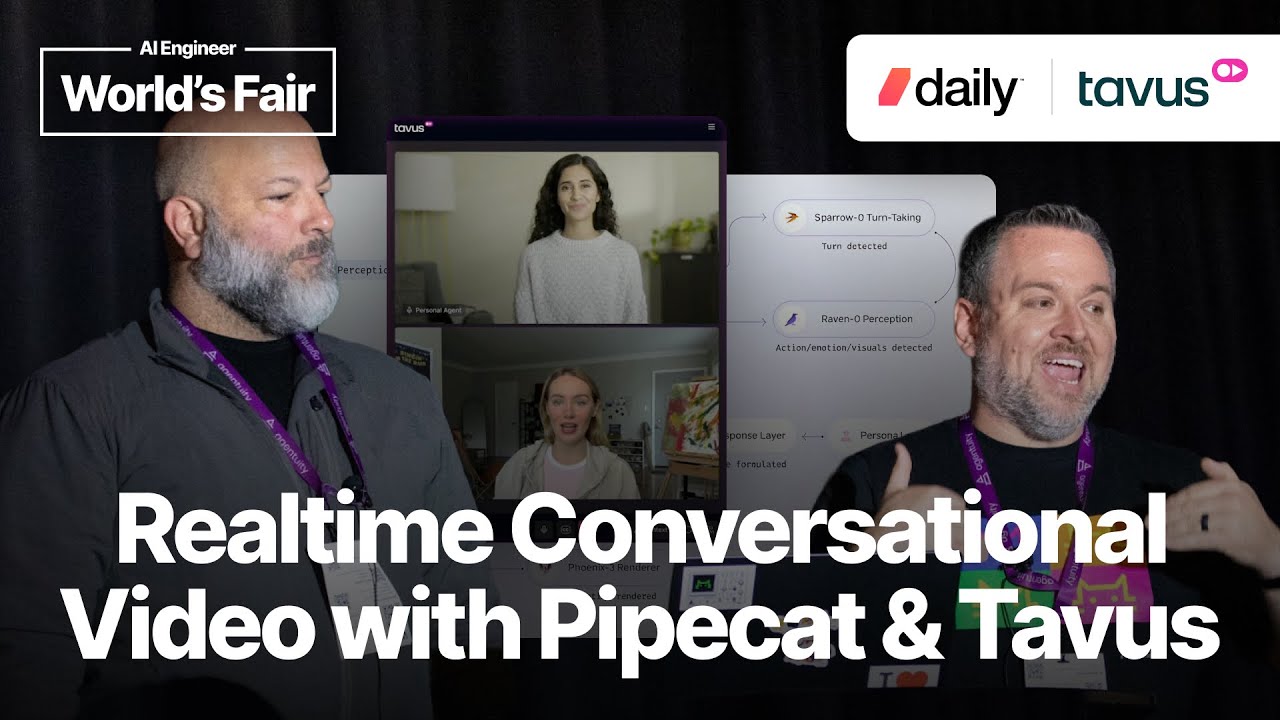
Realtime Conversational Video with Pipecat and Tavus — Chad Bailey and Brian Johnson, Daily & Tavus
Jun 27, 2025 · 18:46
Chad Bailey of Daily and Brian Johnson of Tavus explain how to build real-time conversational video bots using the Pipecat open-source framework and Tavus's avatar platform. They argue that beyond models, an orchestration layer is essential for handling input, processing, and output with low latency. Bailey details Pipecat's pipeline of frames, processors, and pipelines that manage audio/video frames, speech-to-text, LLM inference, and text-to-speech in a modular way. Johnson describes Tavus's 600-millisecond response time and proprietary models—Sparrow Zero, Raven Zero—plus future turn detection, response timing, and multimodal perception models being integrated into Pipecat. They emphasize that Pipecat solves real-world production challenges like observability, barge-in handling, and parallel pipelines for tasks like voicemail detection. Johnson admits Tavus initially built its own orchestration but now plans to adopt Pipecat internally, as its customers are already using it.
Powered by PodHood