
Flux Context
ProductA product discussed on AI Engineer.
3 episodes

ComfyUI Full Workshop — first workshop from ComfyAnonymous himself!
Jul 19, 2025 · 51:25
ComfyAnonymous and Yedrick Kosinski present ComfyUI, an open-source node-based canvas for generative AI that has become the top 150 most popular GitHub repos with 78,000 stars and 3 to 4 million active users. Started as a personal project in January 2023, it now supports image, video, audio, 3D, and text models, with 22,000 custom nodes from 3,000 developers. A key feature is embedding full workflows into generated files for easy sharing. The team discusses its story, including ComfyAnonymous's time at Stability AI and founding ComfyOrg, and addresses questions on CFG, VAEs, LoRAs, control nets, API nodes for remote generation, and future plans for cloud inference and improved onboarding.
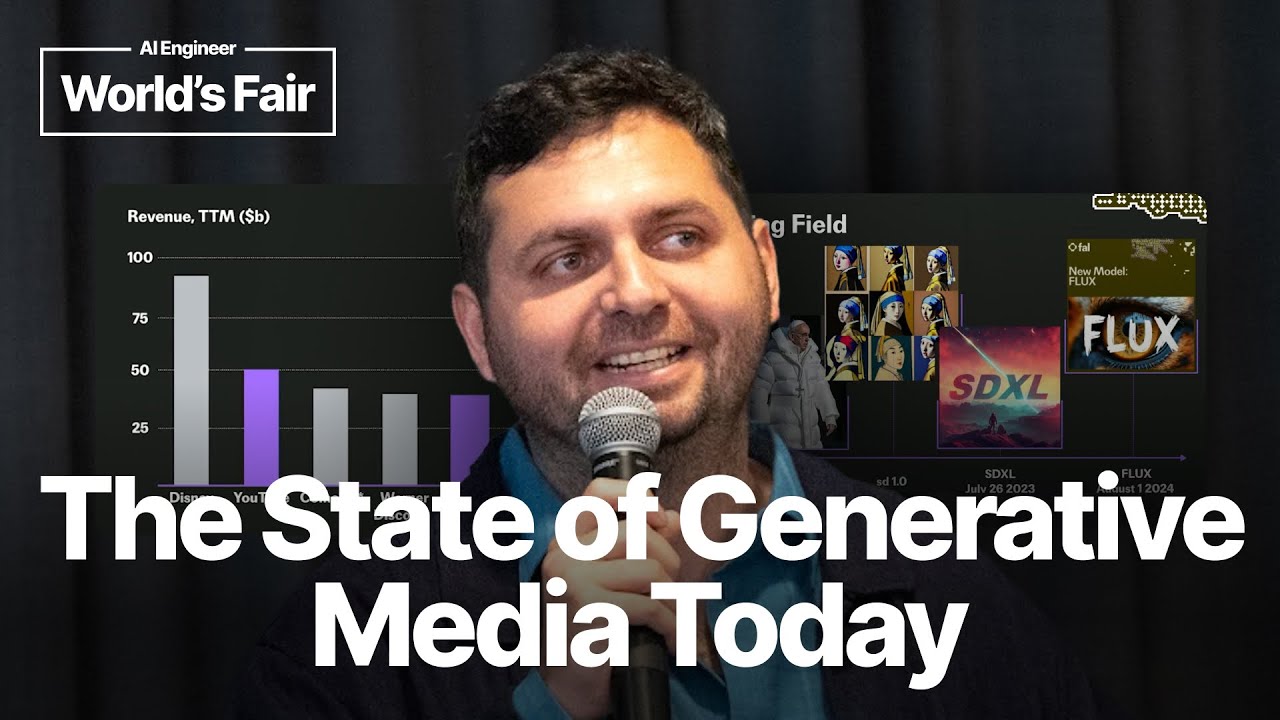
The State of Generative Media - Gorkem Yurtseven, FAL
Jul 16, 2025 · 17:14
Gorkem Yurtseven, co-founder and CTO of fal.ai, argues generative media lowers creation's marginal cost to near zero, transforming advertising and e-commerce. He traces evolution from DALL·E 2 to open-source models like Stable Diffusion and FLUX, with the playing field evening quickly. Video models (Sora, Veo 3) are accelerating: fal's platform saw video usage jump from near zero to 30% of revenue, and he predicts the generative video market 100x-250x bigger than image. Advertising leads with hyper-personalized, interactive ads, like fal's A24 campaign turning selfies into toy soldiers. In e-commerce, virtual try-on is a proven product-market fit. Future real-time video generation will blur games and movies.

Using OSS models to build AI apps with millions of users — Hassan El Mghari
Jul 15, 2025 · 18:47
Hassan El Mghari, a software engineer at Together.ai, explains how he builds open source AI apps that attract millions of users, including roomGPT.io (2.9 million users), restorePhotos.io (1.1 million), Blinkshot.io (1 million visitors), and LlamaCoder.io (1.4 million visitors). He details his simple four-step tech stack: user input, a single API call to an open source model on Together.ai, storing results in a database, and displaying output. His process emphasizes keeping ideas simple enough to describe in five words, spending 80% of time on UI, launching early, and incorporating the latest models like Fluxionel for virality. He advises naming apps with short, memorable names, making them free and open source to encourage sharing, and iterating rapidly—most apps fail, but the key is to keep building. He funds compute through sponsorships from Together.ai and partners like Neon and Clerk, which provide free services for his open source projects.
Powered by PodHood