
Firecrawl
ProductA product discussed on AI Engineer.
3 episodes
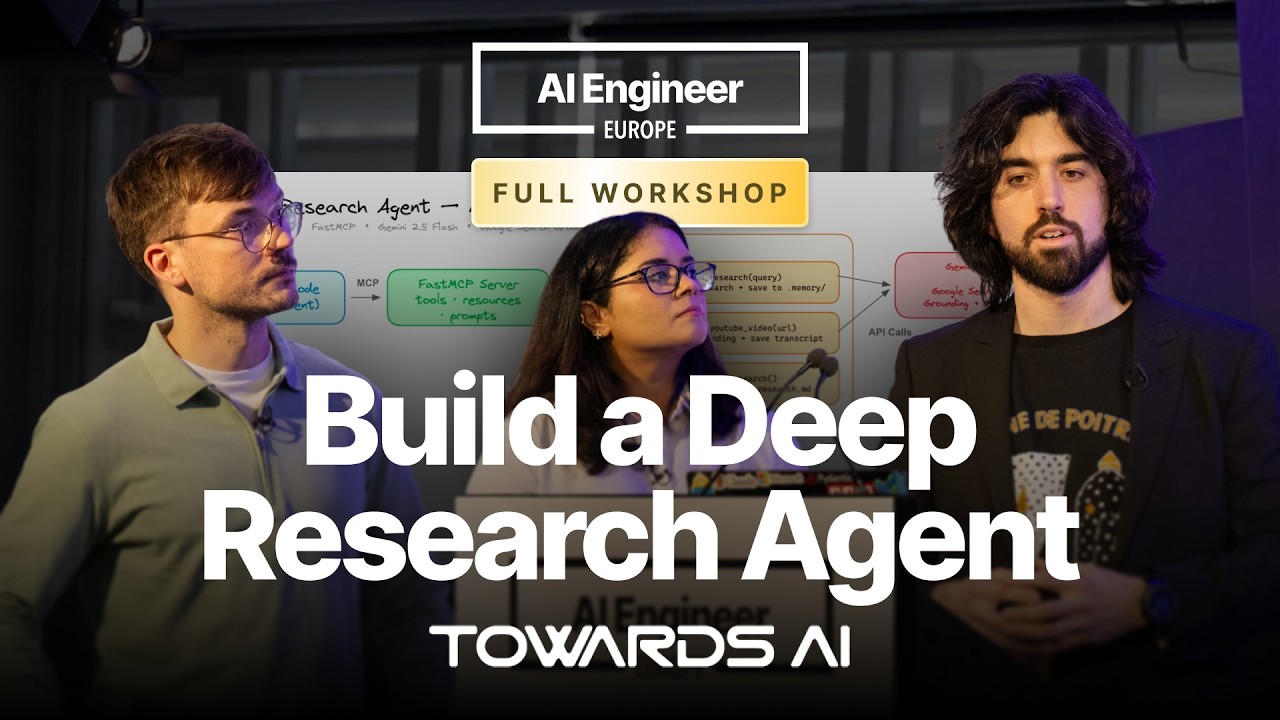
Full Workshop: Build Your Own Deep Research Agents - Louis-François Bouchard, Paul Iusztin, Samridhi
Apr 20, 2026 · 1:57:03
Louis-François Bouchard, Samridhi Vaid, and Paul Iusztin built a combined system of a deep research agent and a deterministic writing workflow to automate high-quality technical content creation, trading flexibility for control. The research agent uses an MCP server (FastMCP) with tools for Google search, YouTube analysis, and report compilation, powered by Gemini and orchestrated by Claude Code. The writing workflow is a static pipeline that loads a user guideline, writing profiles (structure, terminology, character), and few-shot examples into a system prompt, then applies an evaluator-optimizer loop: a reviewer outputs structured pydantic objects with profile/location/comment to flag violations, and the editor applies them in priority order (guideline > research > profile). They stress that research demands autonomy while writing needs constraint, and show how to avoid AI slop by banning specific words and using profiles. For observability, they use Opik to capture all traces, and for evals they built a 20-sample dataset from real LinkedIn posts, split into train/dev/test, to calibrate an LLM judge (binary pass/fail) that they run on dev and test splits to measure F1 and detect…
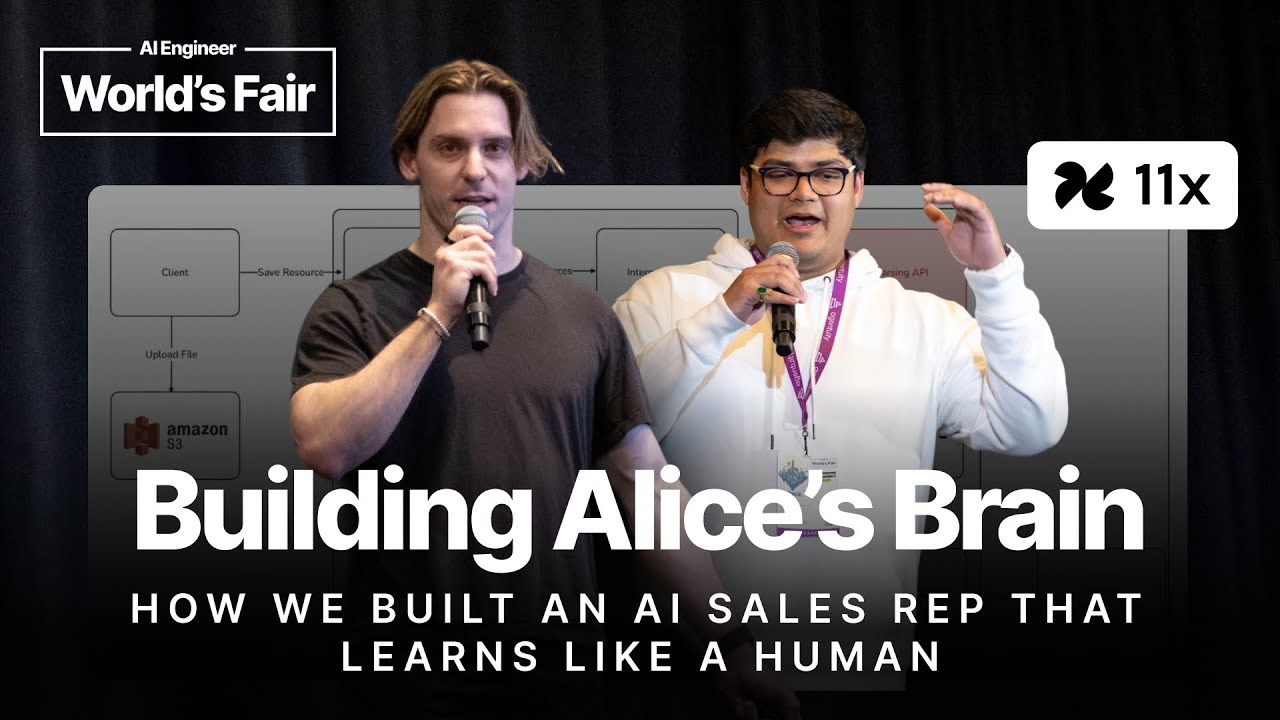
Building Alice’s Brain: an AI Sales Rep that Learns Like a Human - Sherwood & Satwik, 11x
Jul 29, 2025 · 22:18
Sherwood Callaway and Satwik from 11x describe building 'Alice's brain' — a knowledge base that lets their AI sales development representative learn from seller materials as a human SDR would, using a full RAG pipeline. They outsourced parsing to vendors like LlamaParse (documents/images), Firecrawl (websites), and Cloud Glue (audio/video), converting resources into Markdown. Their chunking strategy splits on Markdown headers then sentences and tokens. Storage uses Pinecone vector database for similarity search, with bundled embedding models. For retrieval, they built a deep research agent with Letta that plans and executes context retrieval for email generation. A 3D UMAP visualization lets users inspect Alice's knowledge nodes. Key lessons: RAG is complex, get to production before benchmarking, and leverage vendors for expertise. Future plans include hybrid RAG with a graph database, hallucination tracking, and cost reduction.
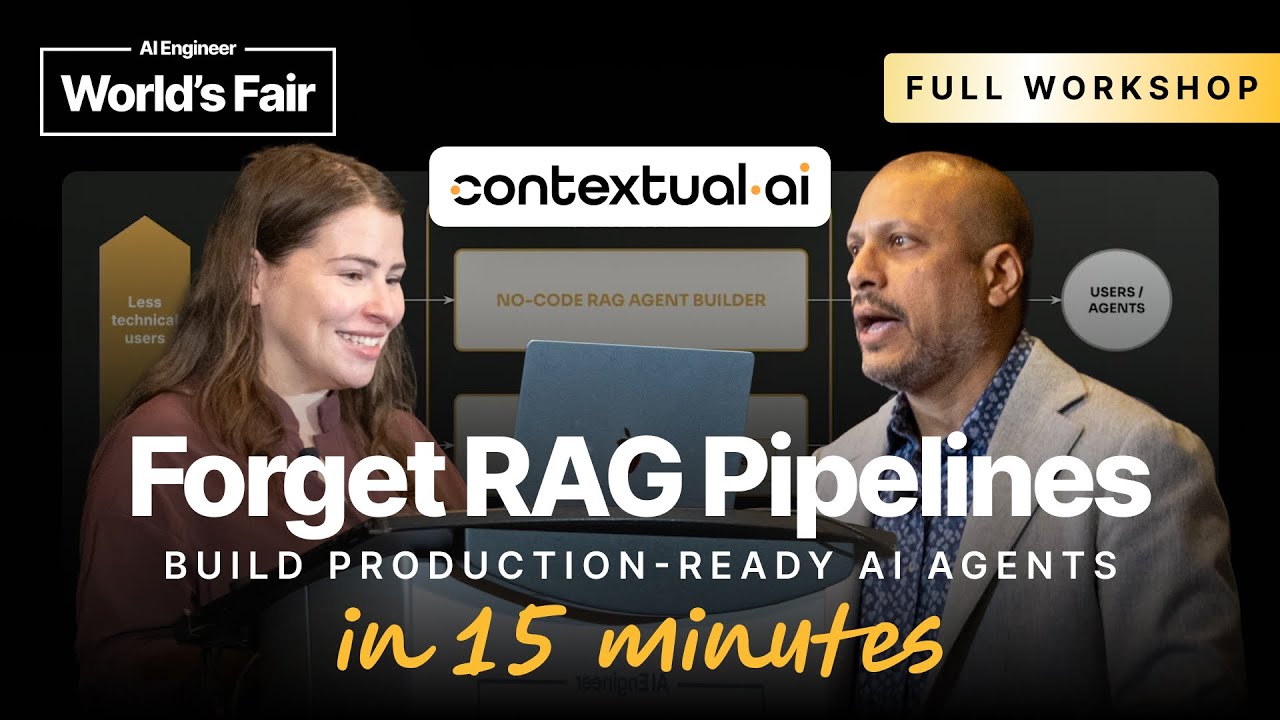
Forget RAG Pipelines—Build Production Ready Agents in 15 Mins: Nina Lopatina, Rajiv Shah, Contextual
Jun 27, 2025 · 1:15:43
Rajiv Shah, Nina Lopatina, and Matthew from Contextual AI demonstrate how developers can build production-ready RAG agents in minutes using Contextual AI's managed RAG platform, emphasizing that RAG should be treated as a managed service to avoid reinventing infrastructure. They walk through ingesting documents like NVIDIA financials and spurious correlation reports, then querying the agent with questions requiring quantitative reasoning across tables. The platform handles extraction, layout analysis, image captioning, hybrid retrieval, and a state-of-the-art reranker, capped by a grounded language model that avoids hallucinations and provides attribution. Evaluation is done via LM Unit, a model-as-judge that scores responses on criteria like accuracy and causation. The episode also shows integrating the agent with Claude Desktop via MCP and answers audience questions on pricing (consumption-based with a $25 credit), scalability, entitlements, HIPAA, and domain-specific language.
Powered by PodHood