
FastMCP
ProductA product discussed on AI Engineer.
5 episodes
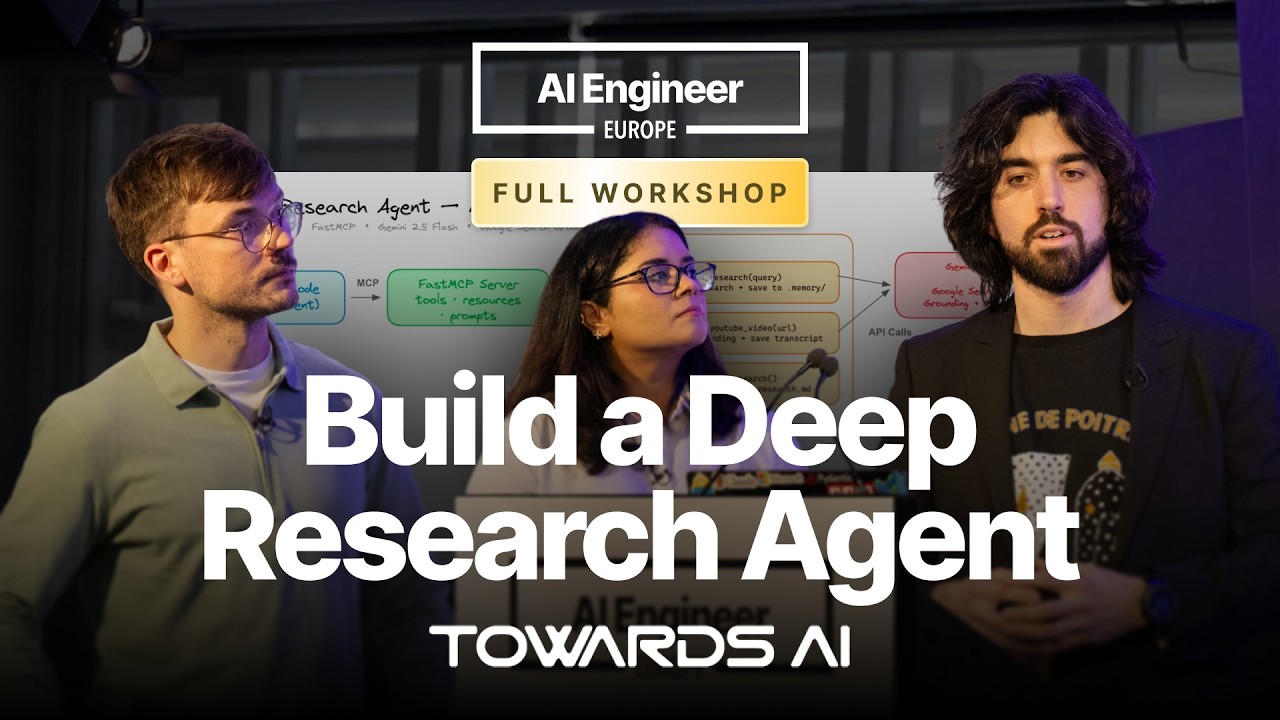
Full Workshop: Build Your Own Deep Research Agents - Louis-François Bouchard, Paul Iusztin, Samridhi
Apr 20, 2026 · 1:57:03
Louis-François Bouchard, Samridhi Vaid, and Paul Iusztin built a combined system of a deep research agent and a deterministic writing workflow to automate high-quality technical content creation, trading flexibility for control. The research agent uses an MCP server (FastMCP) with tools for Google search, YouTube analysis, and report compilation, powered by Gemini and orchestrated by Claude Code. The writing workflow is a static pipeline that loads a user guideline, writing profiles (structure, terminology, character), and few-shot examples into a system prompt, then applies an evaluator-optimizer loop: a reviewer outputs structured pydantic objects with profile/location/comment to flag violations, and the editor applies them in priority order (guideline > research > profile). They stress that research demands autonomy while writing needs constraint, and show how to avoid AI slop by banning specific words and using profiles. For observability, they use Opik to capture all traces, and for evals they built a 20-sample dataset from real LinkedIn posts, split into train/dev/test, to calibrate an LLM judge (binary pass/fail) that they run on dev and test splits to measure F1 and detect…
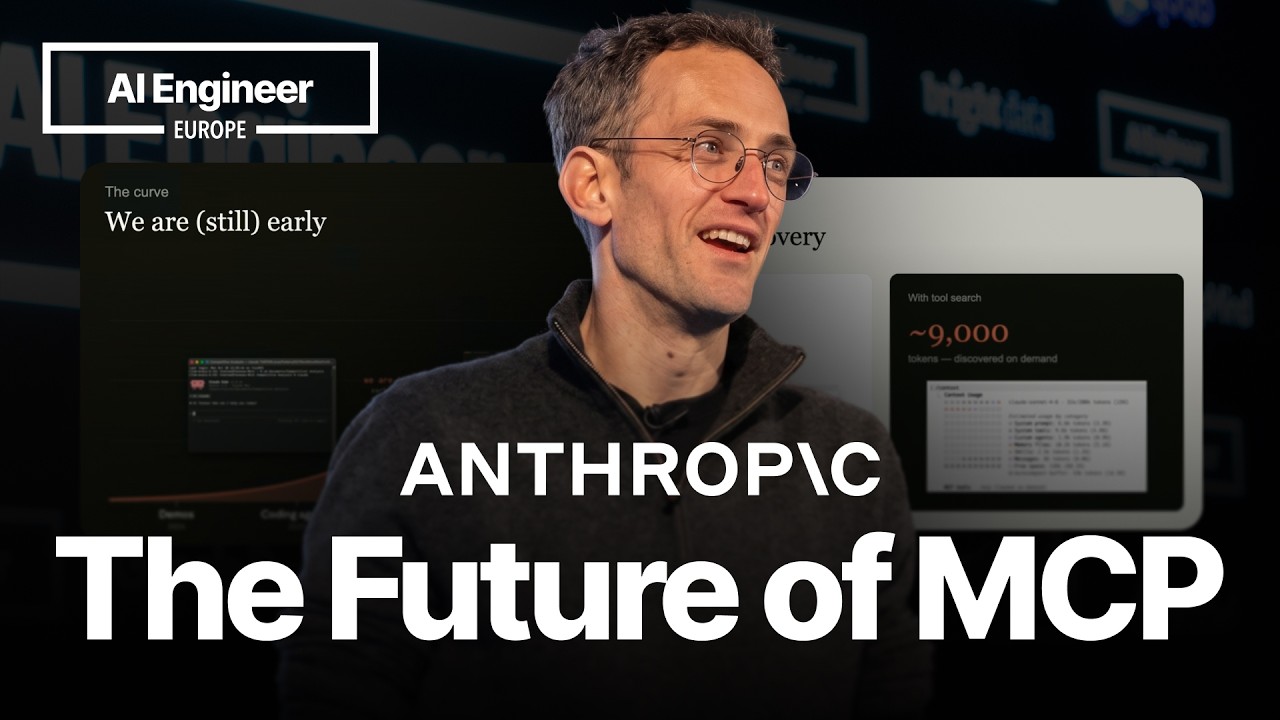
The Future of MCP — David Soria Parra, Anthropic
Apr 19, 2026 · 18:46
David Soria Parra from Anthropic argues that MCP (Model Context Protocol) is the key to connecting agents to tools and data in production, with 110 million monthly downloads—outpacing React's growth at the same stage. He lays out a 2026 connectivity stack combining Skills, MCP, and CLI/Computer Use, each suited for different needs, and emphasizes that best agents will use all three seamlessly. To improve client harnesses, he introduces Progressive Discovery—deferring tool loading via Tool Search to reduce context usage—and Programmatic Tool Calling, where models write scripts to compose tool outputs efficiently. Upcoming MCP protocol improvements include stateless transport (with Google) for easier scaling, async agent-to-agent tasks, enterprise features like Cross App Access and Server Discovery via well-known URLs, and a Skills-over-MCP extension for shipping usage instructions with servers. He calls for community feedback on these directions.

Your MCP Server is Bad (and you should feel bad) - Jeremiah Lowin, Prefect
Jan 12, 2026 · 54:33
Jeremiah Lowin, CEO of Prefect and creator of FastMCP, argues that most MCP servers are poorly designed because they are simply REST API wrappers, leading to confused LLMs and wasted tokens. He presents a framework for agent-native product design based on three dimensions—discovery, iteration, and context—and offers five actionable principles: outcomes over operations, flatten arguments, treat instructions as context, respect the token budget, and curate ruthlessly. Lowin emphasizes that agents fail when given too many tools or complex arguments, citing a hard limit of 50 tools per agent for reliable performance. He shares real-world examples, including a company with 800 endpoints that could not be effectively exposed, and critiques client implementations like Claude Desktop for not respecting spec-compliant features. The central takeaway: MCP servers should be designed as user interfaces for agents, not as developer APIs.

MCP is all you need — Samuel Colvin, Pydantic
Jul 18, 2025 · 15:24
Samuel Colvin, creator of Pydantic, argues that MCP (Model Context Protocol) is all you need for agent-to-agent communication, simplifying what many are overcomplicating. He explains that MCP's tool calling primitive offers advantages over OpenAPI, such as dynamic tools, logging, and sampling—a mechanism for MCP servers to request LLM calls through the client, enabling nested agentic workflows. Colvin demonstrates a research agent using Pydantic AI that queries the BigQuery public PyPI dataset via an MCP server over stdio, showing how sampling allows the server to generate SQL itself while keeping the main agent's context lean. The demo logs progress to Logfire, an observability platform, and outputs human-readable results. He emphasizes that MCP’s standard I/O mode and extensibility make it ideal for autonomous agents beyond its original desktop coding use case.
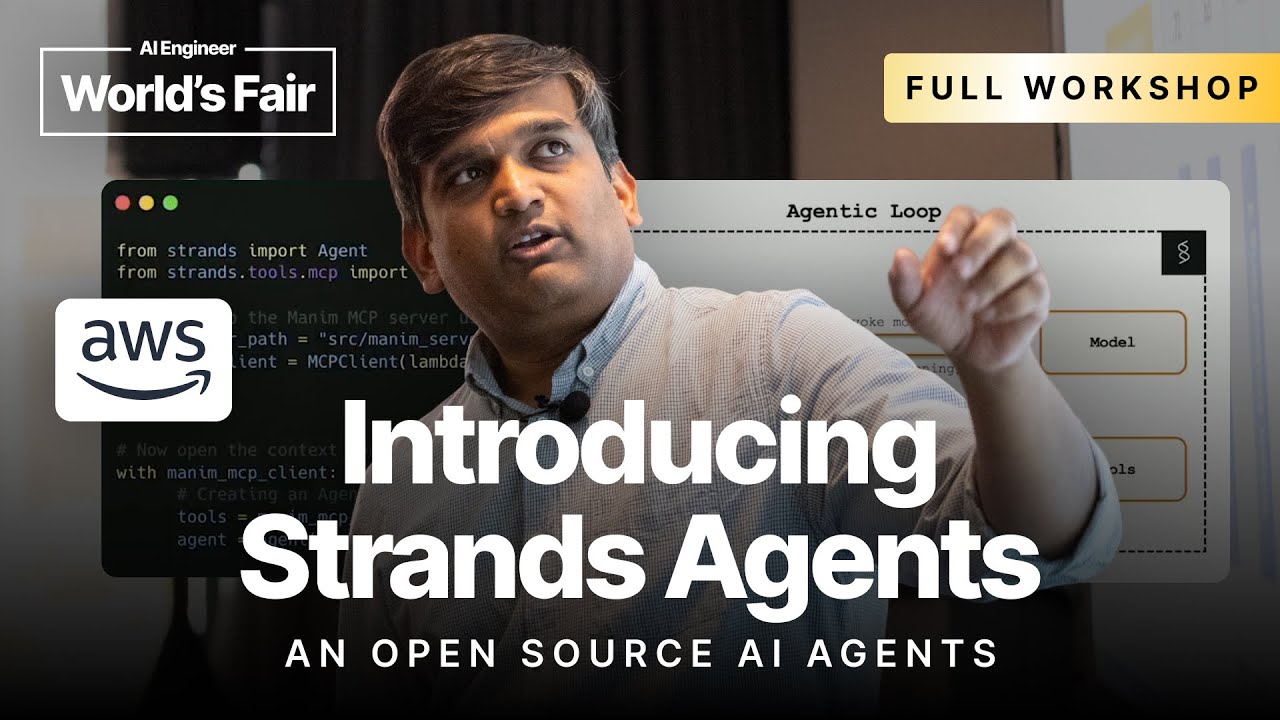
Introducing Strands Agents, an Open Source AI Agents SDK — Suman Debnath, AWS
Jun 27, 2025 · 14:26
Suman Debnath, a Principal ML Advocate at AWS, introduces Strands Agents, an open-source SDK that simplifies AI agent creation by requiring only a model and tools, eliminating scaffolding. He demonstrates building an agent in a few lines of code to read, summarize, and speak a file, using default tools. Another demo integrates Strands with an MCP server to generate animated math videos via Manim, requiring no system prompts—the model reasons autonomously. Custom tools can be created by decorating functions. Strands supports any model via LiteLLM or Bedrock, and is available at strandsagent.com with a GitHub repository for contributions.
Powered by PodHood