
FastAPI
ProductA product discussed on AI Engineer.
11 episodes
A Song of Types and Agents - Roberto Stagi, Ratel
Jul 12, 2026 · 14:16
Roberto Stagi (Ratel) argues that TypeScript is overtaking Python as the dominant language for building AI agents and applications, driven by the rise of coding agents like Lovable, Claude Code, and Cursor that default to TypeScript. He notes that Python still rules training, research, and GPU serving, but the application layer—where AI is shipped inside products—now belongs to TypeScript. Stagi highlights that TypeScript surpassed Python as the most used language on GitHub in August 2025, with GitHub attributing the shift to AI agents. He cites the Vercel AI SDK growing from 1.6M to 15.1M weekly downloads in one year and npm's rich ecosystem of authentication, payments, and UI packages as reasons to build agents in TypeScript. Consistent end-to-end typing via Zod and a unified codebase for agent loops, tools, backends, and UIs further strengthen the case. Stagi concludes by invoking Atwood's Law: any application that can be written in JavaScript will eventually be written in TypeScript, urging developers to build agents in TypeScript to avoid falling behind.

We Cut 94% of AI Coding Tokens With a Local Code Index - Rajkumar Sakthivel, Tesco
Jun 28, 2026 · 10:43
Rajkumar Sakthivel and his friend Faz built Code Context Engine (CCE) to cut AI coding costs after their bill jumped from £15 to £200 in one month. They found that 45,000 tokens were sent per query but only 5,000 were needed, with 90% of cost being input context. Their solution is a local retrieval layer that uses AST-aware chunks, combined vector and keyword search, and a weighted scoring heuristic (50% meaning, 30% keyword, 20% recency) that runs in 0.4 milliseconds. On a FastAPI test, tokens per question dropped from 83k to 4.9k—a 94% reduction—with 90% accuracy. They emphasize that fixing the input, not the model, yields the biggest savings, and their open-source tool shares a single index across Claude Code, Cursor, Copilot, and Codex.

Bypassing the Multimodal Tax: Hybrid RAG, SQL RRF & UI Telemetry - Abed Matini, Ogilvy
Jun 28, 2026 · 45:48
Abed Matini from Ogilvy demonstrates bypassing the multimodal tax by building a local-first hybrid RAG system that converts documents to clean Markdown via Docling, eliminating cloud vision token overhead. Using Ollama (Qwen 2.5 0.5B), PostgreSQL with pgvector, and raw SQL with Reciprocal Rank Fusion, he implements a FAQ assistant for an employee handbook with four chunking strategies—heading-based, paragraph, fixed 512-char with 64% overlap, and sentence-based. The system combines dense embedding vectors and sparse keyword indices (BM25) in a single query, retrieves top 2 chunks, and uses Python functions for speed and testability. Guardrails block prompt injections and out-of-scope questions before reaching the LLM, and LangFuse tracks token usage and latency. Matini argues that a small, local model and code-controlled pipelines reduce hallucination and cost while maintaining full observability.

Research to Reality: Bringing Frontier ML Research to Production - Vaidas Razgaitis, Higharc
Jun 28, 2026 · 14:57
Vaidas Razgaitis, Senior Research Engineer at Higharc, presents three tactical focus areas to accelerate the handoff of frontier ML research into production features. First, he advocates for a Research Prototype Taxonomy Document—a technical design document tailored for ML that maps domain context, business goals, type safety, persistence, and system architecture. Second, he details Higharc's monorepo of cleanly isolated microservices with a layered API/business logic/data structure, enabling researchers to own individual services. Third, he explains using Graphite for stack diffs to decompose monolithic prototypes into small, reviewable PRs that tap subject matter experts asynchronously. The talk offers diagnostic questions to assess team velocity across these three levers.

Agent Optimization with Pydantic AI: GEPA, Evals, Feedback Loops — Samuel Colvin, Pydantic
May 7, 2026 · 1:20:40
Samuel Colvin shows how to improve production agents without redeploying using Pydantic AI's GEPA, evals, and Logfire managed variables. GEPA uses a genetic algorithm to evolve prompts, achieving 96.7% accuracy — up from 87% with a simple prompt and 92% with an expert prompt — on a Wikipedia-based political relations task. Managed variables let you update prompts, models, and parameters live via a web interface and A/B test targeting. Evals compare against a golden dataset of 650 MPs; Colvin runs 65 cases in 30 seconds using GPT-4.1. He discusses that prompt optimization is most valuable with private data, that implicit user feedback (e.g., user's next action) can build golden datasets, and that overfitting to small test sets is a risk — the GEPA optimizer may exclude valid relations like 'uncle' if they don't appear in the training split.
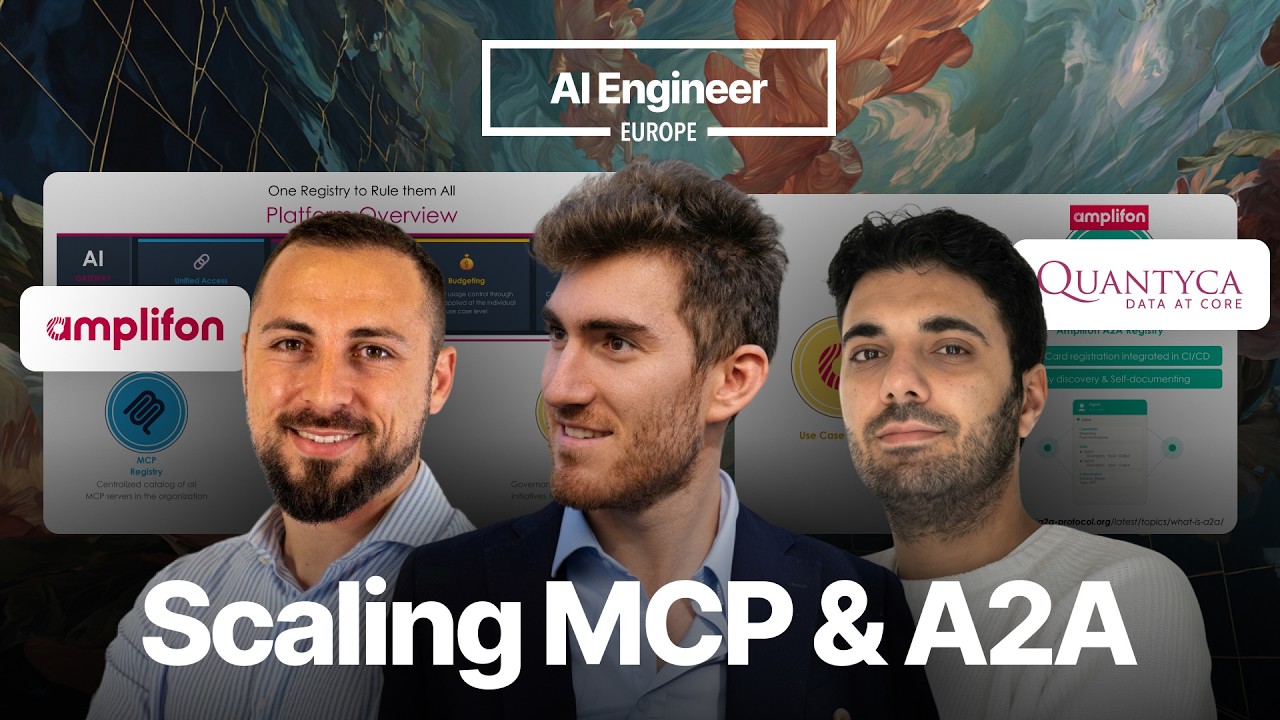
One Registry to Rule them All - Sonny Merla, Mauro Luchetti, & Mattia Redaelli, Quantyca
Apr 10, 2026 · 22:47
Amplifon's AI transformation led to the Amplify program, for which Quantyca built an enterprise-grade registry system for MCP servers and A2A agents. Sonny Merla, Mauro Luchetti, and Mattia Redaelli explain how three registries—MCP, A2A, and use case—are linked via a catalog to provide full lineage, including ownership, environment, authentication, cost attribution, and use case linkage. The solution uses an AI gateway for unified LLM access with Entra ID authentication and budgeting, and provides template repositories on GitHub with CI/CD pipelines that automatically publish agent cards and server metadata to the registries. This enables discovery, governance, and impact analysis across 26 countries and multiple teams, letting developers focus on business logic while avoiding reinventing security and deployment infrastructure.

Supercharging developer workflow with Amazon Q Developer - Vikash Agrawal
Jun 10, 2025 · 13:22
Vikash Agrawal and Linda show how Amazon Q Developer can drive every stage of the software development lifecycle. They build a 2048 game with FastAPI and Poetry using Q's /dev command in the CLI, then add unit tests with /test, generate documentation with /doc, and integrate with GitHub for automated pull requests. After deploying to AWS, they use Q in CloudWatch to debug a runtime import error by analyzing logs and resource topology. The episode emphasizes that planning infrastructure and prompts upfront, along with security scans, are critical for production-ready AI-assisted development.

The Demo I Wish I'd Had: OpenAI's Agents SDK... serverless! - Brook Riggio
Jun 3, 2025 · 17:51
Brook Riggio demonstrates deploying AI agent workflows on Vercel's serverless platform using OpenAI's Agents SDK and Inngest orchestration. He presents a reference architecture: Next.js frontend triggers Inngest events that invoke Python agents on Vercel serverless functions, with automatic retries and step-level observability. His demo builds a newsletter generator: users enter topics, a research agent scans news, a formatting agent structures the content, and results save to Vercel blob storage while the frontend polls for completion. He highlights that Vercel automatically detects Python functions without a config file, and Inngest's step.run ensures reliable execution within serverless time limits. The talk emphasizes cost efficiency (pay only for actual execution), full type safety via Pydantic and TypeScript, and easy integration of long-running agent tasks. The open-source repo is available for fork and contributions.

Cognitive Shield Real Time Real Smart - Rachna Srivastava
Jun 3, 2025 · 44:58
Rachna Srivastava presents Cognitive Shield, a three-layer AI defense system against sophisticated financial fraud such as deepfake voice cloning, synthetic identities, and AI-powered crypto scams that have surged 375% since 2023. Layer one secures user data and uses AI to guide licensing and examination processes. Layer two employs eight detection modules including GAN-based deepfake detection, graph neural networks for fraud ring visualization, and NLP for phishing, all integrated via CrewAI multi-agent orchestration. Layer three provides a unified intelligence console with natural language search, real-time dashboards, and automated case escalation with compliance-ready reporting. The system leverages Neo4j graph databases and Graph RAG to uncover hidden connections, and is built with Streamlit, FastAPI, and Postgres. Srivastava warns that by 2027, 90% of cyber attacks will be AI-driven and fraud losses will surpass $100 billion annually.

Pydantic is STILL all you need: Jason Liu
Sep 6, 2024 · 15:21
Jason Liu returns to the AI Engineer World's Fair to argue that Pydantic (and his library Instructor) is still all you need for structured output with LLMs. He shows that the core API—response_model, streaming with iterables, and partials for real-time validation—remains unchanged, now supporting Ollama, LlamaCPP, Anthropic, Gemini, and more. Liu demonstrates validators that enforce rules like uppercasing names or verifying receipt totals, reducing errors with automatic retries. He applies structured output to RAG: using a Search model with optional date ranges and source selection, and a Response model with follow-up questions and validated URLs. For extraction, he creates classifiers using Literal types, meeting summaries with action items, and even tables as Pandas DataFrames via custom type hints. Liu’s key takeaway is that one retry often suffices, and as models get faster and smarter, structured output makes LLMs compatible with classical programming—turning generative AI into generating data structures defined by the developer.

Running AI Application in Minutes w/ AI Templates: Gabriela de Queiroz, Pamela Fox, Harald Kirschner
Aug 14, 2024 · 1:29:02
In this workshop, Microsoft's Gabriela de Queiroz, Pamela Fox, and Harald Kirschner show how to deploy AI applications in minutes using AI templates, Azure OpenAI proxy, and GitHub Codespaces. They walk through deploying a simple chat app, then two RAG applications: one that queries a Postgres database with SQL filtering, and another that performs RAG on unstructured documents using Azure AI Search. Key decisions include using async frameworks like Quart and FastAPI, token-based chunking, and hybrid retrieval with semantic reranking for best results. They stress the importance of running evaluations with hundreds of samples and share production insights from Copilot Chat, where TFIDF sparse indexing and LLM reranking are used. The session includes free Azure credits and a proxy to bypass Azure OpenAI approval, allowing attendees to deploy everything without spending their own money.
Powered by PodHood