
Emacs
ProductA product discussed on AI Engineer.
4 episodes

Amp Code: Next Generation AI Coding – Beyang Liu, Amp Code
Dec 22, 2025 · 18:31
Beyang Liu, co-founder and CTO of Amp Code, presents Amp as an opinionated frontier coding agent that rejects MCP in favor of custom tools to avoid context confusion and optimize feedback loops. Amp's architecture relies on specialized subagents—the finder for code search, the oracle for deep reasoning, the librarian for external context, and the kraken for large-scale refactors—rather than a model selector. The agent offers two top-level modes: a slower 'smart' agent for complex tasks and a 'rush' agent for quick, in-loop edits, recently updated to leverage Gemini 3. To address inference costs, Amp ships subtle ads in the terminal to sponsor free usage for students and side projects. Liu also highlights a shared-threads feature for team learning and a community called the Weird Builder Cohort, emphasizing a culture of experimentation over hype.
Claude Code & the evolution of agentic coding — Boris Cherny, Anthropic
Jul 4, 2025 · 18:12
Boris Cherny, creator of Claude Code and Anthropic member of technical staff, argues that the product stays intentionally unopinionated and minimal because the model's coding capabilities are improving exponentially and the right UX remains unknown. He traces programming UX from 1950s punch cards to 1980s Smalltalk's live reload, Eclipse's static-analysis autocomplete, Copilot, and Devin's natural-language paradigm. Claude Code's terminal-first approach works in any terminal, over SSH, and inside VS Code or Cursor, with a GitHub integration that keeps data on user compute and a programmatic SDK for custom UIs. Key tips include using Claude for code-based Q&A (shortening onboarding from weeks to days), teaching it tools via `--help` and Claude MD files, leveraging TDD with visual iteration, and running multiple Claude instances in parallel via terminal tabs or GitHub Actions. Today's launch adds a plan mode triggered by Shift+Tab, which makes a plan and waits for approval before writing code.
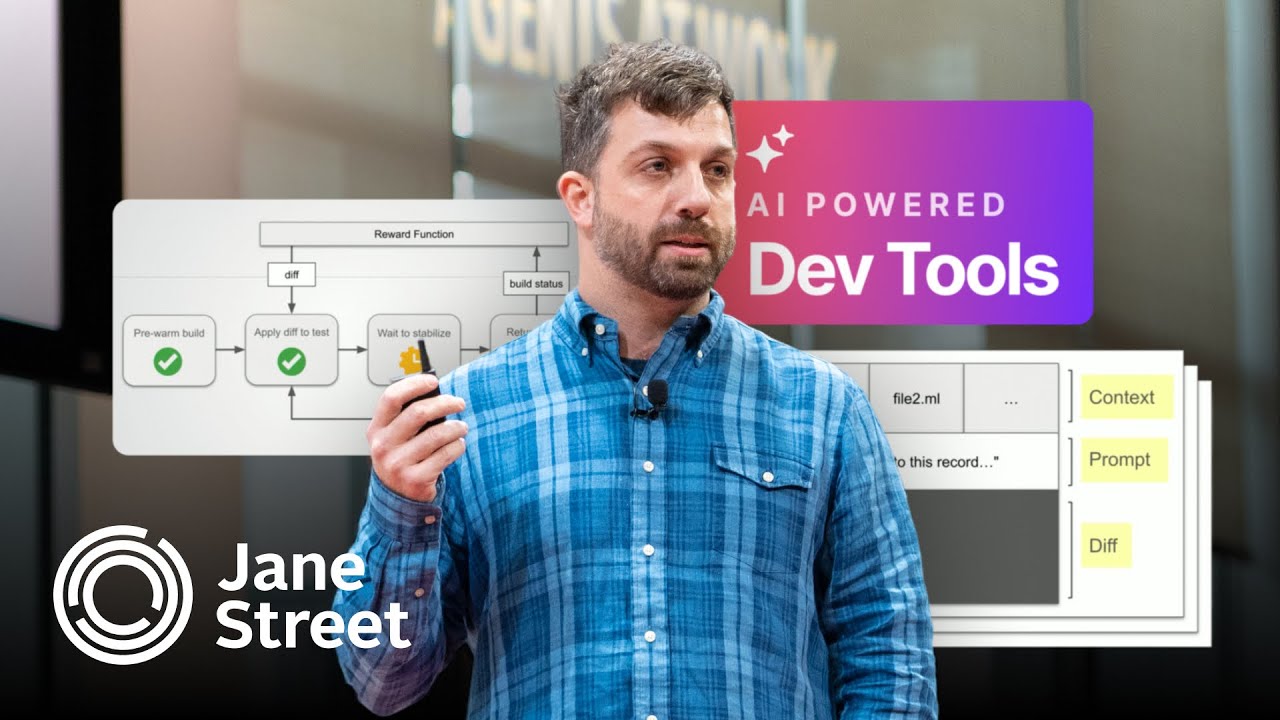
AI Engineering at Jane Street - John Crepezzi
Mar 28, 2025 · 16:57
John Crepezzi, an engineer on Jane Street's AI Assistants team, explains how they built custom LLM-powered coding assistants for OCaml, a functional language with scarce public training data. To overcome off-the-shelf tool limitations, they trained models on data from workspace snapshots — automated captures of developer workstations every 20 seconds, tracking build status changes from red to green. They used a Code Evaluation Service (CES) for reinforcement learning and evaluation, pre-warming builds to quickly test if model-generated diffs compile and pass tests. Their sidecar architecture, AID, serves thin editor integrations for Emacs (used by 67% of the firm), VS Code, and Neovim, allowing easy model swapping and A/B testing (e.g., sending 50% of users to different models). The talk details the end-to-end process: data collection from features, commits, and snapshots; training with supervised data and RL; and building pluggable infrastructure for domain-specific tools.

How Windsurf writes 90% of your code with an Agentic IDE - Kevin Hou, Windsurf
Mar 11, 2025 · 20:50
Kevin Hou, head of product engineering at Codeium, introduces Windsurf as the first AI agent-powered editor, arguing that agents are the future of software development. The editor is built on three principles: trajectories, a unified timeline that lets the agent read the user's mind and execute commands like 'continue my work'; meta-learning, which auto-generates memories of user preferences and codebase context; and scaling with intelligence, removing legacy features like chat and @-mentions as models improve. Windsurf launched three months ago and has already generated 4.5 billion lines of code, with 90% of code now written via its Cascade agent. Hou emphasizes that the agent reduces human-in-the-loop effort by inferring context, running terminal commands in the user's environment, and dynamically retrieving documentation—allowing developers to contribute less input while getting more production-ready output.
Powered by PodHood