
Elasticsearch
ProductA product discussed on AI Engineer.
9 episodes
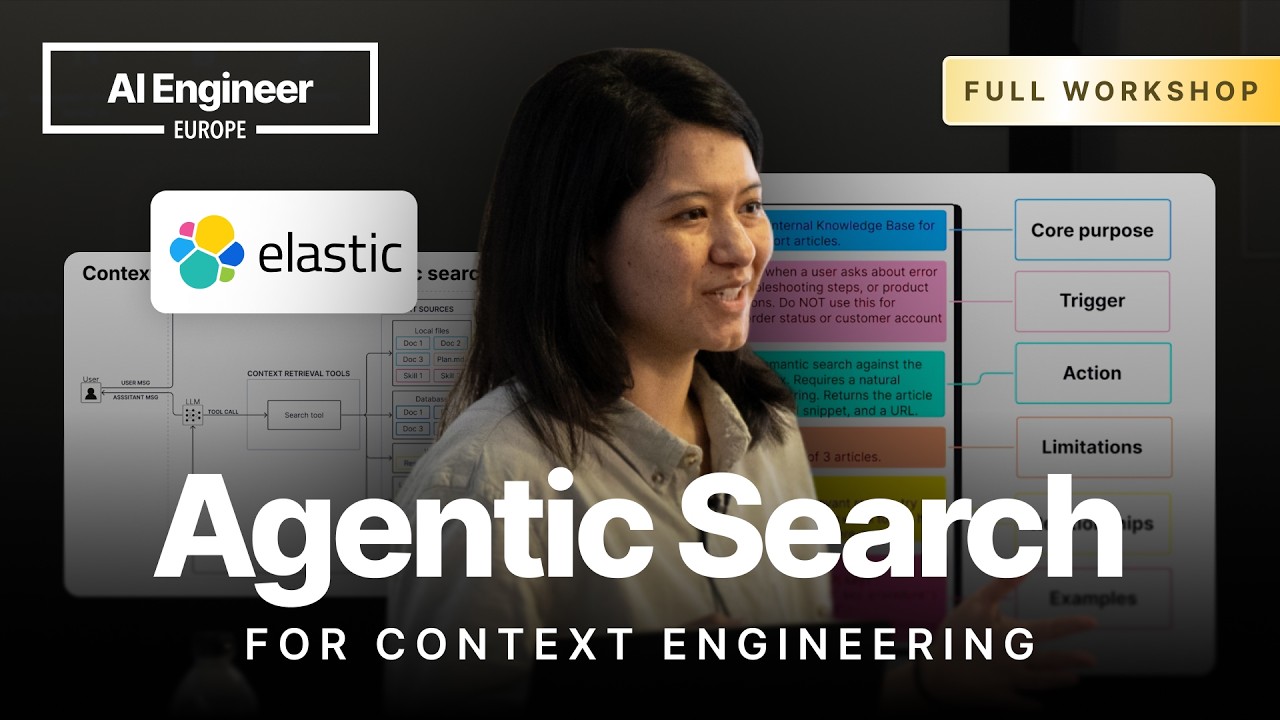
Agentic Search for Context Engineering — Leonie Monigatti, Elastic
May 8, 2026 · 1:03:13
Leonie Monigatti from Elastic argues that context engineering is 80% agentic search—the search tool that decides what to pull from files, databases, memory, and the web. She identifies three failure modes: the agent not calling any tool, calling the wrong tool, or generating incorrect parameters, and shows how detailed tool descriptions and agent skills (progressive disclosure) reduce these. In demos, semantic search fails for keyword 'JEPA' due to embedding similarity; a general-purpose ESQL tool with an agent skill correctly queries the database. Shell/bash tool enables file system search but requires iterative grep, while the custom Gina Grap CLI provides semantic grep for fuzzy queries. Practical recommendations: start with general-purpose tools, log agent behavior, and add specialized tools for frequent queries to balance low floor (easy successes) and high ceiling (complex queries). Hybrid agents combining shell and database tools achieve higher accuracy by verifying results.
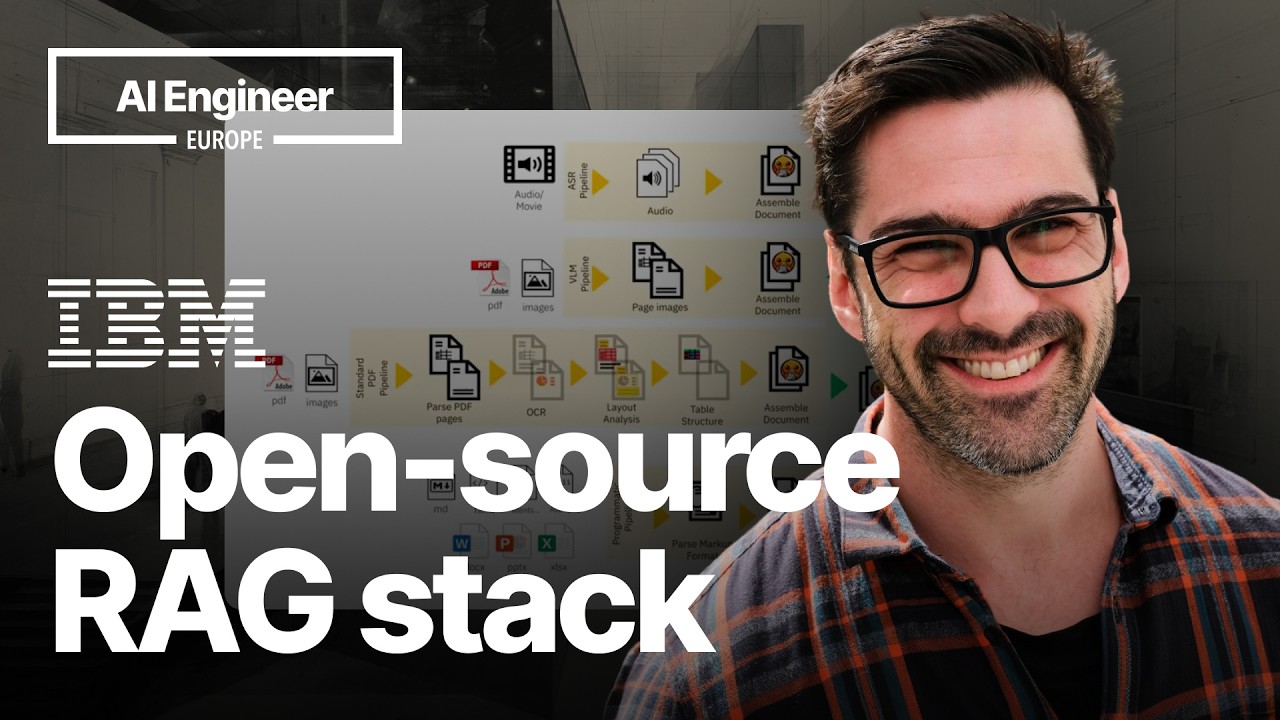
OpenRAG: An open-source stack for RAG — Phil Nash
Apr 8, 2026 · 15:52
Phil Nash introduces OpenRAG, an open-source RAG stack from IBM combining Docling, OpenSearch, and Langflow, arguing that RAG remains hard and custom despite claims it's dead — every business has unique data requiring more than simple vector search. Docling parses PDFs, audio, and more with specialized pipelines, outputting hierarchically chunked text. OpenSearch provides hybrid vector and keyword search using JVector for live indexing and disk-based ANN. Langflow enables visual agentic retrieval where the LLM decides searches with tools like a calculator and MCP servers. The stack supports local models via Ollama, cloud connectors for Google Drive and SharePoint, and an API. Nash demonstrates adding guardrails in Langflow and invites contributions to the open project.
Building the platform for agent coordination — Tom Moor, Linear
Jul 28, 2025 · 19:43
Tom Moor, Head of Engineering at Linear, explains how the company is evolving from an issue tracker into an operating system for engineering teams that treats AI agents as first-class teammates. He details Linear's pragmatic AI journey: starting with embeddings and PG vector, then moving to a hybrid search index using TurboPuffer and Cohere embeddings, leading to features like Product Intelligence (query rewriting, reranking, deterministic rules for suggestions), natural language filters, Slack-to-issue creation, and daily audio pulses. The core of the talk is Linear's agent platform, launched two weeks ago, where coding agents like CodeGen, Bucket, and Charlie integrate via OAuth, GraphQL, and new webhooks, allowing users to assign, mention, and interact with agents just like human teammates. Moor emphasizes best practices for builders: respond fast, inhabit the platform's language, move issues to 'in progress,' and clarify plans before acting, all while keeping interactions concise and value-adding. The episode argues that with this platform, engineering teams can build more, faster, and with higher quality by offloading grunt work to infinitely scalable cloud-based teammates.
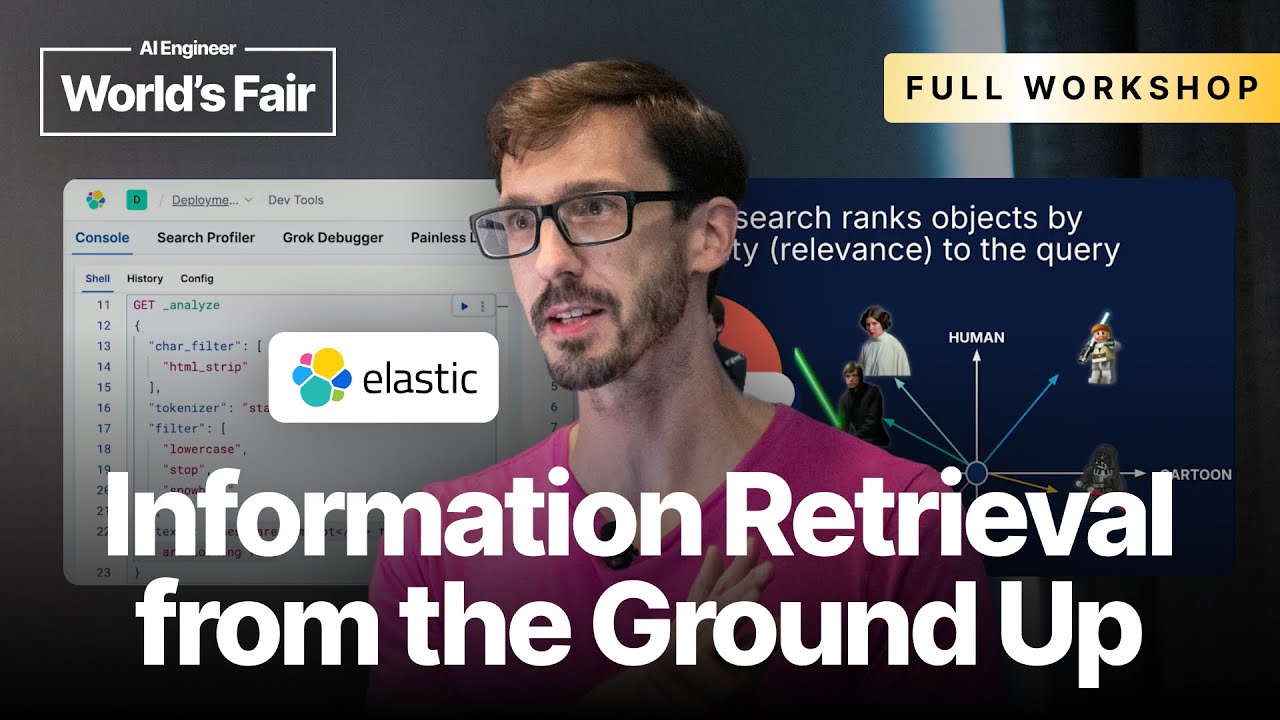
Information Retrieval from the Ground Up - Philipp Krenn, Elastic
Jul 27, 2025 · 1:48:07
Philipp Krenn of Elastic demonstrates that vector search is only a feature of information retrieval, not its foundation, in this hands-on workshop on retrieval for RAG. He contrasts classic keyword search—using tokenization, stemming, stopword removal, and BM25 scoring with the inverted index—with sparse (Elser/Splade) and dense (OpenAI text-embedding-small) vector embeddings. Krenn explains why hybrid search, combining lexical and semantic methods via reciprocal rank fusion (RRF), outperforms any single approach, especially for brand or exact-match queries where keyword search remains superior. He also covers scoring normalization, chunking strategies, and the new `text_similarity_reranker` retriever, showing how Elasticsearch's retrievers API enables two-stage retrieval with a cross-encoder for re-ranking. The session emphasizes that retrieval quality depends on evaluating against a golden dataset or LLM-as-judge, and that 'it depends' is the correct answer for choosing between PgVector and dedicated search engines.

POC to PROD: Hard Lessons from 200+ Enterprise GenAI Deployments - Randall Hunt, Caylent
Jul 23, 2025 · 19:16
Randall Hunt from Caylent shares hard lessons from over 200 enterprise GenAI deployments, arguing that evals, embeddings, and prompt engineering matter far more than fine-tuning. He emphasizes that speed and UX are critical; a slow inference kills adoption, while techniques like generative UI and caching can mitigate latency. Hunt details real-world examples: using audio amplitude spectrographs for sports highlight reels, pooling multimodal embeddings for nature footage search, and noting that nurses prefer chat over voice bots in noisy hospitals. He reports zero regressions moving from Claude 3.7 to 4, and advises optimizing context and economics, such as leveraging Amazon Bedrock batch for 50% cost reduction. The talk underscores that knowing your end customer and minimizing irrelevant context are key to production success.
How to build world-class AI products — Sarah Sachs (AI lead @ Notion) & Carlos Esteban (Braintrust)
Jun 27, 2025 · 1:43:46
Sarah Sachs (AI lead at Notion) and Carlos Esteban (Braintrust) explain that building great AI products requires 10% prompting and 90% evals and observability, with Notion AI using Braintrust to iterate on prompts and models. Sachs details their cycle: curate small datasets, tie them to scoring functions (LLM-as-a-judge with per-sample prompts and heuristic checks), run evals before shipping, and use production logs to catch regressions. She notes Notion AI supports 100M+ users, switches models in under a day, and 60% of enterprise users are non-English—requiring multilingual eval rigor. Carlos and Doug then walk through Braintrust's framework: tasks (prompts, tools, agents), datasets, and scores (0-1). They demonstrate offline evals via playground and SDK, online scoring in production, user feedback capture, human review setup, and remote evals to bridge complex code with the playground. The workshop covers moving from pre-prod evals to production monitoring, closing the feedback loop by adding underperforming spans to datasets.
Rust is the language of the AGI - Michael Yuan
Jun 3, 2025 · 29:14
Michael Yuan argues that Rust, with its strong type system and compiler feedback, is the ideal language for AI code generation, unlike human-friendly Python or JavaScript. He presents Rust Coder, an open-source project supported by two Linux Foundation Mentorship grants, which uses MCP tools to generate, compile, and fix Rust projects. The system integrates a coding LLM (e.g., Qwen Coder) with a self-improving knowledge base of compiler errors, enabling it to generate correct code and automatically fix bugs. Yuan demonstrates its use in a Rust camp of 1000+ students and envisions future AI agents generating and deploying Rust code autonomously for tasks like drone control. He invites contributions to expand the knowledge base and enhance the tools for AGI.
The Hierarchy of Needs for Training Dataset Development: Chang She and Noah Shpak
Oct 15, 2024 · 16:32
Chang She (CEO of LanceDB) and Noah Shpak (AI data platform lead at Character AI) argue that data infrastructure is the critical bottleneck for LLM training, and LanceDB's columnar format solves the 'new cap theorem' for AI: needing fast scans, random access, and handling large multimodal blobs simultaneously. Noah explains how Character AI structures pre-training around wide domain coverage and post-training around granular analytics like token counts and difficulty scores, using synthetic data, quality scoring, and dataset selection to improve models. Chang details how Lance format provides zero-copy schema evolution, time travel, and indexing extensions for vector, scalar, and full-text search, enabling a single table to serve SQL analytics, PyTorch training, and production vector search. The episode emphasizes that speed and iterative dataset management are key to accelerating AI research, with LanceDB facilitating cheap random access and low-infra billion-scale vector search.

AI Engineering 201: The Rest of the Owl
Nov 8, 2023 · 56:57
Charles Frye, instructor of the Full Stack LLM Bootcamp, presents essential patterns for building language user interfaces (LUIs), arguing that while RAG chatbots are the 'to-do list app' of AI engineering, structured outputs via function calling (e.g., OpenAI's JSON schema, Instructor library) improve robustness, and agents with memory (like generative agents or Voyager in Minecraft) represent the true AI frontier. He emphasizes the need for hybrid search combining vector and keyword retrieval (citing Vespa, Postgres, Redis), and warns that monitoring and evaluation are the hardest engineering challenges: monitoring user behavior, latency quantiles (especially 99th percentile), and costs must be paired with observability tools like Honeycomb or Gantry, while evaluation often requires iterated decomposition or using LLMs as evaluators (GPT-4 as 90th percentile crowd worker). The episode concludes that shipping to learn — starting with production data to generate tests — is the dominant engineering mindset, and that the field is still filling in the gaps between inference and full product value.
Powered by PodHood