
Discord
ProductA product discussed on AI Engineer.
12 episodes

Claws Out: Securing and Building with OpenClaw - Nick Taylor, Pomerium
Jul 11, 2026 · 17:12
Nick Taylor, a dev advocate at Pomerium, explains how he contributed trusted-proxy auth mode to OpenClaw, allowing a trusted identity-aware proxy to handle WebSocket authentication and removing the need for tokens and device pairing. He demonstrates building tools like Clawspace, a browser-based file explorer and editor for his OpenClaw workspace, and an MCP server for ChatGPT, all secured with Pomerium's open-core Identity-Aware Proxy. In a live demo, he creates an MCP server by editing files in his OpenClaw workspace via Discord, with changes reflected instantly through Vite hot reload. Taylor argues that hardening OpenClaw access with a trusted proxy improves both security and user experience, showcasing his workflow of building software entirely from his phone.
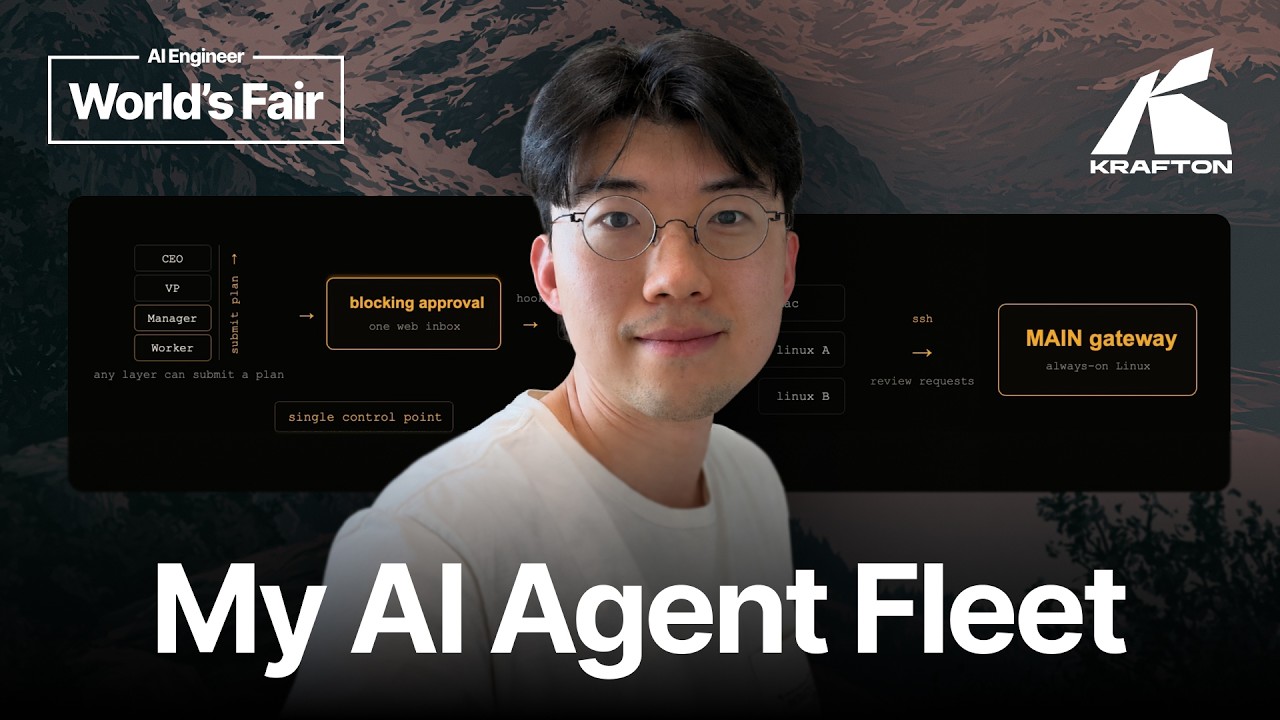
I Run a Fleet of AI Agents Across Three Machines. Here's What Broke. - Kyle Jaejun Lee, KRAFTON
Jul 8, 2026 · 9:11
Kyle Jaejun Lee runs a fleet of AI coding agents across three machines daily and reveals the scaling failures that emerged from a hierarchy of CEO, VP, manager, and worker agents. To overcome his own attention bottleneck, he separated context into entity-specific workspaces on disk and replaced context compaction with full resets that read handoff files. When moving beyond one machine, five things broke: agents doing work instead of delegating, TMUX panes too crowded to read, out-of-memory crashes from stacked Claude Code processes, colliding Git credentials across workspaces, and the MacBook dying mid-task. He offloaded long-running work to always-on Linux boxes, used Git commits and SSH to move context between machines, and consolidated review gateways onto a single always-on machine with Discord as a unified router. Unsolved challenges include consistent credentials, local-only tools, and resource scheduling—he plans to layer his orchestration on top of Kubernetes to handle compute, secrets, and tools.

Dark Factory: OpenClaw Ships Faster Than You Can Read the Diff — Vincent Koc, OpenClaw
Jun 5, 2026 · 16:44
Vincent Koc, a core maintainer at OpenClaw, explains how the open-source project ships code faster than humans can read diffs by running 60–70 autonomous coding agents across swim lanes. In a single night, he and Peter Steinberger executed 2,700 commits touching 82% of the core codebase, launching a plugin architecture and changing close to a million lines of code. Koc describes managing agents as managing people: the key skill is reading reasoning tokens to detect when an agent is bullshitting, gained through sheer volume of token maxing. He argues 2025 was about token maxing; 2026 is about not wasting them, with agent-in-the-loop processes and opinionated swim lanes replacing blind Ralph looping. The episode details his agent development environment using .skills files, Git work trees, and a semantic graph for triaging 60K PRs, emphasizing that the bottleneck shifts from engineering to taste and process.

Scaling Agents on Kubernetes with acpx and ACP — Onur Solmaz, OpenClaw
May 21, 2026 · 19:00
Onur Solmaz, a founding engineer at textcortex and OpenClaw maintainer, built acpx, a headless CLI for the Agent Client Protocol (ACP), to automate processing of 300–500 daily AI-generated pull requests on OpenClaw. He replaces manual PTY scraping with structured agent-to-client communication, driving Codex sessions through a node-based workflow: reproduce the bug, judge the implementation, check for conflicts, run a review loop, and emit structured JSON. Solmaz runs parallel Codex sessions from five Discord channels while traveling, one channel per task. He also presents an open-source Kubernetes operator called Spritz (from textcortex) that provisions disposable full-compute pods per task, wires them into Slack, and tears them down when work is done, advocating for on-demand disposable agents over persistent chat apps.
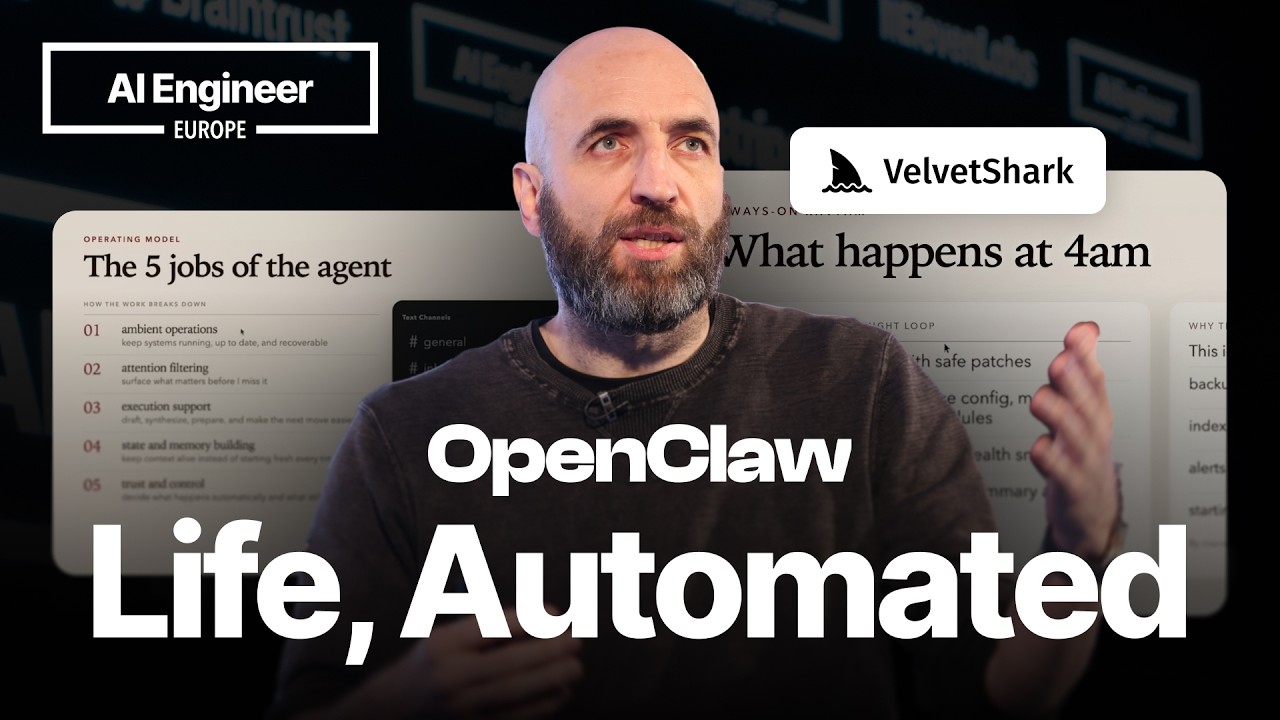
I Gave an AI Agent the Keys to My Life (Here's What Happened) — Radek Sienkiewicz (@velvetshark-com)
May 2, 2026 · 19:34
Radek Sienkiewicz, maintainer of OpenClaw, details how he incrementally gave his AI agent full control over his digital life—from reading files to handling emails, backing up memory at 4am, and drafting business replies. Starting with a single chat channel, he expanded trust step by step, integrating his 3,000-page Obsidian vault for search and memory. The agent now performs ambient operations (overnight updates, indexing), attention filtering (flagging Netflix payment failures, domain renewals), and execution support (drafting email replies) via dedicated Discord channels. Challenges include bad memory compounding, brittle automations, and noisy nodes, which he addresses by keeping the system inspectable in markdown files. The philosophy: optimize for your future self by starting with one pain, growing trust incrementally, and building a knowledge base in markdown.
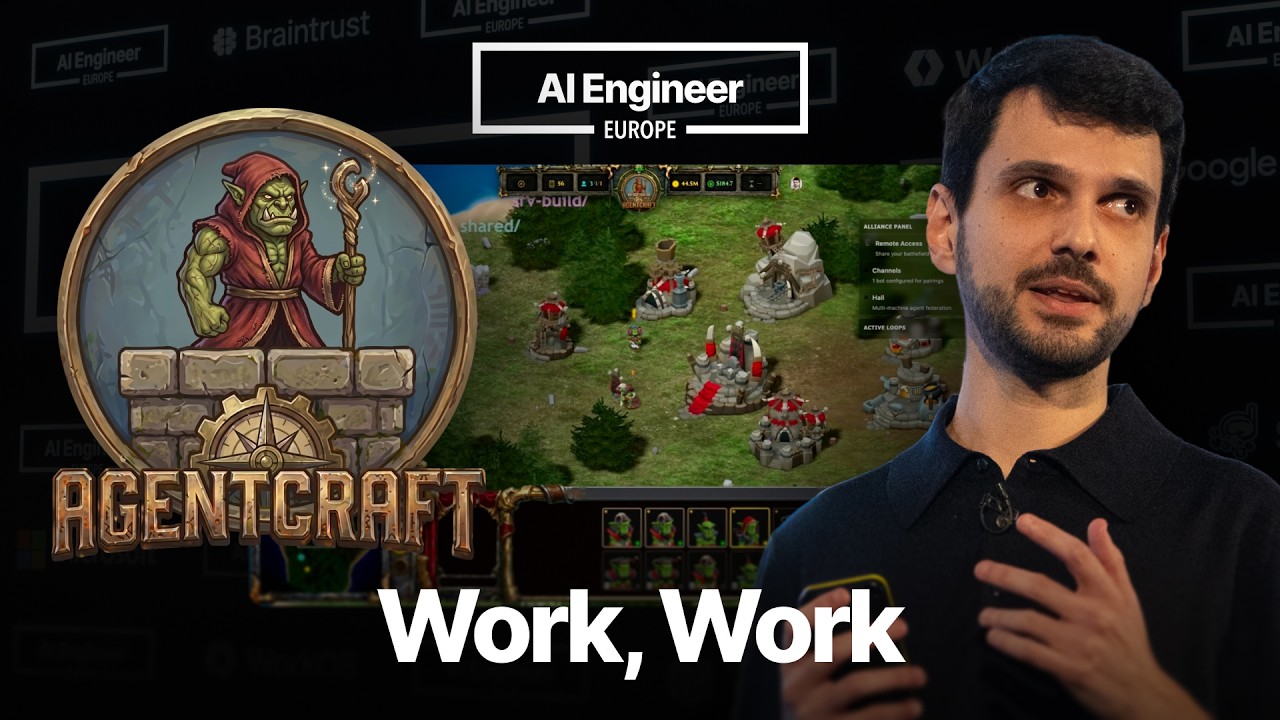
AgentCraft: Putting the Orc in Orchestration — Ido Salomon
Apr 25, 2026 · 11:18
Ido Salomon, creator of AgentCraft, argues that the bottleneck in multi-agent orchestration is not the agents but the humans managing them, and that the skills needed—borrowed from real-time strategy games—are already familiar to gamers. AgentCraft visualizes agents as physical units on a map that projects the file system, allowing users to see which files agents modify and detect collisions via a heat map. To reduce babysitting, Salomon implemented a campaign feature where agents autonomously decompose tasks and plan within containers, shifting the human role to review. Review bundles present changes with screenshots and videos for efficient inspection. Workspaces enable real-time collaboration between humans and agents across teams, with shared visibility and soft coordination. The goal is to raise the ceiling of collaboration through visibility, autonomy, and human-agent interaction.
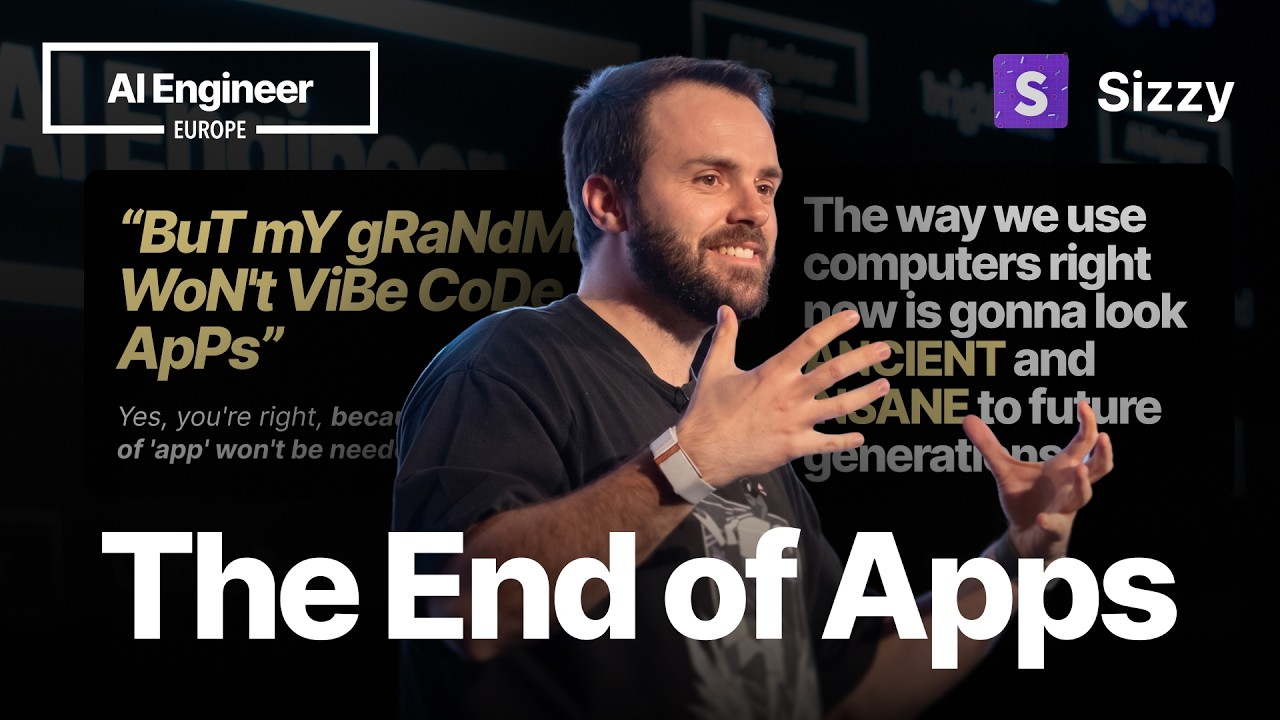
The End of Apps — Kitze, Sizzy.co
Apr 23, 2026 · 20:18
Kitze, creator of Benji and founder of Tinker Club, argues that current productivity apps and AI agents are unreliable and too complex for most users, predicting a future where AI prompts humans instead of the reverse. He traces his 24-year obsession with productivity tools—from a childhood to-do list to building Benji with 60 features—and his move to self-hosting after the ChatGPT moment. Kitze critiques custom agents like OpenClaw as too tinkerer-focused, cloud agents like ChatGPT as too nerfed, and believes local models on devices (Apple, Google Pixel) will win for normies, enabling AI to automatically manage notifications, emails, and tasks. He shares his own experiment, Wolfer, designed for predictable multi-agent orchestration without memory systems, using nested topics for context. The episode delivers a strong claim: the role of AI will invert, with machines prompting humans for decisions while handling all background work.

Z.ai GLM 4.6: What We Learned From 100 Million Open Source Downloads — Yuxuan Zhang, Z.ai
Nov 22, 2025 · 19:39
Yuxuan Zhang from zAI details the technical roadmap behind the GLM 4.6 open-source model series, which has surpassed 100 million downloads and tied for number one on the LMSYS Chatbot Arena alongside GPT-4o and Claude 3.5 Sonnet. The training pipeline uses 15 trillion tokens of pre-training data, followed by 7 trillion tokens of code and reasoning data, repo-level contexts at 32,000 tokens, and 100 billion tokens of long-context agent trajectories up to 128,000 tokens. Zhang introduces SLIME, a hybrid synchronous/asynchronous RL framework that decouples agent-environment interaction from GPU training to avoid bottlenecks. He explains why single-stage RL at 64,000 tokens outperforms multi-stage approaches for preserving long-context abilities, and shows that token-weighted loss converges faster than sequence-average loss for code RL. The multimodal GLM 4.5V model handles native resolution images and video with temporal index tokens, enabling GUI agent capabilities. Deployment is supported via vLLM and SGLang, with an API at z.ai and an open-source coding assistant.
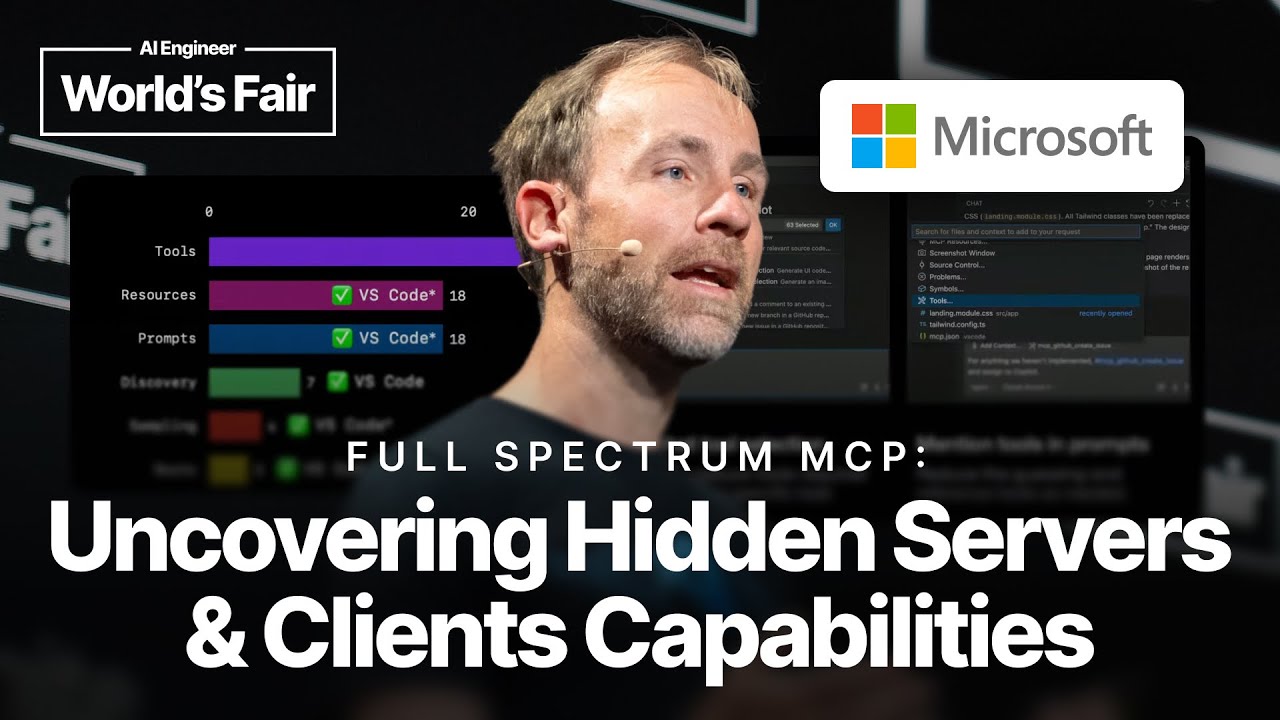
Full Spec MCP: Hidden Capabilities of the MCP spec — Harald Kirschner, Microsoft/VSCode
Jul 18, 2025 · 14:53
Harald Kirschner from Microsoft/VSCode argues that MCP's full specification unlocks powerful stateful interactions beyond the common 'tools-only' implementations, transforming AI assistants into more contextual and efficient agents. He highlights underused primitives like resources for rich data context and sampling for server-requested LLM completions, demonstrated via a dungeon game where dynamic tool discovery adapts to game state. VS Code's upcoming full spec support includes dynamic tool discovery, user-defined tool sets, a debug mode for server development, and support for streamable HTTP to reduce stateful server churn. Upcoming features like elicitations will allow tools to request user input directly. Kirschner calls on developers to build progressive, full-spec servers and contribute feedback to the open ecosystem, emphasizing that client and SDK support will follow as usage grows.

How LLMs work for Web Devs: GPT in 600 lines of Vanilla JS - Ishan Anand
Jul 13, 2025 · 1:41:34
Ishan Anand shows that GPT-2 small implemented in 600 lines of vanilla JavaScript makes LLMs understandable for web developers without ML backgrounds. He explains tokenization via byte-pair encoding, 768-dimensional embeddings representing semantic meaning via co-occurrence, and the Transformer's attention mechanism that lets tokens share context. The multi-layer perceptron learns next-token prediction through backpropagation, while the language head converts embeddings to token probabilities using softmax. Anand demonstrates each step—tokenization, embedding lookup, positional encoding, attention, MLP, and output—in a browser debugger, and notes that GPT-2's architecture underpins ChatGPT, with innovations like scale, supervised fine-tuning, and RLHF. The workshop provides an intuitive mental model of Transformers, turning perceived AI magic into understandable machinery.

12-Factor Agents: Patterns of reliable LLM applications — Dex Horthy, HumanLayer
Jul 3, 2025 · 17:06
Dex Horthy, founder of HumanLayer, presents the 12-Factor Agents framework for building reliable LLM-powered applications, arguing that production-grade agents are primarily deterministic software with targeted LLM steps rather than fully autonomous loops. He distills patterns: own prompts and context windows, treat tools as JSON and code, use small focused agents with three to ten steps, contact humans via tool calls. Horthy emphasizes context engineering—LLMs are pure functions—and shows how to compact errors, unify state, and add pause/resume via APIs. He shares a DevOps agent that became a bash script, and advocates for outer-loop agents. The framework, which gained 4,000 GitHub stars in two months, treats agents as stateless reducers that meet users on any channel, with engineers controlling the inner loop of token and control flow.
The Future of Work: Toran Bruce Richards, Silen Naihin et al
Oct 24, 2023 · 12:53
Toran Bruce Richards and Silen Naihin present Auto-GPT's vision for AI agents that augment human work, announcing 150k GitHub stars and $12M funding from Redpoint Ventures to build an open-source generalist agent. They unveil a forge template and dev tool built on the Agent Protocol, alongside a benchmark that tracks agent success rates from 35% to 55% over August. Safety is prioritized: prompt injection and agents deleting all JSON files on a laptop highlight the need for 100% reliability. The episode argues code agents are the stepping stone to AGI, with the mission to redefine the future of work by giving humans time back for creative tasks.
Powered by PodHood