
DeepSeek R1
ProductA product discussed on AI Engineer.
10 episodes

The Desktop Frontier — Ahmad Osman, Osmantic
Jul 21, 2026 · 18:02
Ahmad Osman, founder of Osmantic, argues that within roughly 18 months (by late 2027) a single RTX 5090 will run intelligence equivalent to GLM 5.2, driven by the Densing Law of increasing impact per parameter. He shows this trend through concrete examples: a 27B-parameter Qwen 3.5 now beats the 405B LLaMA 3, and the same eight RTX 3090s that once struggled with LLaMA 2 can now run 15 parallel Qwen 3.5 agents. Osman presents the Densing Law—every 3.5 months, 50% fewer parameters achieve the same capability—as a systematic pattern, not coincidence. He advocates for sovereign AI: owning your own hardware (like a DGX Station or RTX 5090) gives you control, avoids cloud limitations, and sees hardware appreciate in utility as models become more efficient. He asks why fund cloud data centers when local hardware can run frontier intelligence and grow more valuable over time.
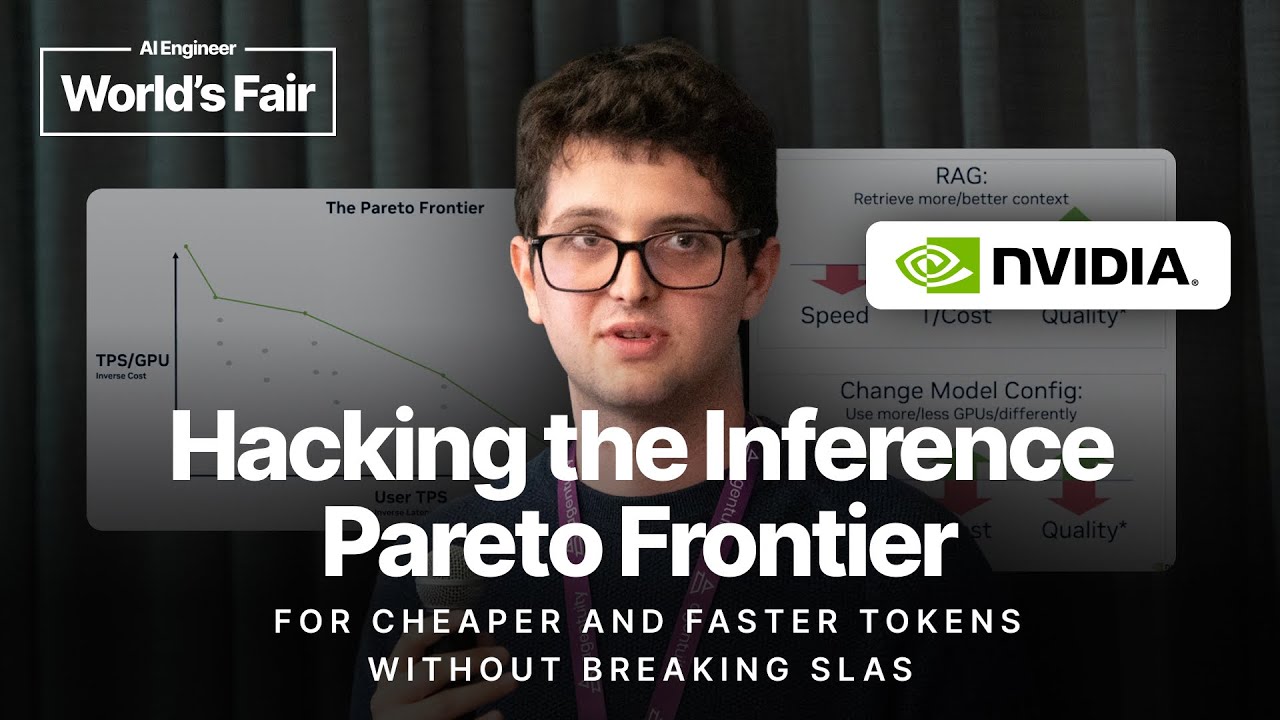
Hacking the Inference Pareto Frontier - Kyle Kranen, NVIDIA
Aug 1, 2025 · 20:25
Kyle Kranen, architect of NVIDIA Dynamo, explains how to break the inference Pareto frontier by manipulating trade-offs between quality, latency, and cost using a toolkit of techniques. Disaggregation separates prefill and decode phases, achieving up to 2× tokens per second per GPU at fixed latency for LLaMA 70B on 16 H100s. Smart routing maximizes KV cache hits, asymptotically reducing prefill work as deployments scale. Structure from agentic workloads, like inference-time scaling, enables smaller models (e.g., 8B queried 3–4 times) to match larger models' quality at lower cost. KV manipulation offloads caches during tool calls (e.g., 30-second delays) to avoid re-prefill. Dynamism adjusts worker specialization and autoscales prefill/decode ratios in real time to handle shifting user distributions, ensuring disaggregation reaches maximum potential.
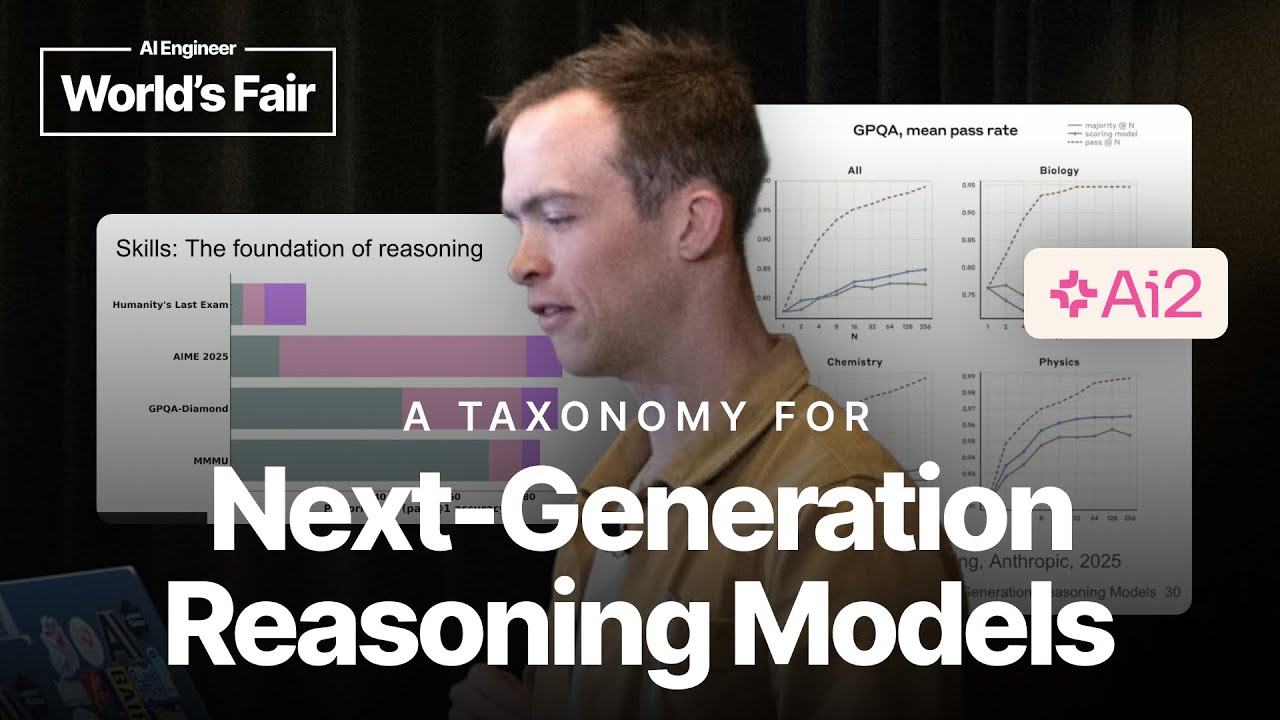
A Taxonomy for Next-gen Reasoning — Nathan Lambert, Allen Institute (AI2) & Interconnects.ai
Jul 19, 2025 · 19:21
Nathan Lambert, senior research scientist at AI2 and founder of Interconnects.ai, argues that next-generation reasoning models require a taxonomy of four traits: skills, calibration, strategy, and abstraction. While current models excel at math and code (skills), they overthink easy problems, wasting tokens and latency—calibration is needed to match output length to task difficulty. The real frontier is planning: models must learn strategy (choosing the right direction) and abstraction (breaking problems into tractable sub-tasks) to enable long-horizon agents like Deep Research and Claude Code. Lambert traces how OpenAI's Q*→Strawberry→o1 took 12–18 months of human data to teach backtracking and verification; planning should be easier because humans can write 5-step plans. He predicts post-training compute could reach parity with pre-training, citing DeepSeek's shift from 0.18% post-training compute in V3 to an estimated 10–20% for R1. The path forward: collect diverse verifiable questions, filter by difficulty, run stable RL—then scale.

Benchmarks Are Memes: How What We Measure Shapes AI—and Us - Alex Duffy, Every.to
Jul 15, 2025 · 15:44
Alex Duffy argues that AI benchmarks function as cultural memes—ideas that spread and shape what models learn—giving those who design them immense power over AI's trajectory. He traces the lifecycle from a single person's idea to saturation, using examples like 'How many Rs in strawberry' and Pokémon. Duffy introduces AI Diplomacy, a benchmark where language models negotiate and betray each other, revealing that models like DeepSeek R1 and Gemini 2.5 Flash excel at social manipulation while Claude models are naively optimistic. He warns against benchmarks that reward sycophancy (like ChatGPT's thumbs-up training) and advocates for multifaceted, experiential, and generative benchmarks that empower people. Duffy urges the audience to ask non-AI people what they care about, turning benchmarks into tools that build trust and define humanity's role in an AI world.

Using OSS models to build AI apps with millions of users — Hassan El Mghari
Jul 15, 2025 · 18:47
Hassan El Mghari, a software engineer at Together.ai, explains how he builds open source AI apps that attract millions of users, including roomGPT.io (2.9 million users), restorePhotos.io (1.1 million), Blinkshot.io (1 million visitors), and LlamaCoder.io (1.4 million visitors). He details his simple four-step tech stack: user input, a single API call to an open source model on Together.ai, storing results in a database, and displaying output. His process emphasizes keeping ideas simple enough to describe in five words, spending 80% of time on UI, launching early, and incorporating the latest models like Fluxionel for virality. He advises naming apps with short, memorable names, making them free and open source to encourage sharing, and iterating rapidly—most apps fail, but the key is to keep building. He funds compute through sponsorships from Together.ai and partners like Neon and Clerk, which provide free services for his open source projects.

Trends Across the AI Frontier — George Cameron, ArtificialAnalysis.ai
Jul 8, 2025 · 17:52
George Cameron of Artificial Analysis presents multiple frontiers—reasoning, open-weights, cost, speed—across the AI stack, arguing that trade-offs between intelligence, latency, and expense are critical for building applications. Reasoning models like O4 mini high use an order of magnitude more output tokens (72M vs GPT-4.1's 7M) and take over 40 seconds per response versus 4.7 seconds, impacting agentic workflows where 30 sequential calls multiply latency. The open-weights gap has nearly closed, with China-based labs like DeepSeek R1 and Alibaba's Qwen 3 leading. O3 cost roughly $2,000 to run the intelligence index, while GPT-4.1 nano is over 500 times cheaper. Output speeds have jumped from GPT-4's 40 tokens/s in 2023 to over 1,000 on a B200 accelerator. Despite efficiency gains, demand for compute will keep rising due to larger models, reasoning’s extra tokens, and multi-step agents.
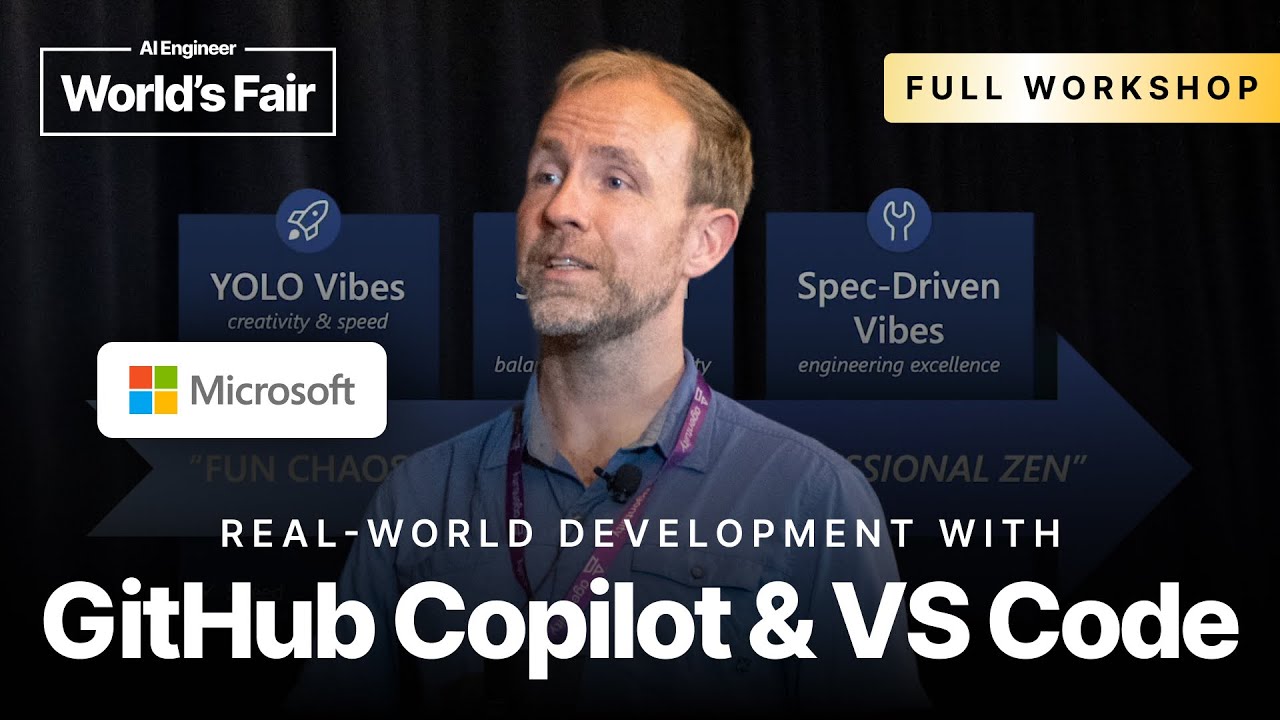
[Full Workshop] Vibe Coding at Scale: Customizing AI Assistants for Enterprise Environments
Jun 27, 2025 · 1:20:38
Harold from the VS Code team demonstrates "Vibe Coding at Scale" at the AI Engineer World's Fair, presenting three stages—YOLO, structured, and spectrum vibes—for customizing AI assistants in enterprise environments. He live-codes a hydration tracking app using GitHub Copilot's agent mode, auto-approve, and new workspace scaffolding, then shows how to enforce design principles via Copilot instructions and reusable prompts. Harold introduces custom modes (e.g., TDD mode), tool sets, and MCP servers like Playwright and Perplexity for research and browser testing. He emphasizes iterating on instructions, committing often, and using spec-driven development to balance speed with reliability, arguing these techniques enable true flow-state collaboration even on complex codebases.

Agents reported thousands of bugs, how many were real? - Ian Butler and Nick Gregory
Jun 3, 2025 · 18:39
Ian Butler and Nick Gregory introduce SM-100, a benchmark of 100 real-world bugs across 84 repositories, and present their agent Bismuth as outperforming existing agents in detecting complex bugs—finding 10 needles vs 7 for the next best. However, even top performers struggle: Bismuth's true positive rate is only 25%, and Codex leads at 45%, while most agents (Cursor, Debian) report thousands of false positives (97% for basic loops). They argue that agents universally exhibit narrow thinking, missing simple bugs like a form state issue that only Bismuth and Codex caught, and that high SWE-bench scores do not translate to maintenance tasks. The episode concludes that software maintenance remains an unsolved problem requiring deeper reasoning and targeted search.

The Future of Qwen: A Generalist Agent Model — Junyang Lin, Alibaba Qwen
Jun 3, 2025 · 25:14
Junyang Lin from Alibaba Qwen presents the latest developments in the Qwen model series, including Qwen3's hybrid thinking mode that combines thinking and non-thinking behaviors in a single model, supporting over 119 languages and dialects. The flagship 235B MOE model activates only 22B parameters and competes with top-tier models like O3-mini, while a 4B model deployable on mobile devices rivals Qwen 2.5 72B. Qwen3 introduces dynamic thinking budgets for inference-time scaling, achieving over 80% on AIME 2024 with 32K thinking tokens, and enhances agent capabilities with MCP support. The vision-language model Qwen2.5-VL excels in benchmarks like MMU and MathVista, and the omni model Qwen2.5-Omni accepts text, vision, and audio inputs while generating text and audio, achieving competitive vision-language performance. Future directions include scaling reinforcement learning with environment feedback, extending context to at least 1M tokens, and unifying understanding and generation across modalities, marking a shift from training models to training agents.
Keynote: Why people think "agent" is a buzzword but it isn't
Feb 22, 2025 · 28:07
Chip Huyen argues that agents are not a buzzword but a practical yet hard technology, facing three core challenges: the curve of complexity, tool use translation, and context management. Even simple queries require multiple steps, and models' success rates drop rapidly past 5 steps—newer reasoning models like DeepSeek R1 are pushing the boundary, but most still fail after 10. Tool use requires translating ambiguous natural language to precise API calls, worsened by poor documentation; she advises narrow functions and asking for clarifications. Context is another bottleneck: agents must juggle instructions, tool docs, and outputs, often exceeding a model's efficient context (many hallucinate beyond 30K tokens), necessitating external memory like RAG. Her benchmark shows planning-specialized models struggle with long context and vice versa, and she recommends breaking tasks into subtasks and using test-time compute scaling.
Powered by PodHood