
DALL-E
ProductA product discussed on AI Engineer.
5 episodes
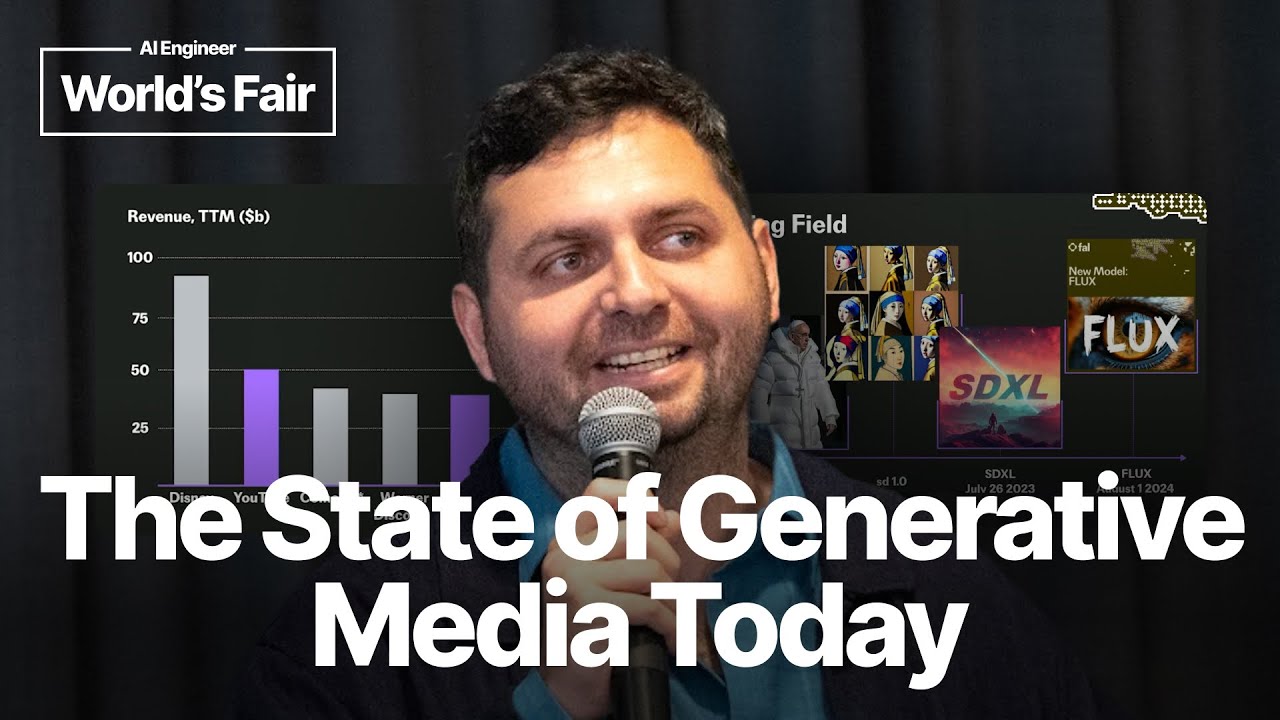
The State of Generative Media - Gorkem Yurtseven, FAL
Jul 16, 2025 · 17:14
Gorkem Yurtseven, co-founder and CTO of fal.ai, argues generative media lowers creation's marginal cost to near zero, transforming advertising and e-commerce. He traces evolution from DALL·E 2 to open-source models like Stable Diffusion and FLUX, with the playing field evening quickly. Video models (Sora, Veo 3) are accelerating: fal's platform saw video usage jump from near zero to 30% of revenue, and he predicts the generative video market 100x-250x bigger than image. Advertising leads with hyper-personalized, interactive ads, like fal's A24 campaign turning selfies into toy soldiers. In e-commerce, virtual try-on is a proven product-market fit. Future real-time video generation will blur games and movies.

Personality Driven Development: Exploring the Frontier of Agents with Attitude
Feb 17, 2025 · 18:00
Ben, from Perpetual, argues that anthropomorphizing AI agents—giving them personalities, forms, and preferences—transforms user adoption and engagement, despite significant challenges. He presents examples like Tech Lead, an artichoke recruiter, and hamster teams, showing how form factors create instant understanding and enable price anchoring (e.g., 1/20th the cost of a junior employee). Benefits include easy problem decomposition (specialized agents outperform generalized), branding, and fun. However, downsides include reinforcing stereotypes (100% of generated software engineers appear male), raised performance expectations, difficulty rebranding, distraction from core value, and stark reminders of job replacement—illustrated by a CEO introducing an IC as the one who 'knows what they're doing.' Ben highlights personality-driven development where every instance is bespoke, with prompt-driven preferences (e.g., 'I like Ivy League schools'), making debugging uniquely challenging.

Multi model multimodal and multi agent innovations in Azure AI: Cedric Vidal
Feb 6, 2025 · 28:56
Cedric Vidal, Principal AI Advocate at Microsoft, demonstrates Azure AI's multi-model, multimodal, and multi-agent capabilities in a session packed with live demos. He shows how GPT-4 Omni mixes text and vision to read handwritten French menus and translate them, and diagnoses infrastructure damage from photos for energy and insurance industries. A new video translation service lets him speak German, Spanish, Italian, and Japanese in his own voice while preserving tone, such as whispering or yelling. The Azure AI model catalog now offers 1,600 models, including serverless deployment options, and Phi-3 Vision, a small 3.8B parameter model running locally in a browser via WebGPU. He also demonstrates code interpreter analyzing a GPX file from a kitesurfing session, plotting a map with turn markers, and GitHub Workspaces preview generating a Java GUI from Python code.
[Workshop] AI Engineering 101
Nov 6, 2023 · 3:02:24
In this hands-on workshop, AI engineer Noah Hein teaches the basics of AI engineering by building five projects with OpenAI's GPT-3, GPT-4, Dall-E, Whisper, and Telegram. Participants create a Telegram bot that uses GPT-3 for chat, implements retrieval-augmented generation (RAG) with embeddings and cosine similarity on MDN docs, generates code with GPT-4 using few-shot prompting, creates images via Dall-E 2, and transcribes voice with Whisper. The session explains core concepts like tokens, chunking, context windows, temperature, and top-p, emphasizing that embeddings and prompt engineering are key to performance. Hein demonstrates that these tools are cheap and accessible—the entire workshop costs about $0.05 in API fees—and shows how AI engineers can integrate multiple models into a single application.
See, Hear, Speak, Draw: Logan Kilpatrick & Simón Fishman
Oct 24, 2023 · 18:43
OpenAI's Simón Fishman and Logan Kilpatrick argue that 2024 will be the year of multimodal models, showcasing how text can currently bridge vision, audio, and image generation. They demo a DALL-E vision loop where GPT-4 with vision describes an image, DALL-E 3 generates a synthetic version, then the models compare and iterate to improve accuracy—all in roughly 50 lines of code. Another demo extracts frames from a video, uses GPT-4 with vision to describe them, combines with Whisper's transcript, and generates a blog post with matching DALL-E images, making video content more accessible. They emphasize that while today's multimodal capabilities are separate, future unified models will directly reason across modalities, eliminating the need for manual integration.
Powered by PodHood