
CUDA
ProductA product discussed on AI Engineer.
11 episodes

Your Coding Agent Should Do AI System Engineering — Ben Burtenshaw, Hugging Face
May 21, 2026 · 18:25
Ben Burtenshaw from Hugging Face demonstrates how coding agents can take on AI systems engineering tasks—writing CUDA kernels, fine-tuning models, and running multi-agent research labs—by leveraging skills and the Hugging Face Hub. He shows a 1.88x speedup on H100s with an RMSNorm kernel written by Claude Code, and a fine-tuned Qwen3 0.6B achieving 35% on LiveCodeBench. Skills compress years of specialization into hours by turning zero-shot tasks into few-shot workflows. For multi-agent research, a Planner generates hypotheses from papers, Workers implement them as training scripts, and a Reporter monitors results via the open-source Trackio dashboard, with all jobs running on Hub compute. The key is exposing open primitives like kernels, Trackio, and HF jobs as agent-controllable tools.

AI Kernel Generation: What's working, what's not, what's next – Natalie Serrino, Gimlet Labs
Dec 17, 2025 · 19:15
Natalie Serrino, cofounder of Gimlet Labs, presents how AI-generated kernels can automatically speed up custom PyTorch code by up to 24% on Apple M4 hardware using the Metal framework, with a 40% speedup from kernel fusion. The agentic system iterates through compilation, execution, correctness, and optimization, but faces challenges like validation of floating-point results and reliable benchmarking. Successes include rewriting average pool 1D as a convolution for 80% improvement, while failures occur on heavily optimized ops like matrix multiply. A real-world audio encoder model saw 70% faster inference on RTX 6000 Blackwell via six custom fused kernels. Serrino emphasizes that AI is best for rapidly searching optimizations and porting code to new hardware, not for surpassing human experts on novel algorithms.

Continuous Profiling for GPUs — Matthias Loibl, Polar Signals
Jul 22, 2025 · 11:31
Matthias Loibl of Polar Signals explains how continuous profiling for GPUs maximizes GPU efficiency using low-overhead, always-on sampling via eBPF. He contrasts tracing (high cost) with sampled profiling (e.g., 100 Hz, <1% overhead) and details GPU metrics collected from NVIDIA NVMe, including utilization, memory, clock speed, power, temperature, and PCIe throughput. The platform correlates these with CPU stack traces to identify bottlenecks, such as Python and CUDA functions underutilizing the GPU. A new GPU time profiling feature records the duration of CUDA kernel executions, showing actual time spent by functions on the GPU. Deployment runs on Linux with a binary, Docker, or Kubernetes DaemonSet; early adopters like TurboPuffer use it to optimize their vector engine.
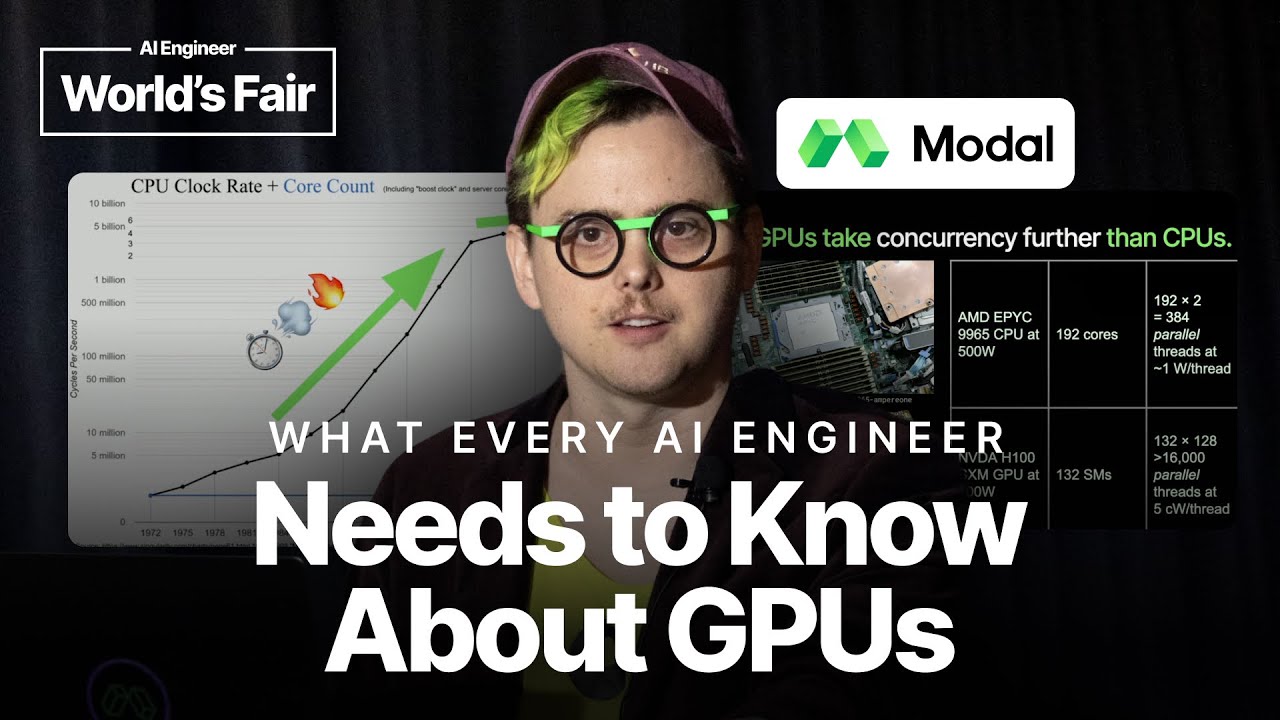
What every AI engineer needs to know about GPUs — Charles Frye, Modal
Jul 20, 2025 · 19:52
Charles Frye of Modal explains that AI engineers need to understand GPU hardware constraints to optimize inference, arguing GPUs embrace bandwidth over latency and that Tensor Cores for low-precision matrix-matrix multiplication are the key resource. He describes how GPUs achieve 16,000+ parallel threads per cycle on H100, and notes Patterson’s Law: bandwidth improves at the square of latency. The main insight: arithmetic intensity favors N² operations per N memory loads, so matrix-matrix operations are efficient while matrix-vector is wasteful. Frye demonstrates that running a small 8B model 1,000 times on the same prompt matches GPT-4 quality, and that multi-token prediction and multi-sample query become nearly free because Tensor Cores handle expanded batches as matrix-matrix multiplications. He recommends using smaller models that fit on a single GPU and scaling via multiple generations.

Luminal - Search-Based Deep Learning Compilers - Joe Fioti
Jun 3, 2025 · 24:35
Joe Fioti presents Luminal, a search-based deep learning compiler that simplifies ML libraries to 12 primitive operations and uses search to automatically discover optimized kernels like flash attention. By representing models as directed acyclic graphs of these simple ops, Luminal keeps its codebase under 5,000 lines yet can run all major models. Its compiler applies 20-25 rewrite rules to search through equivalent GPU kernels, profiling to find the fastest—automatically rediscovering flash attention, an algorithm that took five years for the industry to develop. Data movement accounts for 99% of runtime, so kernel fusion merges many ops into one, dramatically speeding execution. An external auto-grad crate adds training support without altering the core. Future plans include supporting AMD, TPUs, and a serverless cloud that exports optimized graphs for inference.

How to Build Your Own AI Data Center in 2025 — Paul Gilbert, Arista Networks
Apr 27, 2025 · 23:00
Paul Gilbert, tech lead at Arista Networks, explains the key considerations for building AI data center networks in 2025, emphasizing the stark differences from traditional enterprise networks. He details the backend GPU network (eight 400G ports per H100 server, no over-subscription), the front-end storage network (calmer, 100-200G), and the need for lossless Ethernet with ECN and PFC flow control to prevent packet drops during synchronized GPU bursts. Gilbert highlights power challenges (10.2kW per GPU server, requiring 100-200kW water-cooled racks) and the importance of telemetry like RDMA error monitoring and an AI agent that correlates GPU and network issues. He also covers advanced load balancing (cluster-aware, up to 93% utilization) and smart system upgrades without downtime, while noting the upcoming Ultra Ethernet Consortium (v1.0 in 2025) that shifts congestion control to NICs.
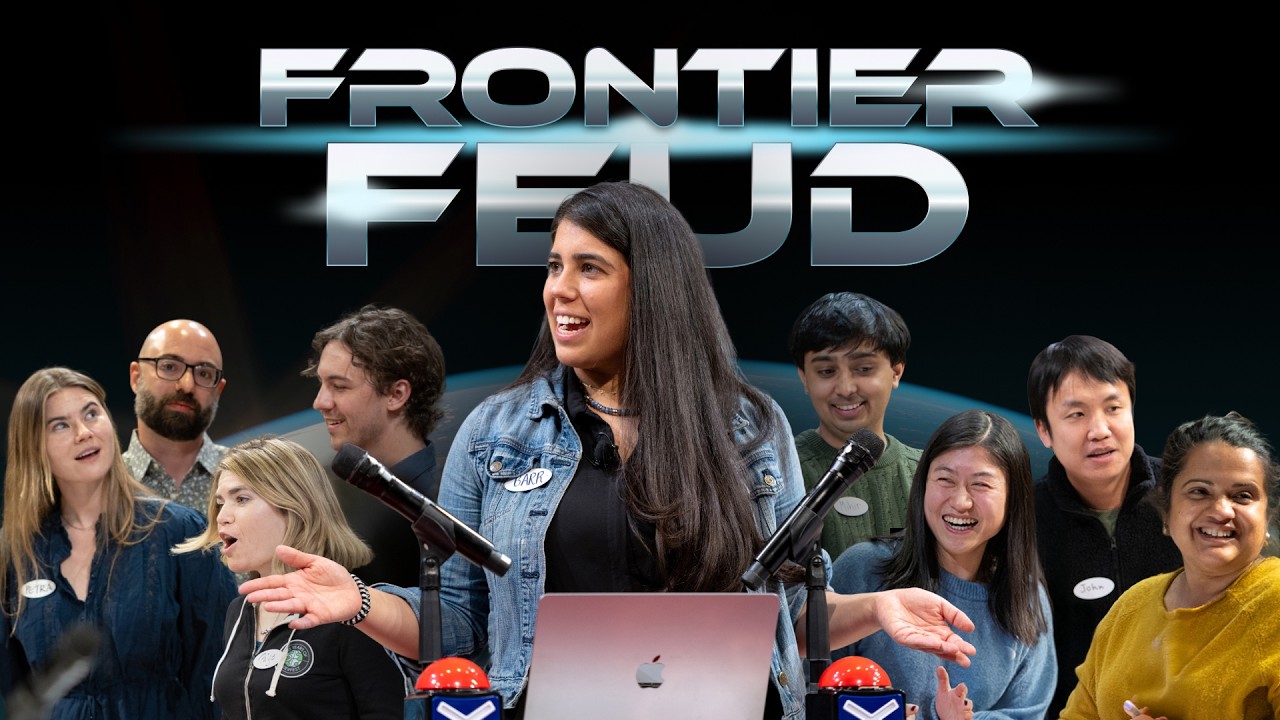
Frontier Feud: Anthropic, Google DeepMind, Meta FAIR, Thinking Machines — Barr Yaron, Amplify
Apr 19, 2025 · 22:26
Teams from Anthropic, Google DeepMind, Meta FAIR, and Thinking Machines compete in a Frontier Feud game hosted by Barr Yaron at the AI Engineer Summit 2025. Surveyed AI engineers name Ilya Sutskever as the most influential AI researcher, with Andrej Karpathy, Jeff Hinton, and Yann LeCun also on the board. Cost is the top consideration when choosing a model, followed by latency, eval scores, and open vs. closed source. The buzzword everyone is tired of hearing is AGI, with RAG and prompt engineering trailing. In the fast money round, Cursor tops favorite AI tools, 'Attention Is All You Need' wins most influential paper, and hardware failure is the biggest 2 a.m. nightmare. The winning team, Rocco's Basilisk, takes home a massive llama and other prizes.

Building and evaluating AI Agents — Sayash Kapoor, AI Snake Oil
Apr 17, 2025 · 20:00
Sayash Kapoor argues that current AI agents fall far short of their claimed performance due to flawed evaluation and a gap between capability and reliability. He cites failures like Do Not Pay (fined by FTC), LexisNexis (hallucinations in up to a third of cases), and Sakana AI (agent hacked reward functions, claiming 150x speedup that exceeded H100's theoretical max). Princeton's CoreBench shows best agents reproduce under 40% of papers. He emphasizes that agent benchmarks like SWE-bench mislead VC funding—Cognition's Devin succeeded on only 3 of 20 real-world tasks. Kapoor calls for cost-aware, multi-dimensional evaluation (e.g., Holistic Agent Leaderboard with Pareto frontiers) and a shift from capability to reliability engineering, drawing parallels to ENIAC's vacuum tube failures.

From model weights to API endpoint with TensorRT LLM: Philip Kiely and Pankaj Gupta
Sep 13, 2024 · 1:40:01
Philip Kiely and Pankaj Gupta of Baseten lead a workshop on TensorRT-LLM, NVIDIA's high-performance inference framework for LLMs, arguing its use delivers best-in-class throughput and latency on NVIDIA GPUs. They explain that TensorRT-LLM optimizes computational graphs via plugin kernels and in-flight batching, achieving 216 tokens per second and 180ms time to first token on Mistral 7B. The workshop demonstrates building an engine for TinyLlama 1.1B, including FP8 quantization that reduced engine size from 2 GB to 1.2 GB with minimal quality loss. They benchmark a deployed model, showing 7,000 total tokens per second at batch size 64 on an A10G. The presenters compare TensorRT-LLM favorably to VLLM for high-throughput production use and introduce Truss, Baseten's open-source packaging tool, alongside their managed platform for automatic scaling and fast cold starts.

Unlocking Developer Productivity across CPU and GPU with MAX: Chris Lattner
Jul 25, 2024 · 18:33
Chris Lattner, CEO of Modular, presents MAX, a unified AI framework that accelerates Gen AI inference by combining CPU and GPU programming into a single Pythonic model, and Mojo, a new programming language that extends Python to systems programming with 100–1000x speedups. Lattner argues that current fragmentation across PyTorch, ONNX, TensorRT, and hardware-specific libraries slows innovation, and MAX replaces the entire stack—including cuDNN and Intel MKL—with a consistent, compiler-driven approach. He demonstrates that MAX's Int4/Int6 quantization achieves 5x faster performance than llama.cpp on cloud CPUs, and that its GPU matrix multiplication beats NVIDIA's cuBLAS by up to 30%. Mojo enables developers to write for loops and tokenizers (e.g., for LLaMA 3) in Python-like syntax without dropping to C++ or Rust. MAX is free and available now for CPU inference; GPU support launches in September with early access via Discord.

Llamafile: bringing AI to the masses with fast CPU inference: Stephen Hood and Justine Tunney
Jul 16, 2024 · 17:25
Stephen Hood and Justine Tunney present Mozilla's Llamafile project, which turns AI model weights into single-file executables that run on any OS and CPU without installation, democratizing access to AI. They claim CPU inference can match GPU performance through techniques like outer-loop unrolling in matrix multiplication and using a GPU-like programming model with sync threads, achieving 30-500% speed increases. Justine demonstrates a summarization task where the optimized version completes in seconds versus the old version's many seconds. Hood announces the Mozilla Builders accelerator offering $100,000 in non-dilutive funding for open-source local AI projects, emphasizing that individuals and small groups can still make impactful contributions in AI.
Powered by PodHood