
CrewAI
ProductA product discussed on AI Engineer.
12 episodes
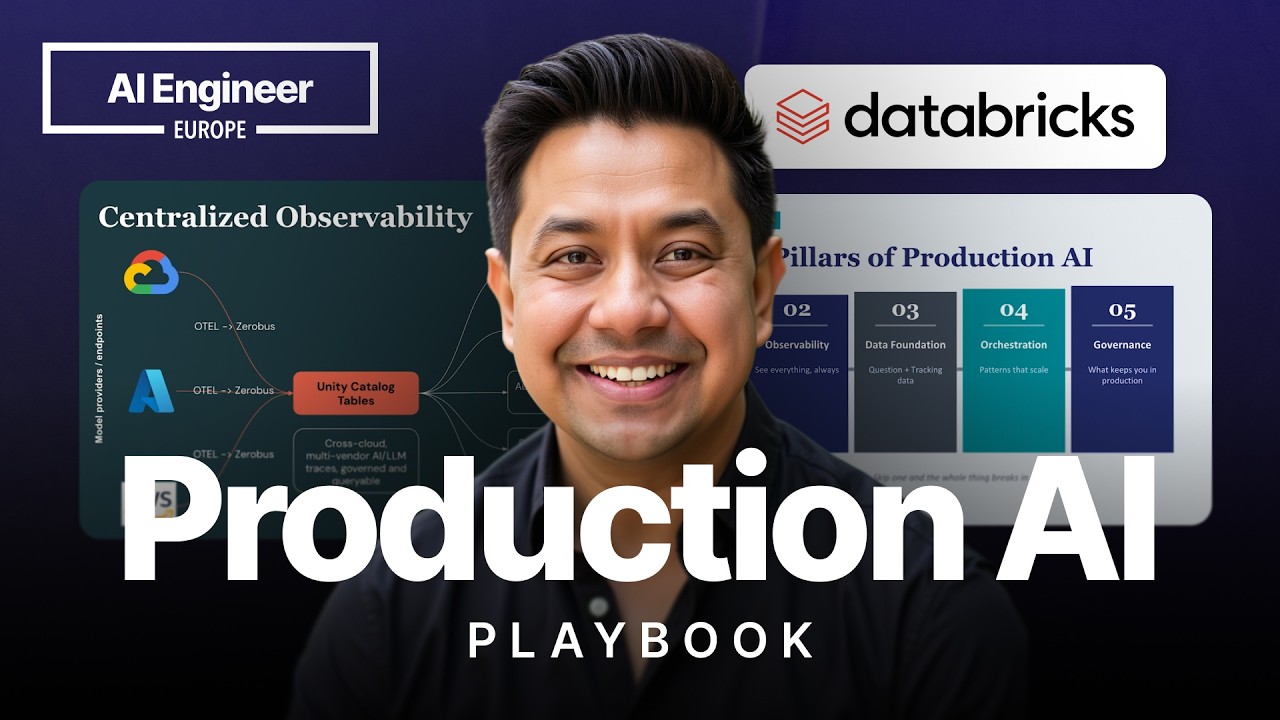
The Production AI Playbook: Deploying Agents at Enterprise Scale — Sandipan Bhaumik, Databricks
Jun 18, 2026 · 37:06
Sandipan Bhaumik, a technical lead for Data and AI at Databricks, presents a five‑pillar playbook for taking AI agents to production: evaluation (define numerical success before touching code), observability (trace every decision for regulators and debugging), data foundation (agents do not forgive bad data), multi‑agent orchestration patterns (orchestrator‑worker, choreography, human‑in‑the‑loop), and governance (PII pre‑validation, prompt versioning as change management). He recounts a retail bank that spent £85,000 over six months on a chatbot PoC that failed because no one could measure or trace it. His team reversed the order: they built the evaluation dataset and tracing infrastructure first, selected the model in week 7 of an 8‑week engagement, and launched successfully. Six weeks post‑launch, when the bank updated interest rate policies, the tracing system caught that the new document had not been re‑embedded, so the agent served stale answers—a production incident the five pillars were designed to handle. The evaluation dataset is a living system that grows from 200 test cases; a production incident playbook connects all pillars: detect via eval dashboard, diagnose with…
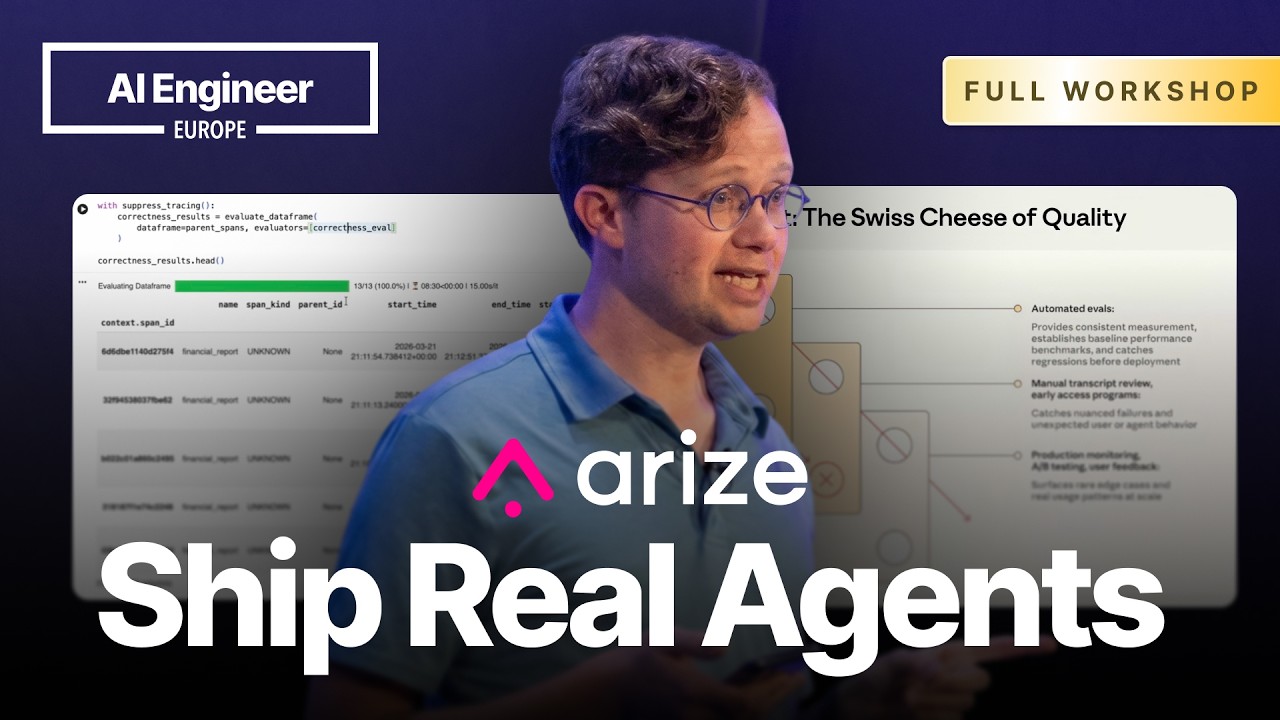
Ship Real Agents: Hands-On Evals for Agentic Applications — Laurie Voss, Arize
May 14, 2026 · 2:04:18
Laurie Voss, head of developer experience at Arize AI, delivers a hands-on workshop on evaluating agentic applications using Arize Phoenix, demonstrating that choosing the right eval matters more than tuning it: a correctness eval scored 0 out of 13 on the same financial analysis agent that a faithfulness eval scored 13 out of 13, because the model doesn't know the current year and cannot verify forward-looking data. He walks through building a complete eval pipeline from scratch—starting with tracing a Claude Haiku-based financial agent, reading and categorizing traces to identify root causes, then implementing code evals, built-in LLM-as-a-judge evals, and a custom actionability rubric with labeled examples. Voss emphasizes the importance of meta-evaluation to validate judge accuracy and introduces Phoenix experiments to prove prompt changes actually improve scores, not just vibes. Practical tips include using the impact hierarchy (data quality > prompting > model selection > hyperparameters) and the value of regression evals for safe model upgrades. The workshop closes with cost-aware evaluation, pairwise evaluation, and reliability scoring as next steps beyond the foundations…

Shipping AI That Works: An Evaluation Framework for PMs – Aman Khan, Arize
Dec 26, 2025 · 1:26:16
Aman Khan, AI PM at Arize, presents a framework for product managers to evaluate LLM-powered products beyond gut-feel 'vibe checks.' He demonstrates building an AI trip planner with multi-agent LangGraph, then using Arize's tracing and prompt playground to iterate on prompts. Khan shows how to create datasets from production traces, run A/B experiments on prompts, and use LLM-as-a-judge evals for friendliness and discount offers, comparing against human labels to refine evaluators. He argues evals are the new requirements docs, enabling PMs to own the product experience by writing acceptance criteria as eval datasets. The talk covers building eval teams, handling variance with temperature settings, and continuously improving golden datasets with hard examples, citing real-world analogies from self-driving cars at Cruise.

Engineering Better Evals: Scalable LLM Evaluation Pipelines That Work — Dat Ngo, Aman Khan, Arize
Jun 27, 2025 · 24:46
Dat Ngo, AI architect at Arize AI, presents advanced LLM evaluation strategies for production systems, arguing that effective evals go beyond out-of-the-box LLM-as-a-judge to include code-based heuristics, human feedback, and golden datasets. He explains how to build a virtuous cycle of collecting observability data, running evals, and tuning them over time, and demonstrates agent evaluation techniques like trajectory evals to identify failure modes across complex workflows. Ngo covers trade-offs between offline evals and inline guardrails, the use of log probabilities for confidence scoring, and automated prompt optimization through meta-prompting, all illustrated with customer examples from Reddit, Duolingo, and Booking.com.
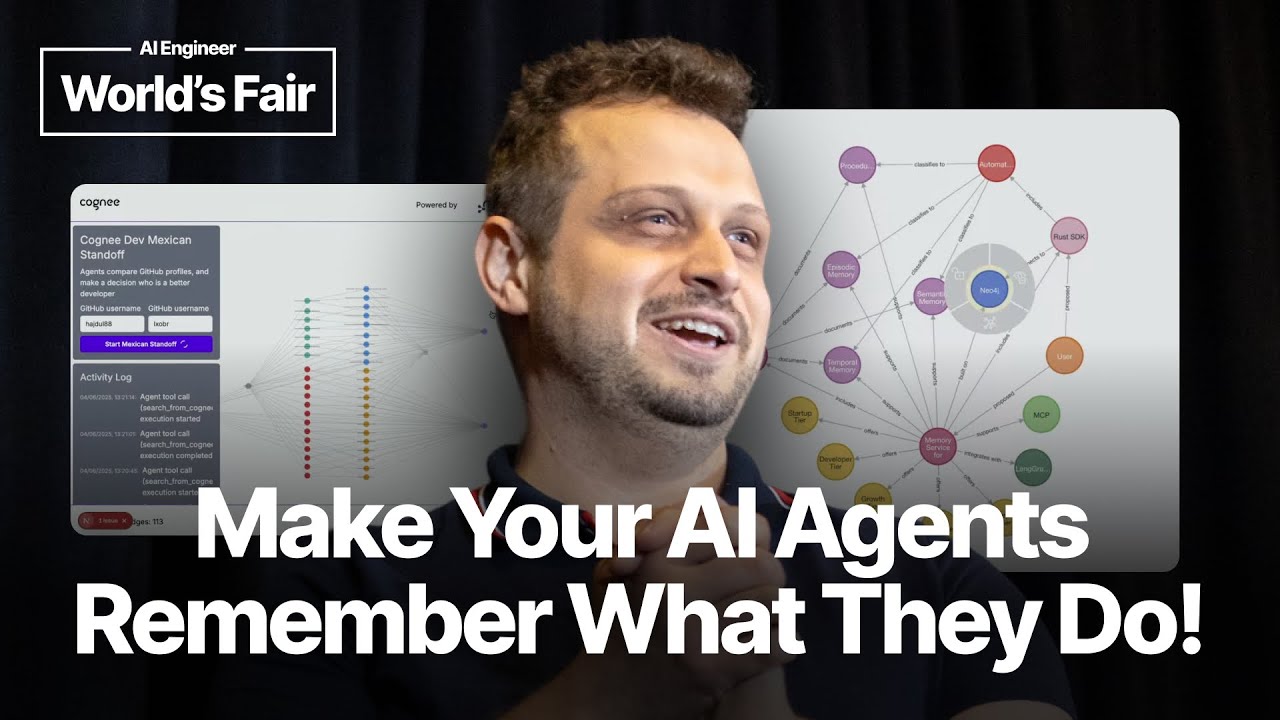
Memory Masterclass: Make Your AI Agents Remember What They Do! — Mark Bain, AIUS
Jun 27, 2025 · 51:25
Mark Bain, Vasilia Markovits, Alex Gilmore, and Daniel Chalev demonstrate that AI memory requires causal relationships and graph databases, not just vector similarity, to solve hallucinations and enable agentic workflows. Bain argues that memory is any data affecting change, and that attention, diffusion, and VAEs follow the same geometric principles as gravity and entropy. Alex shows Neo4j's MCP server storing semantic memory as entities and relationships retrieved across conversations. Vasilia demos Cognee building semantic graphs from GitHub data for agentic hiring decisions. Daniel presents Graphiti's domain-aware memory using custom Pydantic schemas to filter irrelevant facts. Bain introduces a GraphRAG chat arena that switches between memory solutions on a single Neo4j graph, testing different implementations for episodic and temporal recall.

Prompt Engineering is Dead — Nir Gazit, Traceloop
Jun 27, 2025 · 14:19
Nir Gazit, CEO of Traceloop, argues that manual prompt engineering is ineffective and demonstrates an automated, test-driven alternative. He improves a RAG-based documentation chatbot by 5x without hand-tuning prompts, using an LLM-as-a-judge evaluator with 20 example questions (each with 3 expected facts) and a CrewAI agent that iteratively optimizes the prompt based on evaluation scores. The initial score of 0.4 jumps to 0.9 after just two iterations. Gazit warns of overfitting to the small dataset and suggests splitting into train/test sets. The approach replaces manual tweaking with a 'gradient ascent' on evaluators, effectively vibe-engineering prompts.

Cognitive Shield Real Time Real Smart - Rachna Srivastava
Jun 3, 2025 · 44:58
Rachna Srivastava presents Cognitive Shield, a three-layer AI defense system against sophisticated financial fraud such as deepfake voice cloning, synthetic identities, and AI-powered crypto scams that have surged 375% since 2023. Layer one secures user data and uses AI to guide licensing and examination processes. Layer two employs eight detection modules including GAN-based deepfake detection, graph neural networks for fraud ring visualization, and NLP for phishing, all integrated via CrewAI multi-agent orchestration. Layer three provides a unified intelligence console with natural language search, real-time dashboards, and automated case escalation with compliance-ready reporting. The system leverages Neo4j graph databases and Graph RAG to uncover hidden connections, and is built with Streamlit, FastAPI, and Postgres. Srivastava warns that by 2027, 90% of cyber attacks will be AI-driven and fraud losses will surpass $100 billion annually.

Stateful Agents — Full Workshop with Charles Packer of Letta and MemGPT
Apr 19, 2025 · 1:19:34
Charles Packer, lead author of the MemGPT paper and co-founder of Letta, argues that statefulness (memory) is the most important problem to solve for building useful AI agents, since LLMs are inherently stateless transformers. He presents MemGPT's LMOS (Language Model Operating System) approach, which treats memory management as a context compilation problem solved by the LLM itself using tool calling to read and write structured memory blocks. The workshop demonstrates Letta's open-source stack (FastAPI, Postgres, Python) where agents persist state on a server, enabling long-running, learning interactions without context overflow—e.g., an agent can update its core memory (e.g., correcting a user's name) or search archival memory (e.g., recalling user preferences after a reset). Packer also shows multi-agent communication via async message passing between agents running as independent services, and highlights that tools are sandboxed by default with support for Composio integrations. The session includes a live notebook exercise and a low-code UI (ADE) showing context window management and memory editing, emphasizing that true stateful agents improve continuously over time rather…

Tool Calling Is Not Just Plumbing for AI Agents — Roy Derks
Feb 22, 2025 · 25:18
Roy Derks argues that tool calling is the most critical yet overlooked component of AI agents, far more than mere 'plumbing.' He contrasts traditional tool calling—where developers manually manage callbacks, retries, and errors within the agent loop—with embedded tool calling, a black-box approach used by frameworks like LangChain’s createReactAgent. Derks advocates for separation of concerns via the Model Context Protocol (MCP) from Anthropic, which splits tool logic into MCP servers communicating with clients, and via standalone tool platforms such as IBM’s wxflows, Composio, and Toolhouse that let teams build tools once and reuse them across LangChain, CrewAI, or AutoGen. He also introduces dynamic tools, where an agent generates queries on the fly—e.g., using GraphQL or SQL schemas—instead of defining hundreds of static tools, noting that LLMs like Claude handle GraphQL well but may hallucinate on deeply nested schemas. The episode emphasizes that 'an agent is only as good as its tools' and provides practical guidance on designing tool descriptions (which act like system prompts) and output schemas to enable type-safe, chainable tool calls.

Cohere: Building enterprise LLM agents that work (Shaan Desai)
Feb 22, 2025 · 18:29
Shaan Desai, a machine learning engineer at Cohere, presents key strategies for building enterprise LLM agents that are scalable, safe, and seamless. He recommends using native or LangGraph frameworks for high observability in large-scale agents, while CrewAI or AutoGen suit quick proofs of concept. Core insights include starting with a single LLM and a handful of tools, simplifying tool specifications with clear descriptions and sharp examples, and caching chat history to prevent hallucinations beyond 20 turns. For multi-agent setups, the router needs clear routing instructions for edge cases, and sub-agents should be constrained to independent tasks. Safety is paramount, with human-in-the-loop triggered before or after tool calls based on codified rules. Evaluation uses a golden set of ground truth queries, expected tool calls, and outputs. Failure mitigation ranges from prompt engineering for low-severity issues to targeted annotation datasets for 10–20% failure rates and synthetic data fine-tuning for high failure rates. Cohere packages these learnings into NORTH, a single container deployment with RAG, vector DBs, and connectivity to Gmail, Outlook, Drive, and Slack,…

Patrick Dougherty: How to Build AI Agents that Actually Work
Feb 22, 2025 · 17:44
Patrick Dougherty, co-founder and CTO of Rosco (acquired by Klarity in 2024), argues that building effective AI agents requires prioritizing reasoning over inherent model knowledge, iterating on the Agent-Computer Interface (ACI) rather than fine-tuning or relying on frameworks. He defines an agent as a system that takes directions, calls tools, and autonomously reasons—not a prompt chain. His team abandoned RAG-style knowledge injection for discrete tool calls (e.g., SEARCH TABLES, GET TABLE DETAIL), finding that GPT-4o often hallucinates impossible SQL queries while o1 correctly identifies missing data. Switching tool-response formats—Markdown to JSON for GPT-4o, JSON to XML for Claude—dramatically improved accuracy. For production, he warns against over-dependence on abstractions like LangGraph due to security needs (e.g., OAuth credential cascading). In multi-agent systems, a manager agent should delegate to 5–8 specialized worker agents, incentivized by the overall goal, to avoid loops. The true moat, he concludes, is the ecosystem—UX, connections, and security—not system prompts.

Using agents to build an agent company: Joao Moura
Aug 8, 2024 · 13:46
Joao Moura, founder of crewAI, explains how he used AI agents to build his own company, sharing that over 10.5 million agents were executed with crewAI in the last 30 days. He describes starting by building a marketing crew that automated LinkedIn and content creation, which generated 10x more views in 16 days, then a lead qualification crew that led to 150+ customer calls in two weeks. Moura details new features: code execution with a single flag, trainable crews for consistent results, support for third-party agents, and crewAI Plus for deploying crews as auto-scaling APIs in minutes. He emphasizes starting simple with low-risk, high-impact use cases and encourages attendees to bring agents into production now.
Powered by PodHood