
Composer
ProductA product discussed on AI Engineer.
5 episodes
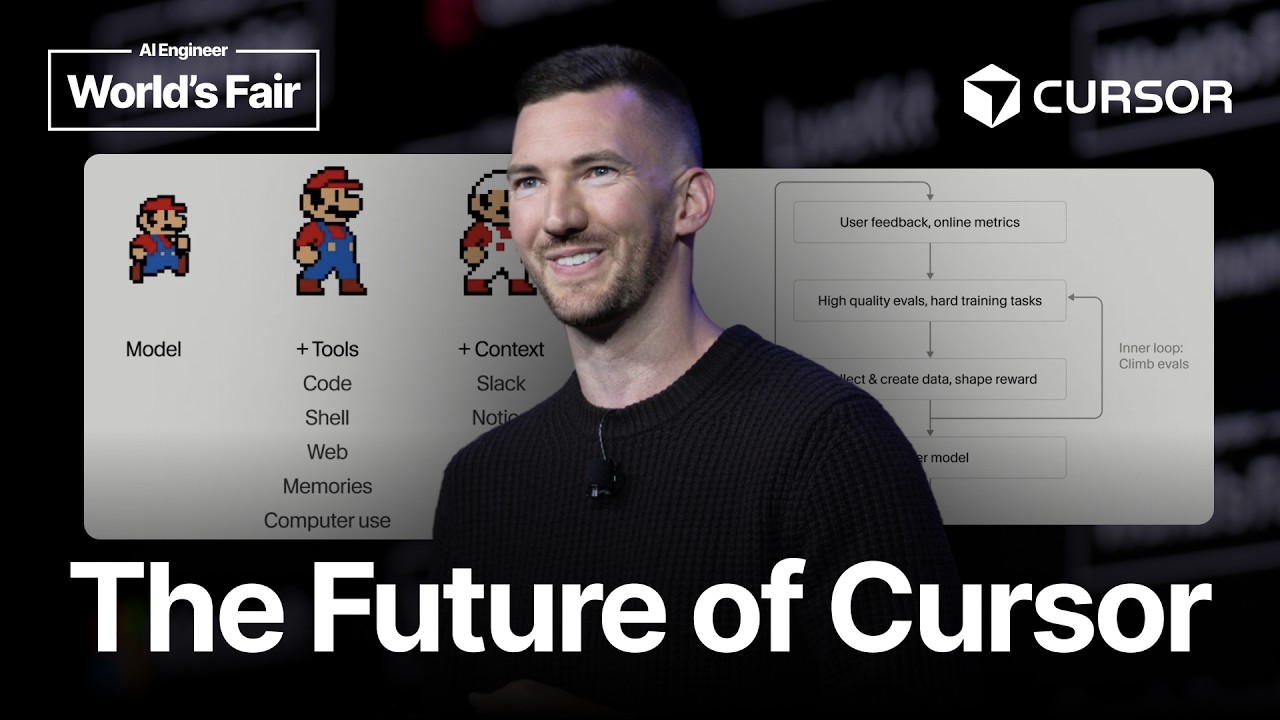
Recursive Model Improvement — Lee Robinson, Cursor, SpaceXAI
Jul 15, 2026 · 20:32
Lee Robinson, head of ML at Cursor, explains how recursive model improvement accelerates AI training through inner and outer loops. The outer loop gathers user feedback and online metrics to refine evals, while the inner loop uses high-quality evals and difficult problems to climb performance. Composer 2.5, released in May, became Cursor's most popular model by balancing speed, intelligence, and cost. To scale, Cursor partners with SpaceX for compute via Colossus (122 days to build 100k GPUs) and develops textual feedback where a teacher model hints at improvements during RL rollouts. Robinson details reward hacking on public benchmarks and the creation of CursorBench, a private eval set. He envisions agent-based automation where researchers launch experiments from Slack and models train derivative models, creating a self-improving intelligence loop.

Replacing 12K LoC with a 200 LoC Skill — David Gomes, Cursor
Apr 30, 2026 · 19:22
David Gomes shows how Cursor replaced 12,000 lines of code for Git WorkTrees and best-of-en features with roughly 200 lines of Markdown using agent skills and subagents. He explains the original implementation's complexity (15,000 lines deleted) and the new slash commands: /worktree, /best-of-en, /apply, /delete. Pros include less maintenance, ability to switch mid-chat, multi-repo support, and better judging with the parent agent stitching results. Cons: models sometimes forget to stay in the WorkTree over long sessions, perceived slowness, and reduced discoverability. He details future improvements through evals and RL training, plus a native WorkTrees implementation in Cursor 3.0 and exploration of non-Git parallelization primitives.
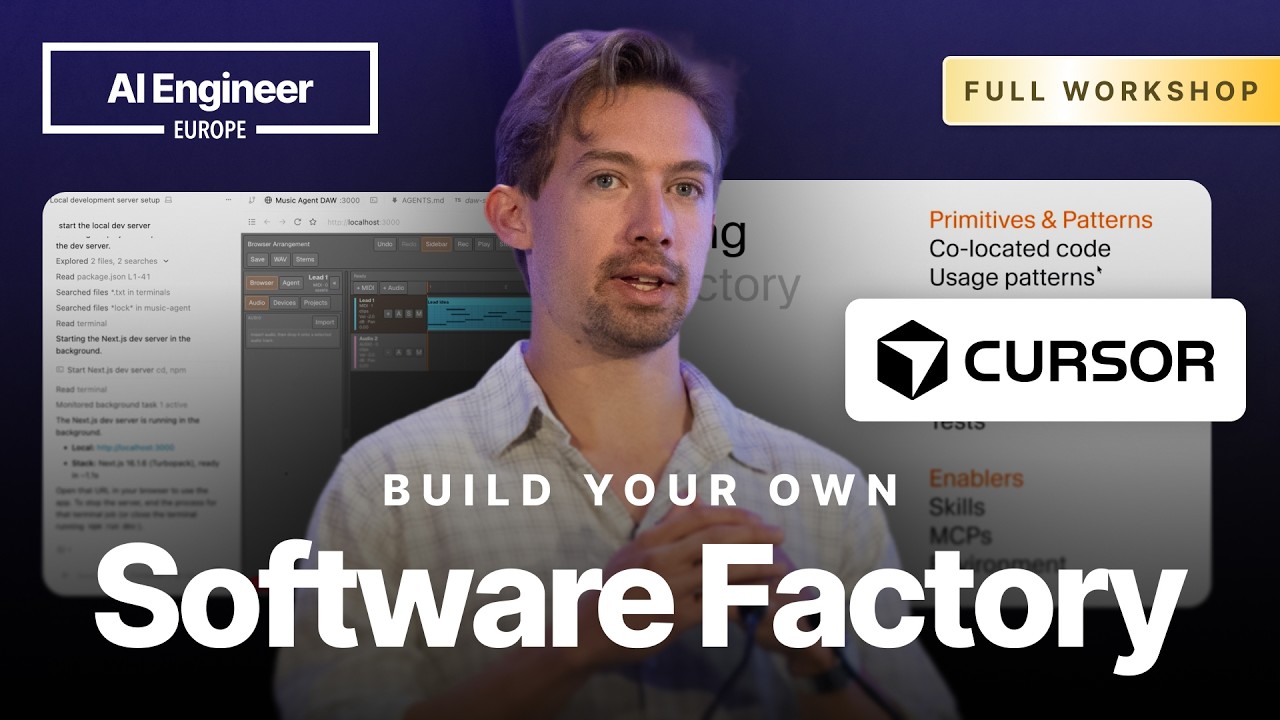
Building your own software factory — Eric Zakariasson, Cursor
Apr 28, 2026 · 1:23:37
Eric Zakariasson, an engineer at Cursor, explains how to build a 'software factory' by scaling from one agent to many, shifting from worker to manager. He outlines six stages of autonomy, from spicy autocomplete to the dark factory, and emphasizes that most teams are stuck at levels two or three. Key primitives include modular codebases, guardrails like rules and hooks that emerge dynamically, enablers such as skills and MCPs, and verifiable systems like automated tests. Cloud agents with isolated VMs allow agents to run asynchronously, test their own work via computer control, and scale to thousands. Eric shares internal automations like daily reviews, PR comment analysis, and continual learning that extracts rules from chat transcripts. He concludes with strategic advice: front-load context, don't outsource critical decisions, and build tools and systems to capture flywheels, noting that human accountability remains essential.

From Vibe Coding To Vibe Engineering – Kitze, Sizzy
Dec 14, 2025 · 25:28
Kitze, founder of Sizzy, argues that "vibe engineering"—actively steering AI agents with technical knowledge—trumps passive "vibe coding" for building real software. He shares how Cursor's Composer 1 let him port Benji.so and Glink to Next.js 16 with Monorepo in under a week, reviving near-dead projects. Kitze insists LLMs excel at React because humans are bad at it, and that repetitive code is fine since agents don't care. He warns against giving AI tools to juniors without oversight, and predicts the bottom of the job market will thin as agents replace interns. The talk ends with a pitch for "vibe code fixers" as a new role, maintaining legacy systems like cowboy coders.

RL Environments at Scale – Will Brown, Prime Intellect
Dec 9, 2025 · 18:30
Will Brown of Prime Intellect argues that scaling reinforcement learning environments beyond engineering—to community and accessibility—is key to broadening AI research. He presents Prime Intellect's open-source stack, including Verifiers for building environments and the Environments Hub for sharing them, as a way to turn any task harness into an RL training or evaluation loop. Brown demonstrates how environment-based fine-tuning boosted a Qwen 3 4B model from 55% to 89% on a Wikipedia search task, matching much larger models. He frames environments as the 'web apps of AI research'—simple to start, but capable of capturing product complexity, as seen with Cursor's Composer and OpenAI's Codex. Prime Intellect validated this approach by training the 100B-param Intellect 3 on 500 GPUs, and will soon release Lab, a platform to run environments without managing infrastructure.
Powered by PodHood