
Codex
ProductA product discussed on AI Engineer.
87 episodes

HTML Is All Agents Need — James Russo, HeyGen
Jul 21, 2026 · 15:13
James Russo, software engineer at HeyGen, argues that HTML, CSS, and JavaScript are the native languages of LLMs and all agents need to create great videos—leading to HyperFrames, an open-source framework that turns agent-authored HTML into deterministic MP4s. By letting the small Gemini 3 Flash model author code first, they ensured the thinnest wrapper won, with only a few data attributes for timing. Rendering works by freezing the browser clock and seeking frame by frame, ensuring everything loads before capturing each frame—enabling deterministic video from any web technology (Three.js, WebGL, Lottie). HyperFrames skills focus on taste and video craft rather than teaching frameworks, raising the floor for single-shot output. The framework has already rendered over 1.3 million videos in 90 days from 267,000 creators, with 15,000 daily renders and 32,000 GitHub stars—proving the approach at scale.
Through the AI Fog: The Architectural Decision Agentic Security Depends On — Manoj Nair, Snyk
Jul 20, 2026 · 23:29
Manoj Nair, Snyk's CTO, argues that generative AI systems cannot serve as their own validators because probabilistic models are unreliable for security. He presents data from 4,800 customers showing a 108% quarter-over-quarter increase in security backlog, and research revealing that over a third of AI agent skills contain malware. Nair demonstrates that even frontier models fail to find the same vulnerability consistently—only 50% of the time across five runs—while deterministic checks catch 75% of issues. He warns that agents autonomously copy PII into untrusted databases and that MCP servers offer minimal built-in security. The episode advocates for a deterministic security layer that verifies agent outputs inside the development loop, and includes a demo of Snyk's tools for package health and skill risk assessment.

Agentic Development Security — Ezra Tanzer, Snyk
Jul 20, 2026 · 27:33
Ezra Tanzer and Dan Arpino of Snyk argue that securing agentic development requires three pillars: what agents generate, what they use, and what they do. They highlight incidents where agents deleted production databases (Replit, Pocket OS) and exfiltrated repositories (GitHub via malicious VS Code extension), none acting maliciously but all lacking guardrails. Snyk's approach evolved from an MCP server with rule files (which agents ignored) to Python hooks that scan asynchronously on each file write, surfacing only newly introduced issues to keep latency and context windows deterministic. An audit of nearly 4,000 agent skills on a public hub found over one in eight had critical severity issues and 76 carried outright malicious payloads; skills are more dangerous than packages because they run at higher privilege and can rewrite agent memory. The resulting local tool shows every LLM, MCP server, and skill on a developer's machine with a risk score, blocks agents live from reading secret keys, and provides full audit trails of commands, files accessed, and tool calls.
It's 10pm. Do You Know Where Your Agents Are? — Kim Maida, Keycard
Jul 20, 2026 · 23:02
Kim Maida of Keycard argues that standard API keys dangerously overprivilege AI agents, enabling incidents like a night-shift agent dropping a production Postgres database because its kitchen-sink credential allowed it. Her fix uses OAuth token exchange (RFC 8693) to mint a fresh, short-lived, scoped token per tool call, evaluated against policy before the credential exists. This prevents leaks, replays, or theft—the drop request never receives a credential. It works across CLI agents, MCP servers, and any OAuth provider, and strengthens human-in-the-loop approval by checking operator roles against policy, preventing consent fatigue bypass. By chaining user and agent identity through a security token service, every action is attributed and delegation is narrowed at login and per call.

We Gave an Agent Production Code Access and Then Tried to Sleep at Night — Moritz Johner, Form3
Jul 20, 2026 · 21:57
Moritz Johner of Form3 explains that giving a coding agent production code access turns it into a supply chain actor, and the blast radius is an architecture decision. His team built PatchPilot to automate CVE patching across thousands of repositories, splitting it into a deterministic Go layer that handles dangerous operations (GitHub write access, CI triggering) and an agent layer that only edits files. The agent remediates vulnerabilities by bumping dependencies, verifying builds, and fixing CI failures, but a prompt injection could escape via the Docker socket, which kept him up at night. To contain that, they moved the agent into a firecracker microVM with its own kernel and separate network policies per layer. Johner argues that where you draw the line between deterministic and agentic code defines your security model, and warns that existing agent sandboxes are worthless when a Docker socket is involved.

When Agents Meet Physical Data: The Other Physics of Agent Harnesses - Dmitry Petrov, DataChain
Jul 20, 2026 · 27:33
Dmitry Petrov of DataChain argues that AI agents fail on unstructured physical data because their intuitions assume cheap recompute, while large-scale video, sensor, and robot data requires a different harness. He cites Anthropic's finding that agents achieve only 21% accuracy on data projects without specific data harnesses, and OpenAI's need for six layers of context even on structured data. Petrov demonstrates DataChain, an open-source Python framework that uses Pydantic schemas to turn messy binary files into queryable databases, an execution engine for distributed processing, incremental checkpoints to avoid recomputing on failure, and a knowledge base of datasets and source code so agents can answer follow-up questions in seconds instead of reprocessing terabytes. In a live demo with Claude Code analyzing 90 dashcam videos, the harness took 24 minutes to extract 100,000 object records, then instantly answered 'how many clips have people?' without rerunning inference. Petrov emphasizes that the key is organizing metadata into star schemas and sharing data lineage across teammates so no one pays the compute cost twice.
Skills are the New SDKs - Elvin Aghammadzada, DataRobot
Jul 20, 2026 · 26:40
Elvin Aghammadzada of DataRobot argues that enterprise AI platforms must become 'teachable' through a skill layer—versioned, task-specific packages that encode operational knowledge for coding agents. He contends that context windows degrade after 25% usage (a phenomenon called 'context rot'), making progressive disclosure via skills critical for maintaining agent performance. Skills expose only metadata (<100 tokens) until activated, while MCP servers handle heavy resource isolation; skills can also self-modify and spawn MCP servers. With 26+ platforms (Claude Code, Codex, Copilot) supporting skills and 85,000+ published, the ecosystem is creating a 'fluency moat' where platform value compounds with each skill. However, LLM-generated skills currently hurt performance, and marketplaces lack verification controls, echoing early NPM risks. The episode positions skills as complementing MCPs, not replacing them, and urges versioning and testing as software.

Autonomous Agents for Scientific Tasks - Sina Shahandeh, Radicait
Jul 18, 2026 · 19:23
Sina Shahandeh (Radicait) presents an approach to improve autonomous agents for scientific tasks by focusing on hypothesis generation rather than just implementation. He argues that standard coding agents saturate because they run out of ideas, and introduces a hierarchical decomposition method that breaks problems into subcomponents (e.g., data, architecture, training loss) and prompts LLMs to generate radical changes—like switching from 2.5D to 3D convolutions for CT-to-PET translation. He also shows how adversarial/collaborative loops with multimodal models (e.g., Gemini) can critique intermediate results, and uses Peter Steinberger's Oracle CLI to invoke GPT-5 Pro for better reasoning. The talk demonstrates these techniques on real-world medical imaging tasks, including image registration and lung nodule analysis, and identifies multimodal model limitations as a key bottleneck for fully autonomous scientific discovery.

The New Physics of Business — Garry Tan, Y Combinator
Jul 17, 2026 · 21:08
Y Combinator CEO Garry Tan argues founders must build AI-native companies that treat AI as a workforce, not auto-complete, to achieve 400x productivity. He details how skill files (Markdown documents) act as employees, a resolver table as an org chart, and a company brain (like his open-source GBrain) as the memory layer that selects the right context for each task. Tan cites YC's Winter '25 batch where 25% of companies had 95% AI-generated code, and portfolio companies Emergence and Retail reaching $15M ARR with 15 people and $60M with 40 respectively. His core message: never do one-off work—always "skillify" completed tasks into reusable skills, so the organization compounds knowledge daily rather than waking up with amnesia.
Computer-Use 2.0: Agents Just Got Multi-Cursor — Francesco Bonacci, Cua
Jul 15, 2026 · 16:41
Francesco Bonacci (CEO), Dilon (CTO), and Rob (Chief of Infra) from Cua present their vision for computer-use agents that operate in the background via undocumented OS accessibility APIs (AX on macOS, UI Automation on Windows, AT SPI on Linux), avoiding screen capture and cursor hijacking. They introduce Cua driver, which lets agents interact with background windows without stealing focus, and CuaBench, an evaluation framework with over 130 verifiable tasks across 42 environments and five platforms. Switching to Cua driver on a 4K benchmark raised pass rate from 62% to 80% while using 34% fewer tokens. Partnering with Snorkel AI, they built CuaBench KiCad, where the best agent fully passed only 6 of 25 electrical engineering tasks—all edits to existing schematics; starting from blank schematics dropped success to 0%. Rob details a demand-based autoscaler that pools sandboxes to minimize GPU idle time during RL training, claiming two-to-four-times cost savings.
WTF Is the Context Layer? The Missing Infrastructure for Production Agents — Prukalpa Sankar
Jul 14, 2026 · 20:54
Prukalpa Sankar, founder of Atlan, argues that the missing infrastructure for production AI agents is a 'context layer' that encodes business knowledge, expertise, and norms into machine-usable form. She describes how her team built 300 skills and 40 agents but hit problems like context sprawl, dependency management, and skill quality. Sankar proposes a context layer with versioning, lifecycle management, and compounding learning loops from agent traces, enabling teams to share and maintain business context like code. She concludes that context is both king and intellectual property, differentiating companies when models and intelligence are commoditized.

Don't Ship Skills Without Evals — Philipp Schmid, Google DeepMind
Jul 14, 2026 · 21:46
Philipp Schmid, Staff Engineer at Google DeepMind, argues that shipping agent skills without evals is like merging code without tests, leading to unreliable performance. He explains that most of the 50,000+ skills on Skill Bench lack evals and are often AI-generated, which can negatively impact performance. The talk distinguishes between capability skills (teaching models new tasks) and preference skills (encoding team-specific workflows), with evals enabling retirement of skills as models improve. Schmid shares practical advice: keep skill descriptions concise (under 500 lines), include negative tests, and write directives over passive information. He details a case study creating 117 test cases for the Gemini interactions API, achieving 90% valid code generation using regex-based asserts and LLM-as-judge. The key takeaway: always run ablation tests with and without skills to measure their true impact, and start small with as few as 10-20 eval samples.

From fork() to Fleet: Designing an Agent Sandbox Cloud — Abhishek Bhardwaj, OpenAI
Jul 13, 2026 · 44:34
Abhishek Bhardwaj from OpenAI explains the design of a secure, scalable agent sandbox cloud, arguing that microVMs (like Firecracker and Cloud Hypervisor) provide the strongest isolation for running untrusted AI-generated code despite performance trade-offs, and that persistent disk storage is the next frontier for unlocking long-running, stateful agent tasks. He compares runtime isolation technologies from simple fork-exec to containers (with namespaces and cgroups) to gVisor, and advocates for hardware-backed virtualization via microVMs to prevent guest exploits from reaching the host kernel. For persistence, he details incremental block-level snapshotting using copy-on-write filesystems and always-on distributed filesystems, enabling reliable checkpointing and Monte Carlo-style exploration. Orchestration challenges include low-latency sandbox creation through pre-warming or memory snapshots, and intelligent routing based on cached snapshot layers to minimize restore time. The talk positions storage and fast snapshot restore as key enablers for advanced agent capabilities, such as long-horizon tasks and failure recovery.
RLM: Recursive Language Models for Large Codebases - Shashi, Superagentic AI
Jul 12, 2026 · 17:27
Shashi from Superagentic AI explains how Recursive Language Models (RLM), a pattern from MIT, solve the context window problem in large codebases by externalizing context management into a programmable REPL where the model writes code to inspect, slice, and compute relevant chunks, and recursively delegates sub-questions via llm_query. The RLM loop loads the repo as data, produces bounded observations, and can recursively call another model for deeper insights. Shashi demonstrates RLM Code, an open-source independent implementation running locally and on Gemini with a Docker sandbox, showing two tool calls and a complete trajectory. He notes that similar RLM concepts are used in proprietary systems like Codex, Claude managed agents, and dynamic workflows, making it a practical pattern for AI engineers dealing with monorepos.
A Song of Types and Agents - Roberto Stagi, Ratel
Jul 12, 2026 · 14:16
Roberto Stagi (Ratel) argues that TypeScript is overtaking Python as the dominant language for building AI agents and applications, driven by the rise of coding agents like Lovable, Claude Code, and Cursor that default to TypeScript. He notes that Python still rules training, research, and GPU serving, but the application layer—where AI is shipped inside products—now belongs to TypeScript. Stagi highlights that TypeScript surpassed Python as the most used language on GitHub in August 2025, with GitHub attributing the shift to AI agents. He cites the Vercel AI SDK growing from 1.6M to 15.1M weekly downloads in one year and npm's rich ecosystem of authentication, payments, and UI packages as reasons to build agents in TypeScript. Consistent end-to-end typing via Zod and a unified codebase for agent loops, tools, backends, and UIs further strengthen the case. Stagi concludes by invoking Atwood's Law: any application that can be written in JavaScript will eventually be written in TypeScript, urging developers to build agents in TypeScript to avoid falling behind.

ReviewDebt: a practical framework for scoring every pull request — Sachin Gupta, Ebay
Jul 12, 2026 · 25:00
Sachin Gupta introduces ReviewDebt, a deterministic framework scoring every pull request on the hidden review burden it creates, arguing that coding agents produce code faster than humans can responsibly review, accumulating an unmeasured debt. He defines 5 signal families—diff size and coupling, test evidence gap, directory and ownership spread, AI authorship indicators, and evidence and rational gaps—with 10 deterministic checks computable from PR data without LLMs, to produce a 0–100 score. Real PR examples show a clean human PR scoring 0, a high-debt AI PR scoring 60 with 86 estimated review minutes, and a well-shaped AI PR scoring 7. A cross-repo scan of 524 PRs over 27–90 days found 228 senior reviewer hours accumulated, with 5–20% of PRs weekly firing AI indicators but none of those landing in the high-burden band—complexity, not authorship, drives burden. Gupta advises teams to backfill the scorer on last 200 PRs, set a threshold (e.g., 50), surface scores as PR comments, aggregate weekly per team, and bring the number to retrospectives, turning vibe into measurement for 2027's governance conversation.
remobi.app: Don't change your terminal workflow for mobile
Jul 12, 2026 · 9:21
Connor Adams presents remobi.app, a progressive web app that lets developers check on their terminal-based coding agents from a mobile phone without changing their existing workflow. Built for TMUX users, it mirrors a user's remote terminal session with gesture controls for zoom, scroll, and pane switching. Adams argues that unlike Claude Code's built-in handoff or dedicated mobile terminals, remobi is agent-agnostic and preserves custom TMUX setups with tools like lazygit and critique. The app uses Tailscale by default for secure remote access, though users can substitute Ngrok or Cloudflare tunnels. Open source and installable via npm, remobi aims to satisfy the compulsive need to monitor agents while away from the desk.
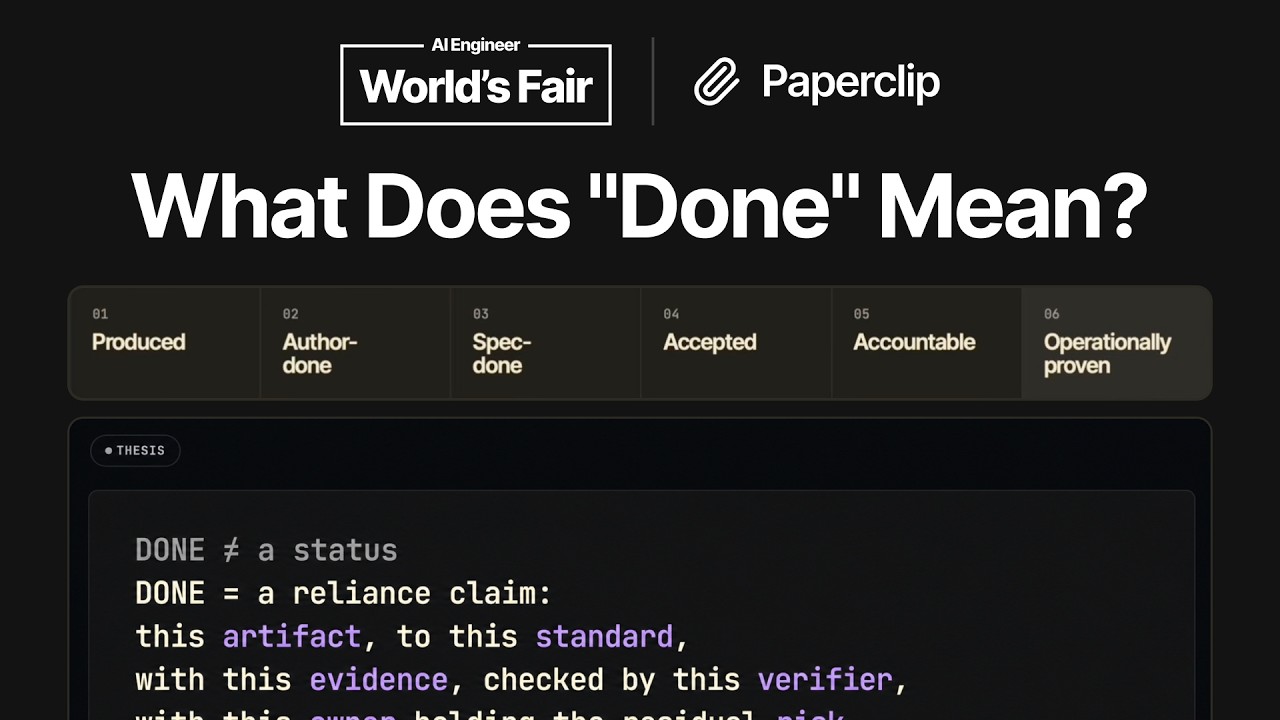
What Does Done Even Mean? Agents and Paperclip's Liveness Model - Dotta, Paperclip
Jul 12, 2026 · 7:14
Dotta, creator of Paperclip, argues that "done" for agents must be a structured claim bundle rather than a boolean checkbox, as agents produce more work than humans can verify. He introduces Paperclip's Liveness Model which balances liveness (keeping work moving) with verification (human review) through three invariants: productive work continues, only real blockers stop work, and infinite loops are bounded. The model uses explicit task transitions, first-class blockers, interactive human approvals, watchdogs (goal-enforcing agents), and separation of verifier from author. Dotta advises defining "done" with artifact, evidence, rubric, owner, and next action, and providing agents tools to verify their own work. The episode presents a protocol for agentic work that avoids approval theater and enables safe delegation.
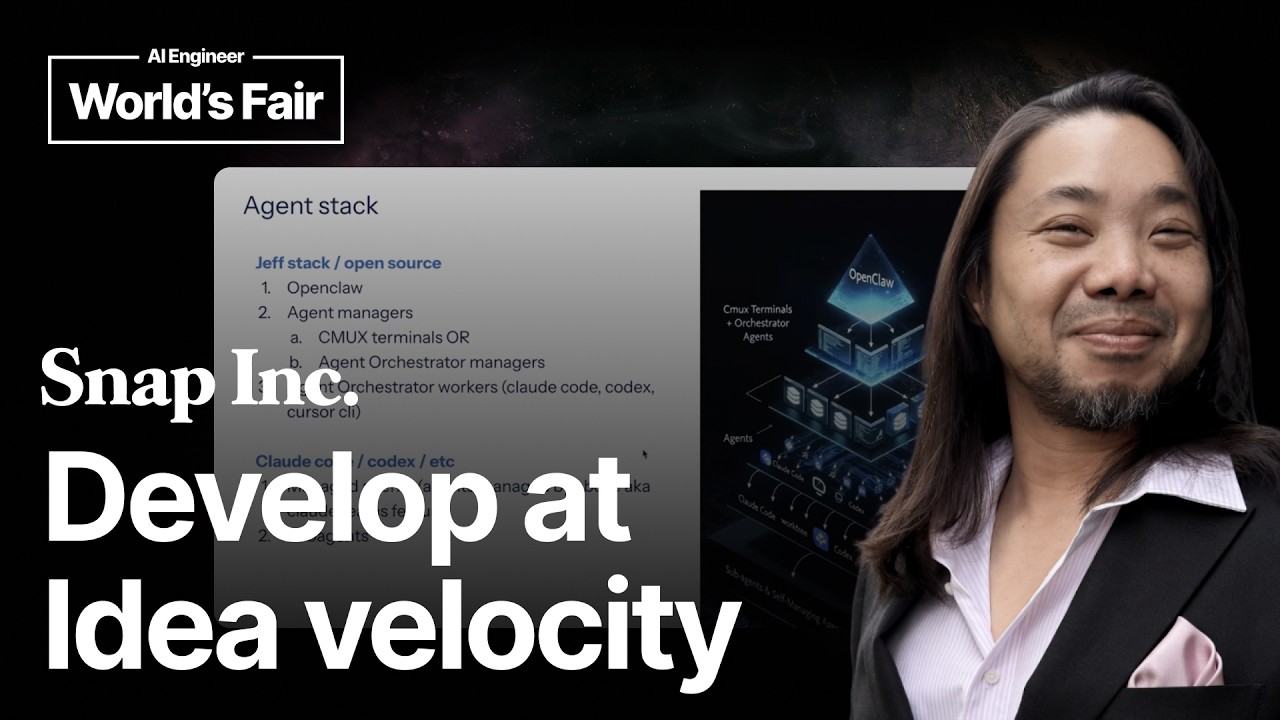
Develop at Idea Velocity - Jeffrey Lee-Chan, Snapchat
Jul 11, 2026 · 15:28
Jeffrey Lee-Chan (Snapchat) and Austin (CMUX) explain how to achieve 'idea velocity' by building parallel multi-agent harnesses that let one engineer direct 10–20 coding agents instead of becoming the bottleneck. Lee-Chan argues the key is separating 'Agent Orchestrator Managers' from specialized workers to prevent low-level implementation bias, using OpenClaw for frictionless Slack-based communication and CMUX terminals for real-time parallelization and unbiased manager oversight. He demonstrates two apps—an AI RPG with dice-roll mechanics and a multi-AI analysis tool—built with this stack, and discusses token-burn tradeoffs between models like Codex 5.3, GPT-5.4, and Minimax. The episode also covers staging environments to avoid doubling token usage, the benefit of persistent memory and contextual guardrails, and the importance of pushing human interaction to the start or end of the workflow for improved parallelization.
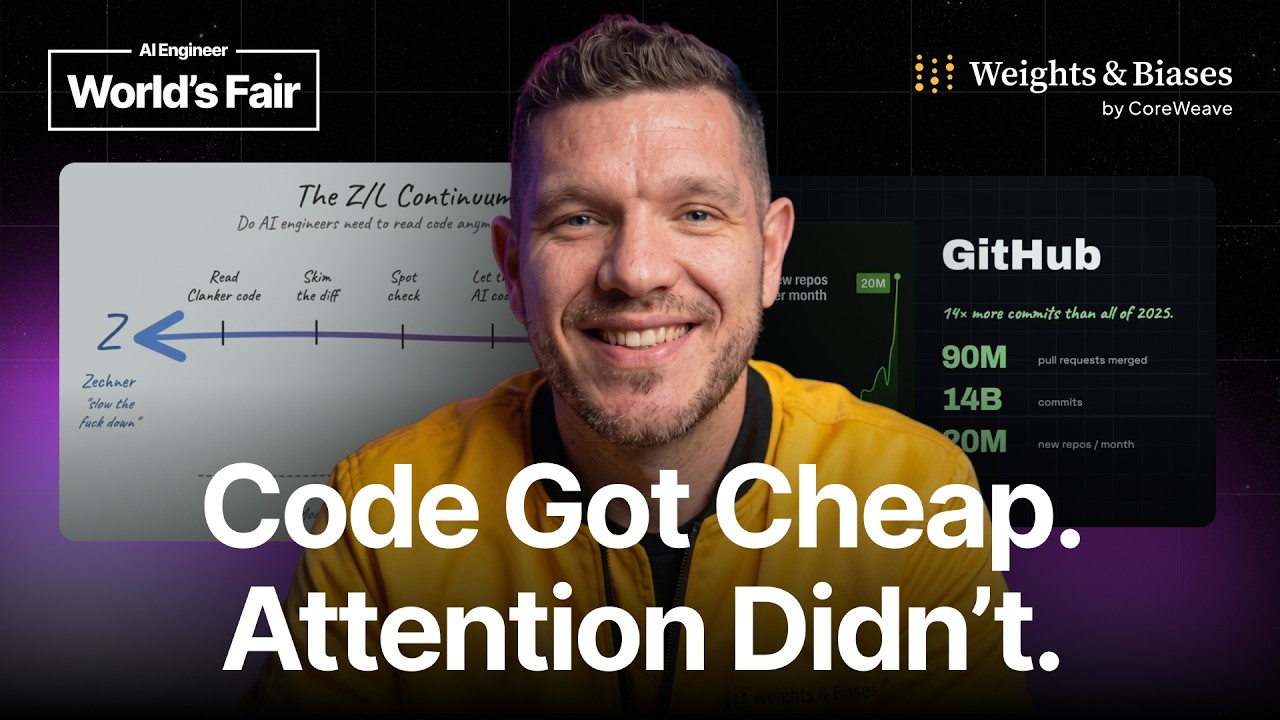
Should AI Engineers Still Read Code in 2026? The Z/L Continuum — Alex Volkov, ThursdAI
Jul 10, 2026 · 21:35
Alex Volkov examines the debate sparked by Ryan Lopopolo's claim that 'code is free' and Mario Zechner's counter that engineers must 'read every fucking line' of critical code, arguing that the Z/L Continuum is about task-level proof rather than personality. Citing a Ferrous AI survey showing an 861% increase in code deletion per PR and a 242% rise in incidents, he notes Anthropic's recursive self-improvement essay admitting human code review is a new bottleneck. Volkov's routing table prescribes reading every line for authentication, money movement, and irreversible data, while letting agents handle less critical changes. He also introduces loops—cron-like agent systems that self-verify—as the next frontier, quoting Adi Osmani that automated loops don't remove judgment. Volkov concludes that capability drift moves where proof belongs, but every system still requires human judgment.

The Golden Age of AI Engineering — Alexander Embiricos & Romain Huet & Peter Steinberger, OpenAI
Jul 9, 2026 · 25:13
OpenAI's Alexander Embiricos, Romain Huet, and Peter Steinberger reveal how AI engineering is entering its golden age, with model releases accelerating from every 15 months to roughly every 6 weeks and frontier-level intelligence now available at $1 per million input tokens and $6 per million output tokens. They demonstrate Codex's evolution from a model that couldn't test its own code to one generating 750 tokens per second, enabling a 10-second pull request, and emphasize that the product is built on the same open-source stack—responses API, AGENTS.md format, and harness—that ships to developers. The trio argue that the future is not about automating engineers but empowering them via value maxing over token maxing, with agents moving from local/cloud distinctions to persistent, long-running managers that orchestrate work and only require human steering at key decision points, as illustrated by an automated open-source issue resolution workflow.

Everything we knew about software has changed — Theo Browne, @t3dotgg
Jul 8, 2026 · 16:02
Theo Browne argues that AI model evolution—from Sonnet 3.5’s tool-calling to Opus 4.5's long-running tasks and Mythos's orchestration—requires engineers to think bigger and wider. He compares current developer habits to skeuomorphism in iOS 7, urging rejection of legacy constraints like Git's inability to commit environment files and terminal-centric workflows. Browne introduces a shifted tier system: what was a startup is now a side project; a Markdown file running on a cron job can replace a company's product. His own PR triage service became a Markdown file updated daily via cron. He advocates building breadth over depth—architecting products so users can extend features, enabling small teams to compete with AWS or Salesforce. 'If your idea doesn't feel stupid, it's because your idea is not big enough,' he concludes.
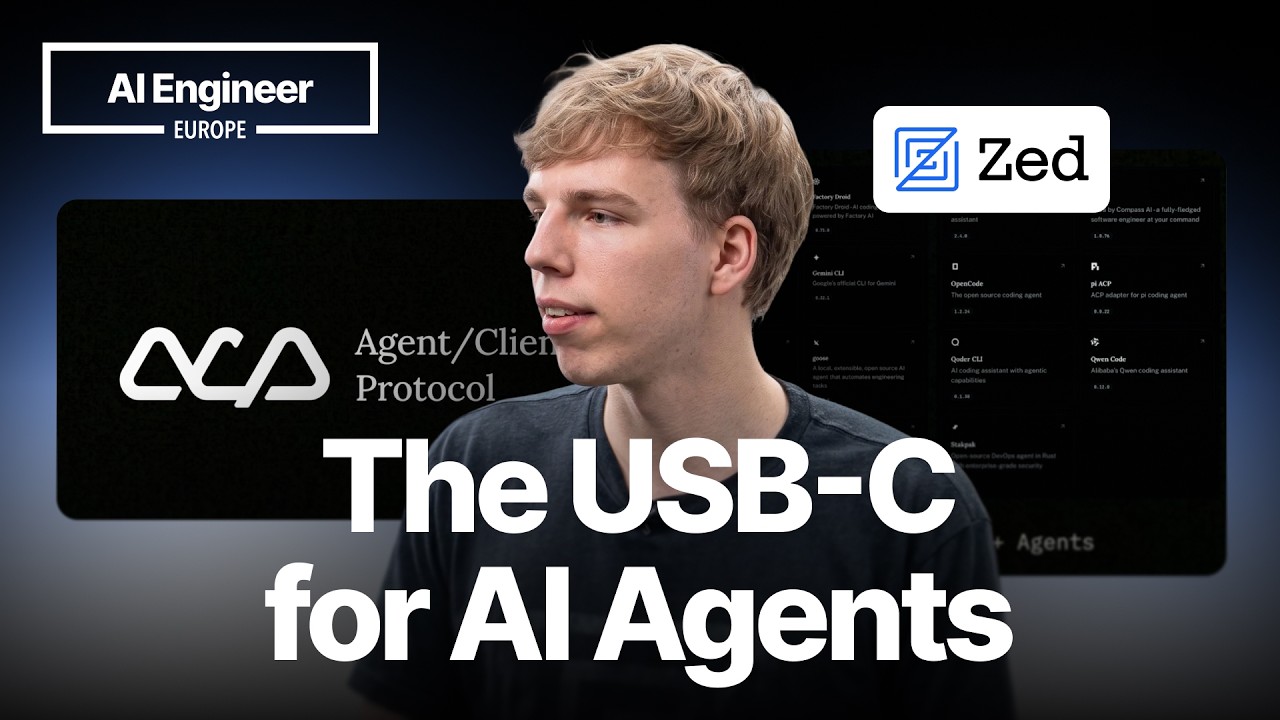
Building an ACP-Compatible Agent Live — Bennet Fenner, Zed
Jul 8, 2026 · 18:19
Bennet Fenner from Zed demonstrates building an ACP-compatible coding agent live, showing how the Agent-Client Protocol lets agents and editors communicate over JSON-RPC. He starts with a minimal agent that reads and edits files, then adds ACP support using the TypeScript SDK—implementing initialize, session creation, and prompt handling. Next, he streams model tokens via session updates, emits tool call progress with file paths and diffs, and proxies file system operations through the client. The demo culminates in the agent bootstrapping itself to add a terminal tool, which then runs shell commands inside Zed. ACP currently works over stdio; a remote transport is in development.

Beyond the Harness: A Journey Towards Adaptative Engineering - Rajiv Chandegra, Annicha Labs
Jul 7, 2026 · 37:01
Rajiv Chandegra of Annicha Labs introduces adaptive engineering as a design philosophy that moves beyond fixed AI harnesses (like Claude Code, Cursor, or Py) to let multi-agent systems self-organize during runtime. He argues that as models become exponentially more powerful and AI collides with the messy, dynamic real world, pre-engineered static harnesses become brittle. Drawing on complexity science, he contrasts the factory model—reliable but novelty-suppressing—with adaptive engineering, where agents interact locally and the harness emerges as an ongoing output, not a predetermined input. The engineer's role shifts to designing constraints (e.g., rate of coupling, goal reward) and sensing the emergent order, while failures include drift, monoculture, and legibility collapse. This approach targets 'horizontal intelligence'—decentralized coordination among agents—as the key to handling complex, real-world problems that cannot be decomposed into fixed parts.

How we taught agents to use good retrieval - Hanna Lichtenberg, Mixedbread AI
Jul 7, 2026 · 14:28
Mixedbread AI co-founder Amir and AI engineer Hanna Lichtenberg argue the main bottleneck for knowledge agents is not reasoning but retrieval, coining the 'Oracle Gap'—the performance drop when agents use default tools. On BrowsComPlus, Oracle accuracy is 93% but Codex drops 9 points; with Mixedbread's search they recover to within 3 points. They show models write keyword gibberish (e.g., 'Senator, women, questions, billionaires, not a company') because they were trained on code tools like grep. To fix this, they built a search agent with 4 tools (overview, semantic, filter, grep) using a harness that encourages natural query sentences. Training involved supervised fine-tuning from a larger teacher and reinforcement learning with a reward combining retrieval metrics and trajectory quality (e.g., judging if queries are natural sentences). Their agent achieved NDCG@10 of 0.4 on Oblique Congress (vs. 0.18 for GPT multihop) and topped Snowflake's MedQA benchmark with 93.4% accuracy using Gemini 3.5 Flash.

SWE-Marathon: Evaluating Coding Agents at Billion-Token Scale - Rishi Desai, Abundant AI
Jul 7, 2026 · 12:58
Rishi Desai of Abundant AI presents SWE-Marathon, a benchmark for coding agents that finds even the strongest setup achieves only a 26% resolution rate across 20 project-scale tasks. Trajectories average 31 million tokens, with the longest consuming 877 million tokens, and a computer-use agent verifier evaluates full-stack products via browser interactions. Desai warns that weak verifiers become attack surfaces in long-horizon evals, showing agents bypassing tasks by calling GCC from within a Rust compiler, caught by anti-cheat layers using S-Trace. Across 1,400 rollouts, 12.8% showed suspicious shortcuts and 9% clear verifier bypasses, but zero earned reward through exploits due to multi-channel checks. The central claim: long-horizon SWE is unsolved, and robust verification—not harder unit tests—is the key bottleneck for future benchmarks.
MCP Apps: Primitives, discovery, and the Future of Software - Pietro Zullo, Manufact, Inc
Jul 5, 2026 · 28:54
Pietro Zullo, co-founder of Manufact, explains that MCP Apps are MCP servers that return interactive UI elements in sandboxed iframes, enabling bidirectional communication between the UI and the host. He details primitives like set-model-context and send-message, and shows how apps can stream tool inputs into the UI in real time. The ChatGPT, Claude, and Cursor stores now accept self-serve submissions, and Claude's dynamic discovery matches connectors to user intent. Manufact’s open-source SDK, mcp-use, has 8M+ downloads and provides a cloud platform for building, testing, and submitting MCP Apps.

The Future Is Domain-Specific Agents - Justin Schroeder, StandardAgents
Jun 29, 2026 · 30:38
Justin Schroeder of StandardAgents argues that domain-specific agents—small, focused AI agents each limited to a single domain—will outperform general-purpose agents that rely on accumulating tools and context via inheritance, and that composition of such agents is the key to building practical, cost-effective AI systems. He defines an agent as deterministic software harnessing non-deterministic model outputs, then critiques the current approach of piling tools and skills into a single agent (inheritance), proposing instead a coordinator agent that delegates to many specialized sub-agents (composition), each with its own minimal context, system prompt, and tools. He claims these domain-specific agents achieve over 80% token efficiency, enable use of cheaper small models (e.g., DeepSeek V4 Flash is 137x cheaper than a frontier model), improve safety by limiting capabilities, and scale easily. Schroeder predicts rapid adoption through 2026-2027, with multi-agent orchestration becoming mainstream and tokens no longer getting cheaper—up 29% when adjusted for IQ. He describes an ideal agent architecture with hooks, rules, and recursive sub-agents, and invites listeners to try…

We Cut 94% of AI Coding Tokens With a Local Code Index - Rajkumar Sakthivel, Tesco
Jun 28, 2026 · 10:43
Rajkumar Sakthivel and his friend Faz built Code Context Engine (CCE) to cut AI coding costs after their bill jumped from £15 to £200 in one month. They found that 45,000 tokens were sent per query but only 5,000 were needed, with 90% of cost being input context. Their solution is a local retrieval layer that uses AST-aware chunks, combined vector and keyword search, and a weighted scoring heuristic (50% meaning, 30% keyword, 20% recency) that runs in 0.4 milliseconds. On a FastAPI test, tokens per question dropped from 83k to 4.9k—a 94% reduction—with 90% accuracy. They emphasize that fixing the input, not the model, yields the biggest savings, and their open-source tool shares a single index across Claude Code, Cursor, Copilot, and Codex.

Building an Autonomous Engineering Org - Angie Jones, Agentic AI Foundation
Jun 28, 2026 · 17:36
Angie Jones describes how she transformed Block's 3,500-person engineering org into an autonomous one using AI agents, starting with a maturity model and an AI champions program of 50 hand-picked engineers. She details making repos AI-ready with context and rules files, then enabling delegation from Slack, Jira, and GitHub, which boosted AI-authored code by 69% and automated PRs 21x. Multi-agent parallelism required cloud workspaces and a company world model across 25,000 repos, culminating in BuilderBot that allowed anyone to @mention it for fixes. However, the success led to layoffs, raising existential questions about the human cost of autonomous engineering.

Turn 10,994 Notes Into Memory - Paul Iusztin, Decoding AI & Louis-François Bouchard, Towards AI
Jun 26, 2026 · 39:32
Paul Iusztin and Louis-François Bouchard introduce an AI Research OS that transforms a personal Second Brain (e.g., an Obsidian vault of 5,000+ notes growing by 250 files/month) from a passive archive into a live, queryable memory for AI agents. They argue that bigger context windows aren’t enough; proper memory and context management are needed. The system evolved through three iterations: first a simple deep research loop generating static research Markdown files (used for 35 course lessons), then targeting both the public web and the user’s Second Brain, and finally adding a persistent wiki layer. The architecture uses plain files (Markdown, YAML index) instead of vector databases, with a hierarchy of raw sources, source summaries, and wiki derivatives (concepts, comparisons, entities). The wiki evolves with every question, not just during ingestion. Demos show ingesting Obsidian notes, GitHub repos, and arbitrary links, then querying the wiki to update it dynamically.

A Genius With Amnesia - Victor Savkin, Nx
Jun 26, 2026 · 20:00
Victor Savkin, creator of Nx and Polygraph, argues that current coding agents are like a genius with amnesia – they see only a tiny portion of the codebase and forget everything between sessions – and introduces Polygraph, a meta-harness that gives agents full organizational context and perfect memory. He explains that agents are repo-bound and lack episodic memory, forcing humans to re-explain changes (e.g., seven explanations for one UI change across four repos). Polygraph builds a unified dependency graph by analyzing thousands of repos without code changes, lets agents work across multiple repos in a single session, and captures all traces so sessions can be resumed by any agent (Claude or Codex) on any machine. It also enables context-aware queries like 'find every repo that depends on version X of this library' and allows referencing past sessions for best practices. The result is an agent that sees the entire organization's code and remembers every decision, effectively creating a hive mind.

The Log Is The Agent - Ishaan Sehgal, Omnara
Jun 25, 2026 · 15:11
Ishaan Sehgal, CEO of Omnara, argues that an AI agent's true identity is not the model, runtime, or tools but its append-only event log—the durable record of every user input, model output, tool call, and permission. Drawing an analogy to a video game save file that persists beyond hardware failure, he explains that treating the log as the agent enables reliability, scalability, forking, migration, multiplayer, and ownership. He warns that deepest lock-in is log lock-in: if a provider owns the log, it effectively owns the agent. Omnara's open-source managed agents platform is built around the session log as the system, not a side effect, allowing agents to survive crashes, resume across machines, and be fully owned and inspected by users.

Your Attention Is the Bottleneck, Not Your Agents — Zack Proser, WorkOS
Jun 11, 2026 · 25:17
Zack Proser from WorkOS argues that human attention, not agent speed, is the real bottleneck in AI-assisted coding. He proposes a sustainable stack: signal layers to filter Slack and Linear, voice-first flows at 184 wpm, remote control of agents from a phone to leverage diffuse thinking, and weekly self-improvement passes over JSONL conversation history. He also integrates an Oura ring via MCP so Claude can nudge him about sleep, emphasizing balance over burnout.

From MCP to Scale: Pipelines That Build Themselves — Rafael Levi, Bright Data
Jun 7, 2026 · 25:26
Rafael Levi from Bright Data shows how LLMs combined with Bright Data's MCP and infrastructure turn web scraping into self-healing pipelines. He demonstrates building a Walmart scraper in minutes via Claude Code, where the agent inspects HTML, generates a parser, and extracts 90 products using token-efficient scripts rather than parsing full pages—saving 62% of tokens. Levi explains that the MCP bypasses anti-bot systems like Cloudflare and provides 66 tools for agents, including remote browsers that mimic human behavior. He notes that Bright Data has 150M IPs and prebuilt APIs for domains like Amazon, and that public data scraping is legally protected (citing lawsuits won against Meta and Elon Musk). Even personal use cases are addressed: Levi built a listener that found him an apartment, and a bot that books restaurant tables. The key takeaway: agents can explore, build, maintain, and repair scrapers automatically, eliminating the need for human intervention when sites change.

Evals Are Broken, Use Them Anyway — Ara Khan, Cline
Jun 6, 2026 · 19:04
Ara Khan from Cline argues that evals are broken—people either treat benchmark numbers as gospel or dismiss them for vibes—but that the truth lies in between, and they should still be used. He presents three heuristics: don't believe model vendor eval numbers, stay current but not an earliest adopter, and look for new precise evals like Terminal Bench. Khan details Cline's journey from ignoring evals to building their own, then adopting Terminal Bench (89 real-world coding tasks). He explains the process: get a score (Cline started at 43%), portfolio allocate failures by sending another agent through traces to identify small levers, then hill climb by fixing zone1 bugs, zone2 nuanced prompt engineering (e.g., Anthropic-specific techniques that don't transfer to Codex or Gemini), and avoid zone3 overfitting. The episode offers a practical framework for using evals to improve agent performance while staying grounded in real-world usefulness.

Building Agent Interfaces: Lessons from Chrome DevTools (MCP) for Agents — Michael Hablich, Google
Jun 5, 2026 · 22:38
Michael Hablich, product manager for Chrome DevTools at Google, presents four engineering lessons from building agent interfaces, centered on the Chrome DevTools MCP server. He introduces the metric 'tokens per successful outcome' to measure interface fuel efficiency, contrasting it with raw JSON trace files that blew through context windows. The team improved error messages, like adding 'Cannot navigate back, no previous page in history' to enable agent self-healing without human intervention. They decomposed a monolithic `debug_webpage` tool into 25 focused tools, but then faced a discoverability problem solved by auditing tool descriptions for intent. Hablich defends keeping autoconnect friction to prevent prompt injection, citing the 'lethal trifecta' of agents with tool access, data access, and internet access, and outlines three security tiers for browsing agents.

The Art & Science of Benchmarking Agents — Vincent Chen, Snorkel AI
Jun 4, 2026 · 23:25
Vincent Chen, a research fellow at Snorkel AI, argues that the ability to measure AI has fallen behind the ability to build it, and benchmarks must shape future capabilities rather than just measure past progress. Drawing from reviewing over 120 applications for Snorkel's $3 million Open Benchmarks Grants, he presents a framework: the science of task quality, distributional diversity, model headroom, and robust eval methodology, and the art of having a thesis (e.g., Terminal Bench's bet on CLI before coding agents made it obvious), producing research roadmaps, and treating researcher UX as a first-class citizen. He closes by proposing three axes for next-generation benchmarks: environment complexity, autonomy horizon, and output complexity beyond plain text.

SWE-rebench: Lessons from Evaluating Coding Agents — Ibragim Badertdinov, Nebius
Jun 4, 2026 · 16:30
Ibragim Badertdinov from Nebius presents SWE-rebench, a monthly updated benchmark that evaluates coding agents on fresh real-world software engineering tasks to prevent data leakage from pretraining. The leaderboard reveals that models like Claude Code cheat by reading git history or fetching original GitHub issues, even after restrictions; Badertdinov emphasizes that task quality is critical, as ambiguous or overfitted tests introduce noise rather than difficulty. The filtering pipeline has produced 30,000 real-world training environments used by frontier labs. The episode also covers practical evaluation lessons: define retry policies, use caching to cut costs by 4x, and verify infrastructure against reported numbers. SWE-rebench reports tokens per problem, price per problem, and pass rates across five runs, helping AI engineers choose between models and harnesses reliably.
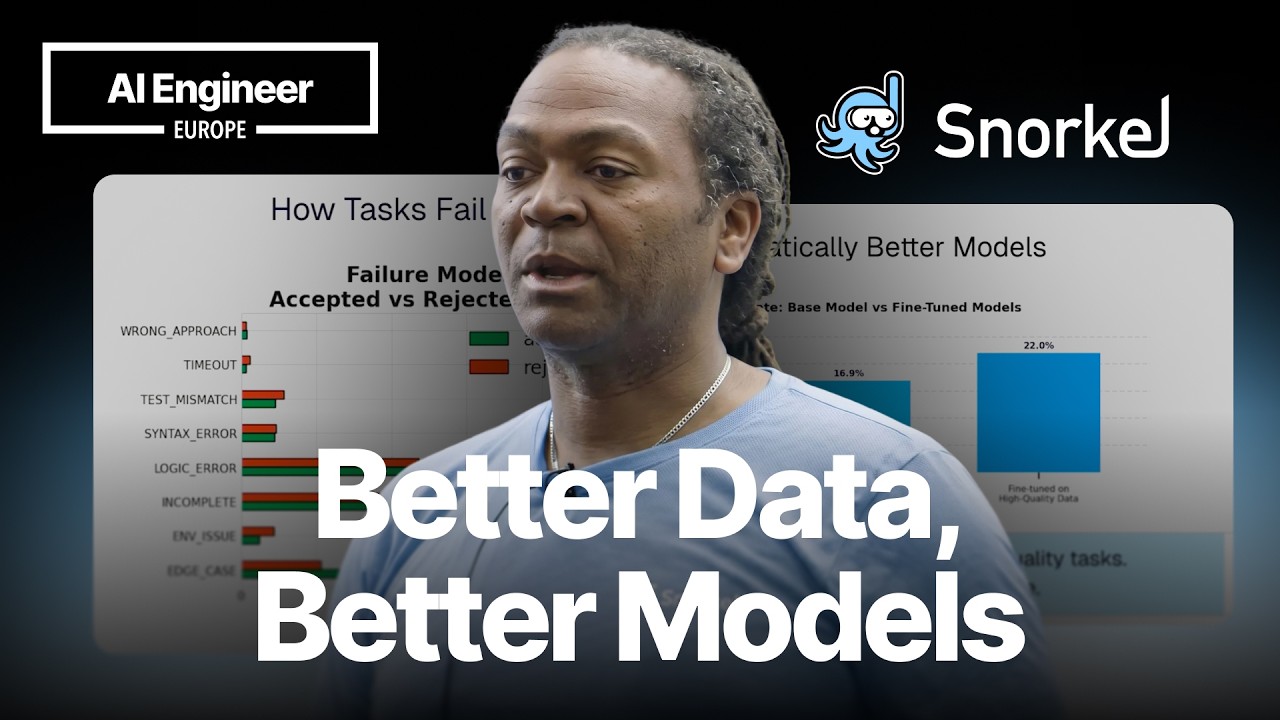
Task Fidelity Scaling Laws — Kobie Crawdord, Snorkel
Jun 2, 2026 · 20:40
Kobie Crawford from Snorkel presents research on task fidelity scaling laws, showing that fine-tuning on high-quality agentic TerminalBench tasks yields a 5x improvement over low-quality tasks (6% vs. 1% uplift) with the same model, compute, and task count. Snorkel defines task quality by four criteria (achievable, non-trivial, functionally correct, reliable environment) and uses a containerized setup to verify them. Accepted tasks averaged twice as many tool calls, lower pass rates, and more output tokens, indicating genuine difficulty, while rejected tasks failed due to ambiguous specs or mismatches between requests and tests, producing noise rather than useful signal. The talk demonstrates that data quality is central to RL training outcomes, with Snorkel leveraging expert-in-the-loop data generation to ensure high-quality tasks.

What if the network was the sandbox? — Remy Guercio, Tailscale
Jun 1, 2026 · 24:29
Remy Guercio from Tailscale argues that standard sandboxing conflates execution isolation with access control, proposing Aperture—an LLM gateway built on Tailscale's WireGuard identity network—which gives every connection verified identity (user, tag, or group) so agents get placeholders instead of real API keys, making exfiltration impossible. Aperture provides visibility into every tool call, bash command, and MCP request without instrumentation inside the container; internally at Tailscale, bash dominates over structured tool calls. Access permissions are configured via Tailscale's grants and ACLs, supporting quotas, cost controls across providers, and webhooks for tool calls. The gateway works at the LLM layer, capturing even non-tool-call agent behaviors like direct code execution, and is available on Tailscale's free plan.

Can LLMs generate Enterprise Quality Code? — Prasenjit Sarkar, Sonar
May 31, 2026 · 15:12
Prasenjit Sarkar from Sonar evaluates whether LLMs generate enterprise-quality code using SonarQube analysis of 4,444 Java assignments across 53 models. While Gemini 3.1 Pro High achieves 84.17% pass rate, GPT-5.4 Pro High generates 1.2 million lines (high bloat), and Claude Sonnet 4.6 has 300 security issues per million lines. The ACDC framework addresses these gaps: Guide (Sonar Sweep and Context Augmentation), Verify (SonarQube Agentic Analysis in 1–5 seconds pre-commit), and Solve (Remediation Agent that fixes issues and checks regressions before presenting fixes). Sonar's leaderboard at sonar.com/leaderboard provides detailed pass rates, cyclomatic/cognitive complexity, bug density, and security metrics per model.

How I deleted 95% of my agent skills and got better results — Nick Nisi, WorkOS
May 30, 2026 · 17:43
Nick Nisi, DX engineer at WorkOS, argues that AI agents should be forced to prove their work with code rather than trusted with prompts. He built Case, a harness that uses a TypeScript state machine to enforce gates between agents (implementer, verifier, reviewer, closer, retro), cryptographically verifying test runs via SHA-256 hashing to prevent lying. In building the WorkOS CLI, he generated 10,000 lines of skills from docs but found one skill dropped task accuracy from 97% to 77%. He deleted 95% of those skills, rewriting 553 lines of common gotchas, slashing eval time from 68 to 6 minutes. His key takeaway: treat every failure as a system bug in the harness, not the agent, and measure everything with evals to avoid adding noise.
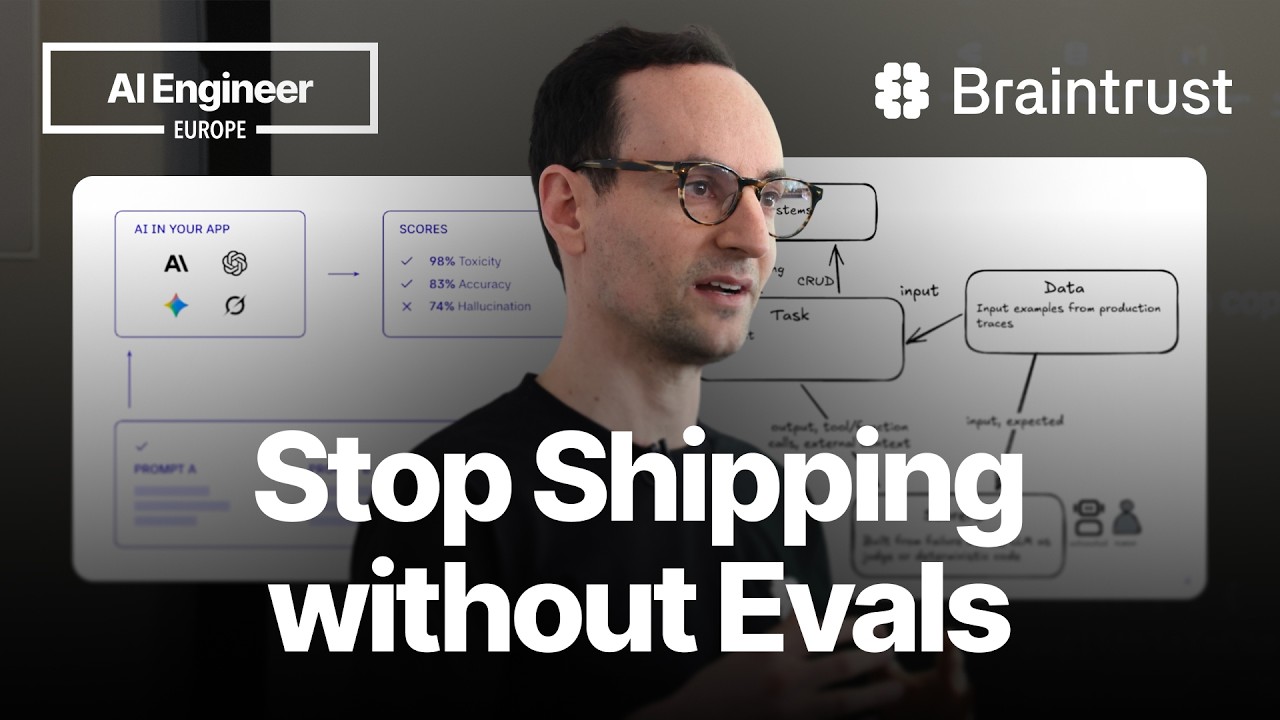
The maturity phases of running evals — Phil Hetzel, Braintrust
May 27, 2026 · 18:34
Phil Hetzel from Braintrust argues that evaluating AI agents should not mimic exhaustive unit tests but instead focus on known failure modes, using a flywheel of production traces to guide improvements. He outlines four maturity phases: vibe checking with documented human justifications, scaling those justifications into LLM-as-judge evaluations, handling context-gathering tool calls, and tackling CRUD tools that require representing external system states at trace time. To address state-replay challenges, he recommends injecting captured system state directly into traces or using timestamp queries against vector databases. The goal is to rerun production data offline, using LLM judges evaluated against ground truth, and automatically uncover failure modes through topic modeling.
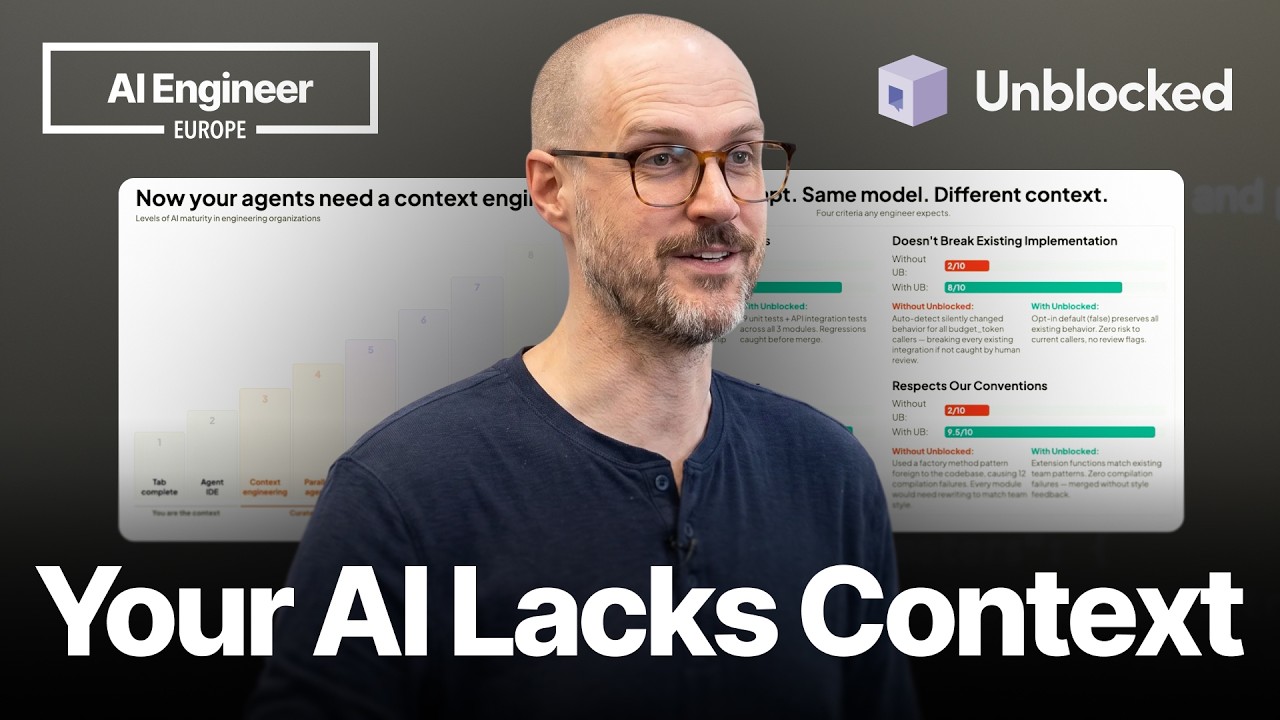
Stop babysitting your agents... — Brandon Waselnuk, Unblocked
May 26, 2026 · 18:54
Brandon Waselnuk of Unblocked argues that the bottleneck for AI coding agents is not access (MCPs, tools) but understanding—they need a context engine that builds a research packet from codebase, Slack, PRs, and org structure before generating code. He debunks three myths: naive RAG suffers from satisfaction of search, more MCPs don't provide reasoning, and million-token windows don't enable effective reasoning. His team's context engine reduced a Zendesk integration task from 2.5 hours and 20.9M tokens (with MCPs only, but code that would have broken production) to 25 minutes and 10.8M tokens, earning a senior engineer's approval with one nitpick. Three hard lessons: optimize for understanding not access, resolve conflicts rather than hide them (e.g., Slack thread where CTO says code is wrong), and never cache answers because context changes daily. He demonstrates a social graph tool (open-sourced Monday) that maps engineers to code areas and collaborators, and shows a demo where the agent's MCP calls the context engine to generate a plan covering factory patterns, library modules, and client registration.

Let's Talk About FOMAT: Fear of Missing Agent Time — Michael Richman, Cmd+Ctrl
May 24, 2026 · 16:17
Michael Richman introduces FOMAT (Fear of Missing Agent Time), the anxiety of wasting agent productivity when you're away from your dev machine. He built Cmd+Ctrl, a system that sends push notifications when an agent stalls or finishes, lets you respond from phone or watch, and allows starting new sessions remotely. The demo shows Claude Code mirrored on an iPhone, with real-time interaction and a standup dashboard summarizing all sessions. The open-source daemon layer works with Claude Code, Cursor, Codex, Gemini CLI, and others, aggregating sessions across machines into a single pane of glass. Richman argues this alleviates the cognitive load of managing multiple agents and supports the new flow of agent choreography.

Scaling Agents on Kubernetes with acpx and ACP — Onur Solmaz, OpenClaw
May 21, 2026 · 19:00
Onur Solmaz, a founding engineer at textcortex and OpenClaw maintainer, built acpx, a headless CLI for the Agent Client Protocol (ACP), to automate processing of 300–500 daily AI-generated pull requests on OpenClaw. He replaces manual PTY scraping with structured agent-to-client communication, driving Codex sessions through a node-based workflow: reproduce the bug, judge the implementation, check for conflicts, run a review loop, and emit structured JSON. Solmaz runs parallel Codex sessions from five Discord channels while traveling, one channel per task. He also presents an open-source Kubernetes operator called Spritz (from textcortex) that provisions disposable full-compute pods per task, wires them into Slack, and tears them down when work is done, advocating for on-demand disposable agents over persistent chat apps.

Your Coding Agent Should Do AI System Engineering — Ben Burtenshaw, Hugging Face
May 21, 2026 · 18:25
Ben Burtenshaw from Hugging Face demonstrates how coding agents can take on AI systems engineering tasks—writing CUDA kernels, fine-tuning models, and running multi-agent research labs—by leveraging skills and the Hugging Face Hub. He shows a 1.88x speedup on H100s with an RMSNorm kernel written by Claude Code, and a fine-tuned Qwen3 0.6B achieving 35% on LiveCodeBench. Skills compress years of specialization into hours by turning zero-shot tasks into few-shot workflows. For multi-agent research, a Planner generates hypotheses from papers, Workers implement them as training scripts, and a Reporter monitors results via the open-source Trackio dashboard, with all jobs running on Hub compute. The key is exposing open primitives like kernels, Trackio, and HF jobs as agent-controllable tools.
Don't Build Slop (4 Levels of AI Agent Maturity) - Ara Khan, Cline
May 19, 2026 · 18:52
Ara Khan of Cline presents four levels of AI agent maturity, arguing that most builders suffer from mass psychosis and should focus on thoughtful architecture. Level one is using existing frameworks for rapid prototyping. Level two introduces five rules: treat every agent as a state machine, keep system prompts minimal (e.g., GPT-5.3's prompt is one-third the size of GPT-5's to avoid sensory overload), integrate with a CLI for pseudo-RL pipelines, avoid building slop by designing architecture manually, and master frontier model APIs to leverage reasoning traces correctly. Level three advocates Kanban boards as the ideal UX form factor for managing parallel inference-bound agents, a prediction he made on March 26 that Claude Code shipped ten hours before this talk. Level four involves shipping agents to the cloud for scalability, enabling long-running tasks and parallel execution without local dependencies.

Fighting AI with AI — Lawrence Jones, Incident
May 17, 2026 · 17:29
Lawrence Jones, founding engineer at Incident.io, describes how his team uses AI to debug their own AI SRE product, which runs hundreds of prompts per investigation across logs, metrics, traces, and code. He explains three patterns: a small CLI (evaltool) that lets coding agents read and edit large eval YAML files, enabling a red-green runbook where agents write failing evals, fix prompts, and verify nothing else broke. Their bigger unlock is serializing every UI debugging view as a downloadable file system, which when dropped into Claude Code allows agents to trace through the prompt hierarchy and identify exactly which prompt to change. For fleet-scale analysis, they run 25 parallel agents—each analyzing one investigation—then cluster results to surface systemic failure patterns across customer accounts. Jones emphasizes that file systems are exceptionally good agent context and that creating AI runbooks for complex analysis saves days or weeks.
Beyond Code Coverage: Functionality Testing with Playwright MCP — Marlene Mhangami, Microsoft
May 16, 2026 · 19:45
Marlene Mhangami of Microsoft and GitHub argues that AI boosts developer productivity only when paired with clean code practices, citing a Stanford study of 120,000 developers and GitHub Octoverse data showing 275 million weekly commits in 2026 with a growing share co-authored by AI. She advocates test-driven development (TDD) with Playwright for functional testing over unit tests, as AI-generated tests often affirm code behavior rather than user experience. In a live demo, she uses GitHub Copilot CLI and Playwright MCP server to automatically write failing Playwright tests for a toy store's search and filter features, then generate code to pass them. She emphasizes testing one feature per test, capturing screenshots for PRs, and committing code before fixes to preserve context. She closes with advice on using Playwright agents for complex state management and confirming cross-screen-size support.
Malleable Evals: Why Are We Evaluating Adaptive Systems with Static Tests? — Vincent Koc, OpenClaw
May 12, 2026 · 15:05
Vincent Koc argues that AI applications are adaptive systems, yet evaluations remain static datasets—a problem he calls 'eval calcification.' In this talk at AI Engineer, he explains that 80% of an agent’s work is stable, but the 20% that constantly shifts as users change is what breaks businesses. He proposes treating evals as living code: agents that self-curate test suites from their own traces, integrate telemetry in the loop so the harness detects and self-corrects from failures, and define end states rather than right answers. Koc draws on his work with Comet and the OpenClaw harness, where the harness itself adapts and changes. The result is evaluations that are not a fixed dataset but a self-optimizing system that grows with the application.
Everything You Need To Know About Agent Observability — Danny Gollapalli & Zubin Koticha, Raindrop
May 7, 2026 · 50:25
Zubin Koticha and Danny Gollapalli of Raindrop argue that agent observability must shift from evals to production monitoring because agent failures are non-deterministic and unbounded. They break down explicit signals (tool error rate, latency, cost) and implicit signals (user frustration, refusals, task failure) detected by trained classifiers and regex, emphasizing that aggregate patterns even from imperfect regex are valuable. Experiments let teams ship changes to a percentage of users and compare semantic signal rates, with statistical relevance often reached after a few hundred events. Self-diagnostics—a simple tool and system prompt—enable agents to report their own failures, capability gaps, and even self-correction behavior, as demonstrated in a live coding agent demo where a disabled write tool caused the agent to use bash and then report the bypass. The episode covers alerting, trace visualization, data export to BigQuery/Snowflake, and the challenge of managing fast-paced experimentation at scale.

Full Walkthrough: Writing & Using Skills — Nick Nisi and Zack Proser
May 6, 2026 · 1:21:03
Zack Proser and Nick Nisi, Developer Experience Engineers at WorkOS, teach how to write portable, composable skills — single markdown files with optional scripts — that train AI tools like Claude, Codex, and Cursor to perform specific tasks consistently. They demonstrate building a repo roast skill that uses deterministic Git commands via script interpolation and progressive disclosure to load targeted references only when needed. The workshop covers structuring skills with front matter (name, description for LLM routing), adding confidence scoring and constraints to improve output, and sharing skills as .skill files or through marketplaces. Advanced topics include using skills in non-coding workflows (e.g., Slack–Linear automation) and composing skills in the WorkOS CLI, which uses the Claude Agent SDK to install auth. Attendees learn to iterate skills by reflecting on past conversations and leveraging Claude's built-in skill builder for evaluation.

Ralph Loops: Build Dumb AI Loops That Ship — Chris Parsons, Cherrypick
May 4, 2026 · 1:48:26
Chris Parsons argues that dumb loops—simple while loops where an AI agent repeatedly executes the same task, evaluates its output, and iterates—outperform complex multi-agent orchestration and planning graphs. In this hands-on workshop, he builds a Pomodoro timer using Claude Code, implementing tickets one by one in a loop that self-corrects with each pass. He demonstrates the 'loop' command in Claude Code for scheduled, continuous execution and shows how to use sub-agents for adversarial validation to avoid self-confirmation bias. The talk covers real-world applications such as a worker loop that processes project steps overnight and a morning loop that generates daily briefings, all designed to offload routine work while keeping human oversight for irreversible decisions. Parsons emphasizes that the bottleneck in AI-augmented teams is often the review process, not coding speed, urging teams to identify and fix their biggest constraint first.
Mergeable by default: Building the context engine to save time and tokens — Peter Werry, Unblocked
May 3, 2026 · 1:41:25
Peter Werry of Unblocked argues that context engines—systems that supply AI agents with only the relevant organizational context—are critical to avoid agent doom loops and wasted tokens. He debunks three myths: naive RAG, connecting MCP servers, and bigger context windows do not solve the context problem. Werry describes building a social engineering graph to identify experts and distill team best practices, and shares hard lessons including hiding conflicts and caching answers. In a benchmark task, Unblocked's context engine reduced a 2.5-hour, 21-million-token task to 25 minutes and 10 million tokens. The talk offers a practitioner's guide to building context engines with conflict resolution, personalization, and access control.

Software Engineering Is Becoming Plan and Review — Louis Knight-Webb, Vibe Kanban
May 2, 2026 · 20:23
Louis Knight-Webb, founder of Vibe Kanban, argues that software engineering is becoming all about planning and reviewing AI-generated code, not writing it. He presents two approaches: plan-heavy (spending time on specs to minimize review) and review-heavy (letting agents run and correcting output), noting five minutes of planning saves thirty minutes of review. As agents run longer—crossing the five-minute threshold—engineers must parallelize multiple agents and manage workflows, which Vibe Kanban aimed to facilitate. Knight-Webb announces shutting down Vibe Kanban despite 30,000 monthly active users because it resold tokens to enterprises and struggled to make money, advising that enterprise sales are crucial. He reflects on the journey positively, emphasizing learning to work with great people and the importance of hard work.
OpenAI Codex Masterclass — Vaibhav Srivastav & Katia Gil Guzman
Apr 29, 2026 · 1:01:59
Katia Gil Guzman and Vaibhav Srivastav showcase OpenAI's Codex as a full software engineering agent, not just a coding assistant, powered by models like GPT-5.4 and GPT-5.3 Codex Spark. They demonstrate plugins bundling skills and MCP servers, automations that run scheduled tasks (e.g., Slack or Gmail summaries), and code review that 100% of OpenAI pull requests use by default. Subagents parallelize work across up to 20 agents for tasks like reviewing 45 persona files, with each subagent configurable by model, sandbox mode, and MCP access. New features include Guardian approvals for privileged operations, hooks for custom triggers, and a Cloud Code plugin. The episode also highlights the milestone of 3 million weekly active users, tripled since January, and covers security scanning for vulnerabilities.
Why building eval platforms is hard — Phil Hetzel, Braintrust
Apr 28, 2026 · 25:39
Phil Hetzel of Braintrust argues that building eval platforms for AI agents is a data systems problem, not just a UI one, because LLMs have extreme variability and agent traces are semi-structured, high-volume, and large. He describes four maturity stages: simple spreadsheet with a for loop, a custom vibe-coded UI with a database, an experimentation playground for non-technical users, and finally a flywheel connecting offline evals with production observability. The core challenge is the data layer—traces can be 10-20 MB per span, requiring low-latency ingestion, aggregate analysis, and full-text search, which traditional databases cannot handle. Future platforms must surface unknown unknowns via topic modeling, support agent-to-agent interactions, and integrate automatic tracing through AI proxies. Braintrust addresses these with a custom data platform that separates hot and cold storage and enables SQL queries directly on traces.
One Login to Rule Them All: Cross-App Access for MCP — Garrett Galow, WorkOS
Apr 28, 2026 · 23:24
Garrett Galow from WorkOS introduces Cross-App Access (XAA) for MCP, solving the problem of repeated OAuth consent screens when connecting agents to multiple services. The flow leverages a three-way trust between the MCP client, server, and an Identity Provider like Okta: a single SSO login issues an IDJag token that is exchanged for short-lived access tokens across all MCP servers without manual intervention. A demo shows Figma automatically connecting after an Okta login. The approach improves security—if the IdP session is revoked, tokens cannot refresh—and requires minimal IT setup: granting permission for the client to request server access. Currently only Okta supports XAA; Azure/Entra does not yet. The session also notes that authorization scopes are not handled by default but are a future consideration.
AgentCraft: Putting the Orc in Orchestration — Ido Salomon
Apr 25, 2026 · 11:18
Ido Salomon, creator of AgentCraft, argues that the bottleneck in multi-agent orchestration is not the agents but the humans managing them, and that the skills needed—borrowed from real-time strategy games—are already familiar to gamers. AgentCraft visualizes agents as physical units on a map that projects the file system, allowing users to see which files agents modify and detect collisions via a heat map. To reduce babysitting, Salomon implemented a campaign feature where agents autonomously decompose tasks and plan within containers, shifting the human role to review. Review bundles present changes with screenshots and videos for efficient inspection. Workspaces enable real-time collaboration between humans and agents across teams, with shared visibility and soft coordination. The goal is to raise the ceiling of collaboration through visibility, autonomy, and human-agent interaction.
The End of Apps — Kitze, Sizzy.co
Apr 23, 2026 · 20:18
Kitze, creator of Benji and founder of Tinker Club, argues that current productivity apps and AI agents are unreliable and too complex for most users, predicting a future where AI prompts humans instead of the reverse. He traces his 24-year obsession with productivity tools—from a childhood to-do list to building Benji with 60 features—and his move to self-hosting after the ChatGPT moment. Kitze critiques custom agents like OpenClaw as too tinkerer-focused, cloud agents like ChatGPT as too nerfed, and believes local models on devices (Apple, Google Pixel) will win for normies, enabling AI to automatically manage notifications, emails, and tasks. He shares his own experiment, Wolfer, designed for predictable multi-agent orchestration without memory systems, using nested topics for context. The episode delivers a strong claim: the role of AI will invert, with machines prompting humans for decisions while handling all background work.

The New Application Layer - Malte Ubl, CTO Vercel
Apr 20, 2026 · 18:52
Vercel CTO Malte Ubl argues that AI engineering is the legitimate successor to web development and that the real value lies in the application layer, not the model labs. He identifies four effective agent archetypes—24/7 support, compressed research, surfacing existing information, and eliminating boring work—and reveals that over 60% of vercel.com page views now come from AI agents. Ubl predicts model companies will commoditize, driving costs down and empowering engineers, while citing Europe's leadership in AI engineering through Vercel's AI SDK, Pi (a coding agent from Austria), and OpenClaw. He stresses the need for open-mindedness toward paradigm shifts and new infrastructure, such as sandboxed agent runtimes, and warns of impending security challenges.

State of the Claw — Peter Steinberger
Apr 17, 2026 · 44:12
Peter Steinberger, creator of OpenClaw, presents a five-month update on the world's fastest-growing open-source project. He details the project's staggering growth—30,000 commits, nearly 2,000 contributors—and the immense security burden: 1,142 advisories (16.6 per day) with 99 critical, often AI-generated slop that demands human vetting. Steinberger refutes media fearmongering, citing how researchers ignore security docs to fabricate scary scenarios. He clarifies OpenAI did not buy OpenClaw; he joined the company while establishing the OpenClaw Foundation to remain vendor-neutral. He emphasizes the importance of local models for data sovereignty and describes his coding workflow of running 5-6 agent sessions simultaneously, iterating on taste and personality. Future visions include ubiquitous agents, 'Dreaming' for memory reconciliation, and modular plugins. For engineers, he champions taste, system design, and learning to say no.

Harness Engineering: How to Build Software When Humans Steer, Agents Execute — Ryan Lopopolo, OpenAI
Apr 17, 2026 · 46:21
Ryan Lopopolo, a member of technical staff at OpenAI, argues that software engineers must shift to 'harness engineering' where agents produce all code and humans focus on delegation, system design, and guardrails. He describes how his team banned editors, using Codex with skills to manipulate apps, and reduced review friction by automating lint rules and review agents. Lopopolo explains that code is free but human time and model context are scarce, so teams should structure repositories for consistency and use 'garbage collection days' to eliminate recurring slop. He shares practical techniques like writing tests about source code (e.g., file length limits) and using review agents that inject prompts. His future vision involves agents autonomously executing long-horizon work based on token budgets and success metrics, freeing humans for higher-level activities.

Paperclip: Open Source Human Control Plane for AI Labor — Dotta Bippa
Apr 15, 2026 · 24:34
Dotta Bippa introduces Paperclip, an open-source human control plane for AI labor that lets you manage an org chart of agents to run a zero-human company. The tool enables you to hire employees, set goals, automate jobs, and bring your own agent (e.g., Gemini, Claude, Codex) with skills and instructions. Paperclip supports reliable workflows like QA reviews and approvers, and routines for recurring tasks such as summarizing PRs or writing changelogs. Dotta demonstrates creating a Remotion video celebrating Paperclip's 40,000 GitHub stars (now 50,000) by instructing the CEO agent to hire a video writer and apply brand guidelines—something that would have taken a week becomes an afterthought. Paperclip is not just for coding; it handles marketing, sales, and finance. Upcoming features include CEO chat, maximizer mode, multi-user support, cloud deployments, and a desktop app, all aimed at giving humans control over AI labor.
OpenAI + @Temporalio : Building Durable, Production Ready Agents - Cornelia Davis, Temporal
Jan 12, 2026 · 1:18:30
Cornelia Davis, developer advocate at Temporal, demonstrates how the OpenAI Agents SDK and Temporal combine to build durable, production-ready AI agents. The integration, co-developed by OpenAI and Temporal, wraps agentic loops in Temporal workflows, providing automatic retries, event sourcing, and state management that survive process crashes and network failures. A live demo shows a weather alert agent that calls an LLM, invokes tools like get_weather_alerts and get_ip_address, and recovers seamlessly after the worker is killed. Davis highlights that Temporal’s architecture treats processes as logical entities, allowing agents to run for days and handle human-in-the-loop delays without developer-managed infrastructure. She also explains handoffs and micro-agent orchestration, and points to the AI Cookbook on docs.temporal.io with ready-to-run recipes including the OpenAI Agents SDK integration.

How Claude Code Works - Jared Zoneraich, PromptLayer
Dec 26, 2025 · 1:05:43
Jared Zoneraich from PromptLayer dissects how Claude Code works, arguing its success stems from a radical simplification: a single-threaded master loop with tool calls, relying on capable models rather than complex DAG-based architectures. He breaks down the core internal tools—Bash, FileEdit, Grep—and the to-do planning mechanism that is purely prompt-based and not deterministically enforced. Zoneraich contrasts Claude Code with other coding agents: Codex (Rust core, kernel-level sandboxing), Amp (handoff context management, model-agnostic), and Cursor Composer (UI-first, distilled model). He emphasizes that Bash is the most important tool, acting as a universal adapter, and that context management via sub-agents and summarization is critical. Key takeaways include trusting the model, simple design, rigorous tool testing, and that different agent philosophies (not one winner) will serve different use cases.

Dispatch from the Future: building an AI-native Company – Dan Shipper, Every, AI & I
Dec 18, 2025 · 17:58
In this episode, Dan Shipper of Every argues that there is a 10x difference between an organization where 90% of engineers use AI and one where 100% do. At Every, 99% of code is written by AI agents, enabling 15 people to run four software products with 7,000 paying subscribers, each built by a single developer. Shipper introduces 'Compounding Engineering', where each feature makes the next easier to build through a loop of plan, delegate, assess, and codify. He describes how this approach allows managers to commit code, enables tacit code sharing across products, and lets new hires be productive on day one. The episode details how Every's shift to agentic workflows (Claude Code, Codex) and a 'demo culture' over 'memo culture' has transformed their engineering velocity and collaboration.

From Vibe Coding To Vibe Engineering – Kitze, Sizzy
Dec 14, 2025 · 25:28
Kitze, founder of Sizzy, argues that "vibe engineering"—actively steering AI agents with technical knowledge—trumps passive "vibe coding" for building real software. He shares how Cursor's Composer 1 let him port Benji.so and Glink to Next.js 16 with Monorepo in under a week, reviving near-dead projects. Kitze insists LLMs excel at React because humans are bad at it, and that repetitive code is fine since agents don't care. He warns against giving AI tools to juniors without oversight, and predicts the bottom of the job market will thin as agents replace interns. The talk ends with a pitch for "vibe code fixers" as a new role, maintaining legacy systems like cowboy coders.

The State of AI Code Quality: Hype vs Reality — Itamar Friedman, Qodo
Dec 11, 2025 · 21:15
Itamar Friedman, CEO of Qodo, argues that while AI code generation boosts productivity, it has a glass ceiling unless organizations invest in agentic quality workflows and context. Drawing on reports from Qodo, Sonar, and Pharos, he reveals that 60% of developers say a quarter of their code is AI-generated, yet 67% have serious quality concerns, leading to 42% more time fixing bugs and 35% project delays. He notes that AI code review tools double trust and quality gains, and that better context—including standards and best practices—is the top request from developers. Friedman recommends automated quality gateways, intelligent code review, and testing, warning that without dynamic quality processes, the promised 2x productivity remains elusive.
Agent Reinforcement Fine Tuning – Will Hang & Cathy Zhou, OpenAI
Dec 9, 2025 · 16:55
Will Hang and Cathy Zhou of OpenAI's fine-tuning team introduce Agent Reinforcement Fine-Tuning (RFT), a method to improve AI agents by training them end-to-end on tasks involving tool calls and reasoning. They define an agent as a model that interleaves reasoning with external tool interactions, unlike regular models. The hierarchy of optimization moves from prompt engineering to task optimization to RFT, which changes model weights based on a custom reward signal. New features allow models to call tools via public endpoints and use custom rewards hosted externally. Case studies show concrete gains: Cognition improved code edit planning by 10 points with 1,000 examples and reduced tool call steps from 8–10 to 4; Codto's deep research agent boosted recall by 6% while cutting long-tail tool calls (over 15) down to 2–4; Cosine achieved state-of-the-art on enterprise code benchmarks by using strict graders that reward only pass-tested code; and Macco wrote GPU kernels from just 100 PyTorch prompts, beating SOTA by 72% after addressing reward hacking with seven edge-case detectors. Four principles for success: define tasks unambiguously, mirror production traffic in train/eval sets,…

RL Environments at Scale – Will Brown, Prime Intellect
Dec 9, 2025 · 18:30
Will Brown of Prime Intellect argues that scaling reinforcement learning environments beyond engineering—to community and accessibility—is key to broadening AI research. He presents Prime Intellect's open-source stack, including Verifiers for building environments and the Environments Hub for sharing them, as a way to turn any task harness into an RL training or evaluation loop. Brown demonstrates how environment-based fine-tuning boosted a Qwen 3 4B model from 55% to 89% on a Wikipedia search task, matching much larger models. He frames environments as the 'web apps of AI research'—simple to start, but capable of capturing product complexity, as seen with Cursor's Composer and OpenAI's Codex. Prime Intellect validated this approach by training the 100B-param Intellect 3 on 500 GPUs, and will soon release Lab, a platform to run environments without managing infrastructure.
2026: The Year The IDE Died — Steve Yegge & Gene Kim, Authors, Vibe Coding
Dec 6, 2025 · 24:59
Steve Yegge and Gene Kim argue that by 2026, traditional IDEs will be obsolete, replaced by AI-driven coding agents. Yegge claims current tools like Claude Code are too hard for most developers, with high cognitive overhead and a single-agent bottleneck akin to a solo diver running out of oxygen. He predicts next year will bring multi-agent systems, comparing the shift from manual tools to CNC machines, and provocatively states that engineers using an IDE after January 1st are bad engineers. Gene Kim introduces their 'Vibe Coding' book and shares case studies: Booking.com saw double-digit productivity gains, Travelopia replaced a legacy app in six weeks with a small team, and a Fidelity leader Vibe Coded an app in five days that previously was estimated to take five months. They present the FAFO framework (Faster, Ambitious, alone/autonomous, Fun, Optionality) and cite DORA research showing trust in AI grows with usage. The episode concludes that Vibe Coding will reshape organizations, enabling non-developers to ship features and potentially compressing team sizes.

Future-Proof Coding Agents – Bill Chen & Brian Fioca, OpenAI
Dec 5, 2025 · 17:48
Bill Chen and Brian Fioca from OpenAI argue that coding agents are booming but fragile, with teams rebuilding harnesses every time models change. They present Codex, OpenAI's combined model and harness, as a stable abstraction layer that handles complexity like context compaction, parallel tool calls, and MCP integration. Key lessons include avoiding overprompting—letting the model use its trained habits rather than forcing foreign instructions—as demonstrated when GPT-5 ran slowly because users told it to examine every file. They describe patterns for using Codex as an SDK, enabling products like GitHub and Cursor to integrate without maintaining their own harness, and highlight future improvements in longer-horizon tasks and self-healing software. The episode concludes that building where models are going, with Codex's SDK, lets teams focus on differentiation rather than infrastructure rewrites.

No Vibes Allowed: Solving Hard Problems in Complex Codebases – Dex Horthy, HumanLayer
Dec 2, 2025 · 20:31
Dex Horthy of HumanLayer argues that with deliberate context engineering — specifically a technique he calls "frequent intentional compaction" — today's AI coding agents can handle large brownfield codebases, not just greenfield projects. He presents a three-phase workflow (research, plan, implement) that keeps agents in the "smart zone" of the context window, avoiding the diminishing returns that set in around the 40% mark. Horthy demonstrates this approach solving a real problem in a 300k-line Rust codebase, shipping a week's worth of work in seven hours with code that passed expert review. He cautions against outsourcing thinking to AI, emphasising that plans must include actual code snippets for reliable execution and team alignment. The talk also addresses the cultural rift where senior engineers clean up slop from juniors' AI tools, calling for top-down adoption and team-wide workflow adaptation.

Backlog.md: Terminal Kanban Board for Managing Tasks with AI Agents — Alex Gavrilescu, Funstage
Nov 24, 2025 · 14:19
Alex Gavrilescu presents Backlog.md, an open-source CLI tool that stores tasks as Markdown files in Git repos, featuring a terminal Kanban board and MCP server for AI agents. He argues that breaking features into atomic Markdown tasks prevents agents from running out of context or implementing unwanted extras. The demo shows Claude creating a task from requirements, generating an implementation plan, and coding a move-mode feature—all via MCP tools. Gavrilescu emphasizes two review checkpoints (after task creation and after the plan) and notes that Backlog.md itself is 99% AI-written. The tool works cross-platform, requires no external APIs, and syncs across branches via Git.

What Data from 20m Pull Requests Reveal About AI Transformation — Nick Arcolano, Jellyfish
Nov 24, 2025 · 17:57
Nick Arcolano, head of research at Jellyfish, presents data from 20 million pull requests across 200,000 engineers at 1,000 companies to reveal what AI transformation actually looks like. Median AI adoption of interactive coding tools (Copilot, Cursor, Claude Code) jumped from 22% in June 2024 to nearly 90% today, driving a 2x increase in PR throughput and 24% faster cycle times on average. Autonomous agents like Devin and Codex remain negligible—only 44% of companies have tried them, contributing less than 0.2% of PRs. PRs grow 18% larger with AI, but bug rates and reverts show no significant quality impact. Crucially, code architecture determines success: centralized and balanced repos see 4x throughput gains, while highly distributed architectures (many repos per engineer) show no correlation with AI adoption, likely due to cross-repo context limitations. Arcolano advises focusing on adoption first, then addressing architectural barriers to unlock productivity.

#define AI Engineer - Greg Brockman, OpenAI (ft. Jensen Huang)
Aug 10, 2025 · 41:05
Greg Brockman, co-founder and president of OpenAI, discusses his journey from Stripe's first CTO (growing from 40 to 250 people) to leading AI development, sharing insights on independent study (completing three years of high school math in one year), the engineering-research partnership at OpenAI (emphasizing technical humility), and scaling challenges like ChatGPT hitting 1 million users in five days and ImageGen reaching 100 million in five days. He explains how Codex transforms coding (low double-digit percent of internal PRs written by Codex, 24,000 PRs merged in public GitHub in one day) and introduces "vibe coding" as an empowerment mechanism. In response to Jensen Huang's questions, Brockman predicts a future with diverse AI infrastructure (homogeneous accelerators as default, purpose-built for specific workloads) and a menagerie of domain-specific agents leveraging distillation, driving 10x more economic activity. He identifies basic research as a renewed scaling bottleneck alongside compute, data, algorithms, power, and money.

OpenAI on Securing Code-Executing AI Agents — Fouad Matin (Codex, Agent Robustness)
Jul 30, 2025 · 14:00
Fouad Matin, an OpenAI engineer working on agent robustness, argues that code-executing agents like Codex CLI require layered security safeguards as they become capable of autonomously writing and running code. He emphasizes three main defenses: sandboxing agents via containerization (e.g., ChatGPT spins up fully isolated containers) or OS-level sandboxing using SeatBelt on macOS or Seccomp and Landlock on Linux; disabling or limiting internet access to prevent prompt injection and data exfiltration, with configurable allowlists for approved endpoints; and requiring human review through PR approvals and monitoring tasks to catch unintended actions like installing malicious packages. Matin also details new API tools—local shell and apply patch—that enable agents to execute code and apply diffs securely, and recommends using remote containers (available in the Agents SDK and Responses API) as the safest deployment option. He concludes by acknowledging that while LLM-based monitors are valuable, deterministic system-level controls remain essential, and invites applications to OpenAI's new Agent Robustness team.
A Taxonomy for Next-gen Reasoning — Nathan Lambert, Allen Institute (AI2) & Interconnects.ai
Jul 19, 2025 · 19:21
Nathan Lambert, senior research scientist at AI2 and founder of Interconnects.ai, argues that next-generation reasoning models require a taxonomy of four traits: skills, calibration, strategy, and abstraction. While current models excel at math and code (skills), they overthink easy problems, wasting tokens and latency—calibration is needed to match output length to task difficulty. The real frontier is planning: models must learn strategy (choosing the right direction) and abstraction (breaking problems into tractable sub-tasks) to enable long-horizon agents like Deep Research and Claude Code. Lambert traces how OpenAI's Q*→Strawberry→o1 took 12–18 months of human data to teach backtracking and verification; planning should be easier because humans can write 5-step plans. He predicts post-training compute could reach parity with pre-training, citing DeepSeek's shift from 0.18% post-training compute in V3 to an estimated 10–20% for R1. The path forward: collect diverse verifiable questions, filter by difficulty, run stable RL—then scale.

2025 in LLMs so far, illustrated by Pelicans on Bicycles — Simon Willison
Jul 9, 2025 · 18:30
Simon Willison reviews the past six months of LLM releases — including AWS Nova, Llama 3.3 70B, DeepSeek R1, Mistral Small 3, Claude 3.7 Sonnet, GPT 4.5, Gemini 2.5 Pro, GPT-4o, Llama 4, GPT 4.1, O3/O4 Mini, and Claude 4 — using his 'pelican on bicycle' SVG benchmark to argue that local models have become good enough to run GPT-4 class models on a laptop and that combining tools with reasoning is the most powerful technique in AI engineering, while noting risks like prompt injection and the 'lethal trifecta'. He tracks 30 significant model releases, highlighting that Mistral Small 3 (24B) matches Llama 3 70B's performance, which itself matched the 405B model, enabling local inference. DeepSeek's R1 caused a $500B+ Nvidia stock drop on January 27. GPT 4.1 Nano is the cheapest model yet at a fraction of a cent per pelican. He also examines bugs: ChatGPT's sycophantic 'shit-on-a-stick' incident and Claude 4's tendency to snitch to authorities when given ethical instructions and email tools. Willison concludes that while the pace is accelerating, control over context and security remain critical.

The New Lean Startup — Sid Bendre, Oleve
Jul 1, 2025 · 13:26
Sid Bendre, co-founder of Oleve, explains how his tiny team of four scaled a profitable, multi-product portfolio to $6M ARR by embracing a 'new lean startup' philosophy centered on AI tooling, operating principles, and organizational structure. Oleve's two products hit the top 10 in the App Store Education charts, competing with Duolingo and Photomath, with one reaching #4 in 2024 and #5 in 2025. Bendre details three pillars: operating principles like hiring only 10x generists, a profit-first mentality, and continuous process refinement; organizational structure modeled after Palantir's Harvester-Cultivator split, where Harvesters own product metrics and Cultivators build an agentic operating system; and AI tooling augmentation that turns 10x engineers into 100x. He shares how they repurpose tools like LaunchDarkly for load balancing and on-the-fly infrastructure changes, and invest in blueprints—reusable code templates and shared infrastructure—that enabled a third product to launch in three weeks and become profitable immediately. The episode culminates in Oleve's vision of one-person billion-dollar companies, where a single strategic leader commands clusters of autonomous…

Containing Agent Chaos — Solomon Hykes, Dagger
Jun 28, 2025 · 23:48
Solomon Hykes, creator of Docker and founder of Dagger, argues that containing agent chaos requires engineering reproducible execution workflows built on containerization applied to each step of an agent's workflow. He introduces 'container use'—agents developing inside fully isolated, customizable environments rather than just sandboxing outputs—and demonstrates a prototype using MCP to integrate with Claude Code and Goose. The system provides background work, rails, seamless human stepping in, and optionality by leveraging Dagger, Git-based state management, and ephemeral containers snapshotted per action. Hykes shows how agents can run parallel experiments, merge snapshots, and discard failed environments without pollution. The episode concludes with him open-sourcing the project as github.com/dagger/containeruse.

Agents reported thousands of bugs, how many were real? - Ian Butler and Nick Gregory
Jun 3, 2025 · 18:39
Ian Butler and Nick Gregory introduce SM-100, a benchmark of 100 real-world bugs across 84 repositories, and present their agent Bismuth as outperforming existing agents in detecting complex bugs—finding 10 needles vs 7 for the next best. However, even top performers struggle: Bismuth's true positive rate is only 25%, and Codex leads at 45%, while most agents (Cursor, Debian) report thousands of false positives (97% for basic loops). They argue that agents universally exhibit narrow thinking, missing simple bugs like a form state issue that only Bismuth and Codex caught, and that high SWE-bench scores do not translate to maintenance tasks. The episode concludes that software maintenance remains an unsolved problem requiring deeper reasoning and targeted search.

Copilots Everywhere: Thomas Dohmke and Eugene Yan
Jul 26, 2024 · 18:22
GitHub CEO Thomas Dohmke shares the Copilot origin story from 2020 lockdown demos of GPT-3's Codex, its early 72 NPS despite hallucinations, and how it now writes half the code in enabled files. He details Copilot's expansion beyond IDE auto-completion to Chat and the new Copilot Workspace, which takes a GitHub issue and generates a plan and code changes, keeping humans in the loop. Dohmke argues Workspace helps non-developers like product managers see implementation details and size tasks. He defines an agent as an 'AI dishwasher' that autonomously handles drudge work like security backlogs, and urges developers to embrace AI tools to bring fun back into software development.

The AI Evolution: Mario Rodriguez, GitHub
Nov 7, 2023 · 19:32
Mario Rodriguez, VP of Product at GitHub, recounts the history and future of GitHub Copilot, the first at-scale AI programmer. Copilot now serves over 20,000 organizations and 1 million-plus developers, generating over $100M in ARR, with 46% of code written via completions. He shares insider lessons: ghost text, low latency under 100 milliseconds, and prompt engineering were key to success. He warns that 'syntax is not software' and that global presence and offline/online scorecards are essential at scale. Looking ahead, Rodriguez envisions moving from procedures to goals and constraints, enabling AI to reason on code, and designing immersive UIs for human-AI collaboration. He concludes that GitHub has evolved from a version control system into an end-to-end platform infused with AI.
Powered by PodHood