
Code Interpreter
ProductA product discussed on AI Engineer.
2 episodes
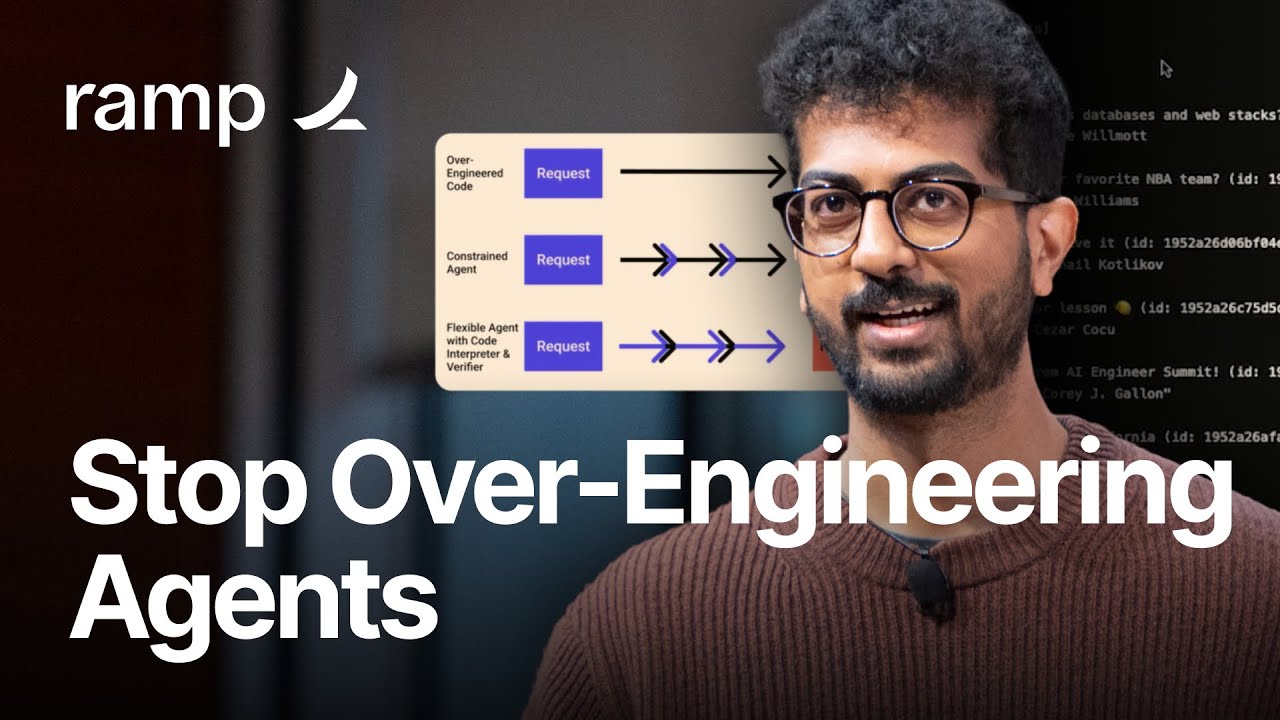
Rethinking how we Scaffold AI Agents - Rahul Sengottuvelu, Ramp
Mar 19, 2025 · 16:32
Rahul Sengottuvelu, Head of Applied AI at Ramp and co-founder of Cohere.io, argues that building AI agents should follow the 'bitter lesson' from AI research: systems that scale with compute outperform handcrafted, deterministic code. He illustrates this with Ramp's switching report agent, which ingests arbitrary CSV files from third-party card providers. Three approaches are compared: manually coding parsers for the 50 most common vendors, using LLMs only for column classification, and a fully LLM-driven method where the model writes and runs pandas code via a code interpreter, repeated 50 times in parallel. The last approach, though using 10,000x more compute, costs under a dollar and generalizes better, saving Ramp far more in failed transactions. Sengottuvelu also demonstrates a prototype email client where the backend is an LLM with access to a code interpreter and the user's Gmail token; the LLM renders the UI as Markdown and handles clicks by re-prompting itself, simulating a full web app without traditional backend code. He contends that as models exponentially improve, shifting more execution into 'fuzzy' LLM compute—rather than rigid code—lets builders ride the trend for…

Open Challenges for AI Engineering: Simon Willison
Jul 17, 2024 · 18:49
Simon Willison argues the GPT-4 barrier has been broken as GPT-4o, Claude 3.5 Sonnet, Gemini 1.5 Pro, and open models like LLaMA 3 70B now compete, making GPT-4-class models a commodity. He highlights the AI trust crisis with examples of Dropbox and Slack being falsely accused of training on user data, and notes Anthropic trained Claude 3.5 Sonnet without customer data. Willison warns about prompt injection vulnerabilities, citing the Markdown image exfiltration bug affecting six major chatbots, and defines slop as unreviewed AI-generated content, calling for accountability and responsible use patterns.
Powered by PodHood