
Claude Agent SDK
ProductA product discussed on AI Engineer.
4 episodes

Self Driving Products: Product Signals to Pull Requests — Joshua Snyder, PostHog
Jun 10, 2026 · 15:39
Joshua Snyder of PostHog explains how they're building a pipeline that turns product signals—errors, Slack messages, session replays—into automated pull requests. He reveals that off-the-shelf embedding models cluster signals by structural similarity, so they embed LLM-generated queries instead. He argues specificity determines whether the agent produces a useful PR, with error tracking being immediately actionable while Slack and replay usually are not. He advises starting with costly agents to discover patterns, then collapsing expensive steps into one-shot calls.
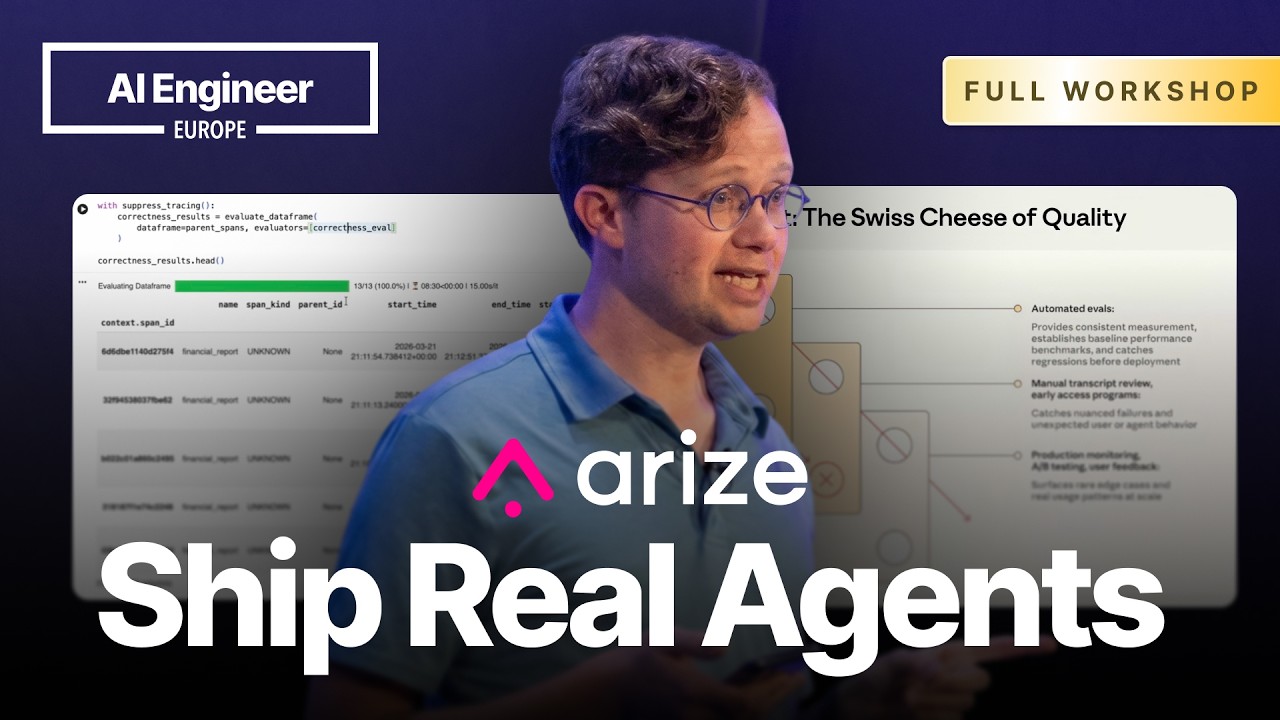
Ship Real Agents: Hands-On Evals for Agentic Applications — Laurie Voss, Arize
May 14, 2026 · 2:04:18
Laurie Voss, head of developer experience at Arize AI, delivers a hands-on workshop on evaluating agentic applications using Arize Phoenix, demonstrating that choosing the right eval matters more than tuning it: a correctness eval scored 0 out of 13 on the same financial analysis agent that a faithfulness eval scored 13 out of 13, because the model doesn't know the current year and cannot verify forward-looking data. He walks through building a complete eval pipeline from scratch—starting with tracing a Claude Haiku-based financial agent, reading and categorizing traces to identify root causes, then implementing code evals, built-in LLM-as-a-judge evals, and a custom actionability rubric with labeled examples. Voss emphasizes the importance of meta-evaluation to validate judge accuracy and introduces Phoenix experiments to prove prompt changes actually improve scores, not just vibes. Practical tips include using the impact hierarchy (data quality > prompting > model selection > hyperparameters) and the value of regression evals for safe model upgrades. The workshop closes with cost-aware evaluation, pairwise evaluation, and reliability scoring as next steps beyond the foundations…

Full Walkthrough: Writing & Using Skills — Nick Nisi and Zack Proser
May 6, 2026 · 1:21:03
Zack Proser and Nick Nisi, Developer Experience Engineers at WorkOS, teach how to write portable, composable skills — single markdown files with optional scripts — that train AI tools like Claude, Codex, and Cursor to perform specific tasks consistently. They demonstrate building a repo roast skill that uses deterministic Git commands via script interpolation and progressive disclosure to load targeted references only when needed. The workshop covers structuring skills with front matter (name, description for LLM routing), adding confidence scoring and constraints to improve output, and sharing skills as .skill files or through marketplaces. Advanced topics include using skills in non-coding workflows (e.g., Slack–Linear automation) and composing skills in the WorkOS CLI, which uses the Claude Agent SDK to install auth. Attendees learn to iterate skills by reflecting on past conversations and leveraging Claude's built-in skill builder for evaluation.

Claude Agent SDK [Full Workshop] — Thariq Shihipar, Anthropic
Jan 5, 2026 · 1:52:25
Thariq Shihipar of Anthropic presents the Claude Agent SDK, arguing that Bash and file-system-based agents outperform traditional tool-only approaches for autonomous tasks. He defines agents as systems that build their own context and trajectory, contrasting with structured workflows. The SDK, built on Claude Code, emphasizes the Bash tool as the most powerful primitive for composability and code generation, enabling non-coding tasks like data analysis. He demonstrates live-coding a Pokémon team advisor that dynamically fetches API data via scripts, and explains security through a 'Swiss cheese defense' of model alignment, AST parsing, and sandboxing. Shihipar also covers skills for progressive context disclosure, sub-agents for parallel work, and hooks for deterministic verification, stressing that agent building is an art of reading transcripts and iterating on context engineering.
Powered by PodHood