
Chrome
ProductA product discussed on AI Engineer.
6 episodes
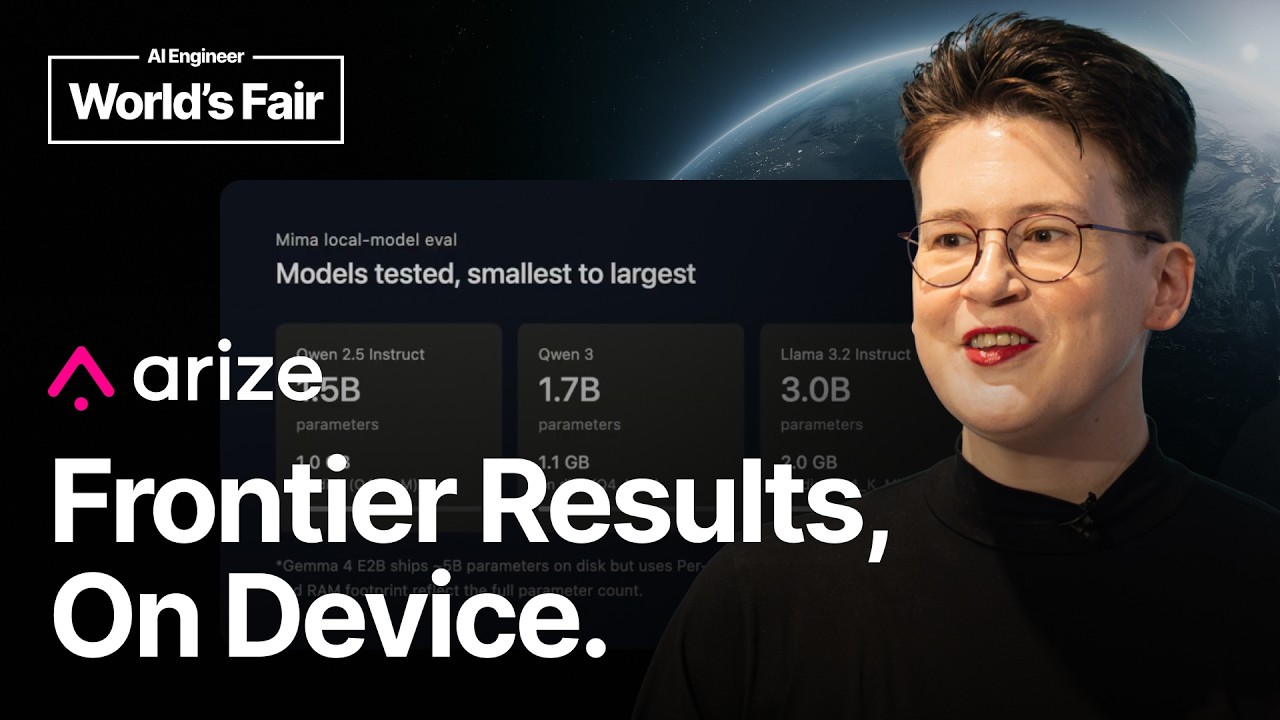
Frontier results, on device - RL Nabors, Arize
Jun 29, 2026 · 30:52
RL Nabors (Arize) argues that most frontier-model calls can be replaced by smaller, local models, saving cost, latency, and energy. She presents a four-step framework: prototype big with a foundation model, collect a golden dataset, run capability evals using Arize's open-source Phoenix, then select the 'sage' (small and good enough) model. Demonstrating with her social app Mima, she tested Qwen 2.5, Qwen 3, LLaMA 3.2, and Gemma 4 against Claude Sonnet on summary accuracy, latency, and cost. LLaMA 3.2 (3B params) won at 90% accuracy and 1-second P50 latency, versus Gemma 4's 8 seconds. Prompt engineering—specifically few-shot prompting—closed the gap further, achieving 92.9% factual consistency and 100% JSON validity. Nabors emphasizes running regression evals to prevent regressions, and notes that on-device inference eliminates data exposure and round-trip latency.
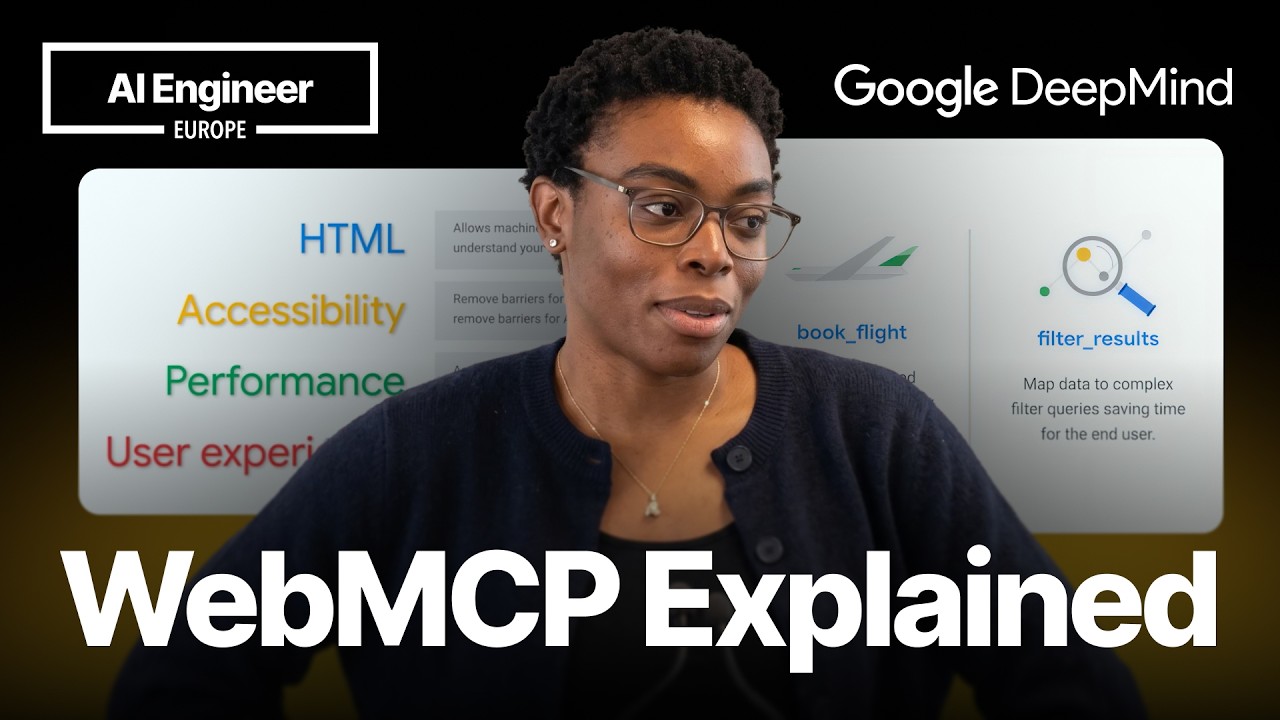
The agent-ready web: Simplify user actions with WebMCP — Tara Agyemang, Google
Jun 11, 2026 · 21:34
Tara Agyemang from the Google Chrome team introduces WebMCP, a proposed web standard that replaces brittle DOM scraping with structured tools for AI agents. She explains two implementation paths: the declarative API (adding HTML attributes to forms) and the imperative API (registering custom JavaScript tools). A live demo shows a concert ticket purchase completed in three tool calls: search, open page, purchase. WebMCP is in early preview on Chrome 146, with an eval CLI and inspector extension available for testing.

Defying Gravity - Kevin Hou, Google DeepMind
Dec 2, 2025 · 25:10
Kevin Hou from Google DeepMind introduces Antigravity, a new agent-first IDE that combines three surfaces: an AI editor, an agent-controlled Chrome browser, and an Agent Manager. The central claim is that agents should live outside the IDE, enabling longer-running tasks and multimodal interactions. Key features include Artifacts—dynamic representations like plans, screen recordings, and diagrams—that replace raw chain-of-thought with visual summaries. The browser enables context retrieval and verification via screen recordings, while image generation allows iterative design through comments. Hou explains the research-product flywheel: DeepMind researchers use Antigravity internally to identify model gaps, improving capabilities like computer use and instruction following, which then ship in the product. He also details four categories of model improvements: intelligence, tools, long-running tasks, and multimodal, all powered by Gemini 3 Pro and related models.

How LLMs work for Web Devs: GPT in 600 lines of Vanilla JS - Ishan Anand
Jul 13, 2025 · 1:41:34
Ishan Anand shows that GPT-2 small implemented in 600 lines of vanilla JavaScript makes LLMs understandable for web developers without ML backgrounds. He explains tokenization via byte-pair encoding, 768-dimensional embeddings representing semantic meaning via co-occurrence, and the Transformer's attention mechanism that lets tokens share context. The multi-layer perceptron learns next-token prediction through backpropagation, while the language head converts embeddings to token probabilities using softmax. Anand demonstrates each step—tokenization, embedding lookup, positional encoding, attention, MLP, and output—in a browser debugger, and notes that GPT-2's architecture underpins ChatGPT, with innovations like scale, supervised fine-tuning, and RLHF. The workshop provides an intuitive mental model of Transformers, turning perceived AI magic into understandable machinery.

Windsurf everywhere, doing everything, all at once - Kevin Hou, Windsurf
Jun 23, 2025 · 16:03
Windsurf head of product Kevin Hou explains the company's philosophy of a shared human-AI timeline and its vision to be everywhere, do everything, and work all the time. The AI ingests context from tools like Google Docs, Figma, GitHub, and Notion, and takes actions beyond coding—opening PRs, deploying, and reviewing code. Windsurf generates 90 million lines of code daily and processes over 1,000 messages per minute. Its new model SWE-1, trained on software engineering workflows, achieves near-frontier performance with a fraction of the resources. Hou emphasizes a data flywheel where user feedback on real workflows drives continuous improvement, arguing that successful AI products in 2025 require harmony among model, data, and application.

Arrakis: How To Build An AI Sandbox From Scratch - Abhishek Bhardwaj, OpenAI
Jun 3, 2025 · 40:18
Abhishek Bhardwaj, founder of Arrakis, explains why MicroVM-based AI sandboxes are the next unlock for AI agents, detailing how Arrakis provides secure, fast code execution and computer-use environments. He argues that sandboxes are essential for tool-calling models, reinforcement learning, and multi-tenant security, with Arrakis booting in under 7 seconds and supporting backtracking via snapshot/restore. The talk covers the choice of Cloud Hypervisor over other VMMs, overlayFS storage with per-sandbox read-write layers, iptables-based networking, and a built-in code execution server. A demo shows Claude using Arrakis via MCP to build a collaborative Google Docs clone and then revert to a snapshot, illustrating how a full Linux sandbox enables agents to autonomously debug and iterate without extensive prompting.
Powered by PodHood