
BLOOM
ProductA product discussed on AI Engineer.
5 episodes

Stop Writing Tone Instructions. Layer Them. - Isadora Martin-Dye, Isadora & Co
Jun 26, 2026 · 20:57
Isadora Martin-Dye, founder of Isadora & Co and builder of AI for a wedding venue, a personal companion, and a missing persons tool, argues brand voice requires a four-layer architecture instead of a single system prompt. The layers are immutable identity (hard rules like never claiming a body), situational mode (adjusting to user's context like grief), example-anchored voice (tone guide), and a post-generation veto (deterministic check catching errors like offering a booked date). Instructions are probabilistic; the veto is deterministic. A prompt will eventually fail; the only question is whether it's caught before reaching a customer. Examples include a wedding AI that must disclose it is AI and not say "I'd love to show you around," and a missing persons tool that must never use "confirmed" or "matched." She notes that multi-tenant voice leaks require identity to never have a default. The veto layer is the cheapest and most critical safeguard.
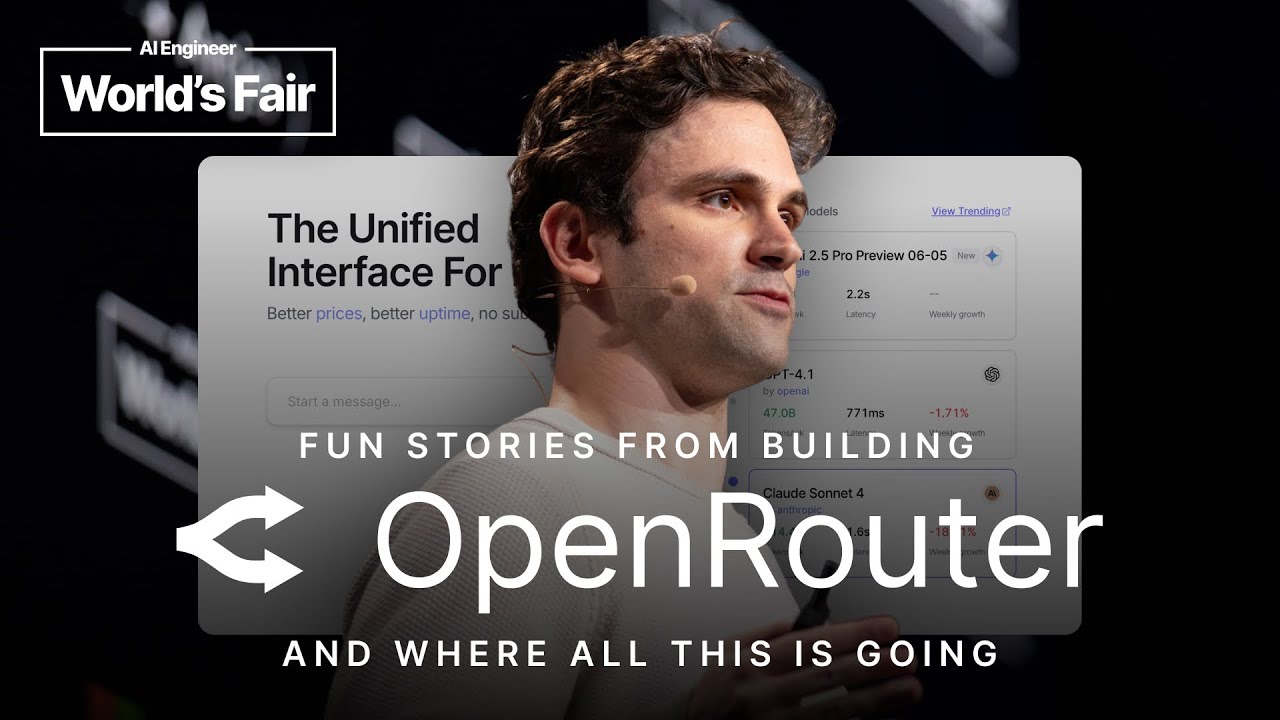
Fun stories from building OpenRouter and where all this is going - Alex Atallah, OpenRouter
Jun 25, 2025 · 18:47
Alex Atallah, founder of OpenRouter, tells the story of how he launched the LLM aggregator in early 2023 after observing the open-source race sparked by Meta's Llama 1 and Stanford's Alpaca distillation under $600. He argues the inference market is not winner-take-all, citing OpenRouter's data showing Google Gemini growing from 2-3% to 34-35% of tokens over 12 months. The platform evolved from a simple model collection into a marketplace with over 400 models and 60 providers, solving architecture challenges like 30-millisecond latency, cancelable streams, and a middleware plugin system for web search and PDF parsing. Atallah explains that OpenRouter grew 10-100% month-over-month for two years, and he predicts future additions like transfusion models that generate images and more powerful geographic routing for enterprise optimization.

[Full Workshop] Llama 3 at 1,000 tok/s on the SambaNova AI Platform
Feb 7, 2025 · 1:00:58
Michelle Matern and Petro Milan of SambaNova present their full-stack AI platform, built on the SN40L RDU chip with a three-tiered memory architecture capable of storing up to 5 trillion parameters. They demonstrate Samba1 Composition of Experts (CoE), a trillion-parameter model combining 92 expert models behind a single endpoint, and show Llama-3-8B achieving 1,000 tokens per second with a time-to-first-token of 0.09 seconds and total inference time of 0.65 seconds—far exceeding GPU-based providers. The workshop includes a hands-on basic inference call using LangChain and SambaStudio API, and a RAG-based Q&A system for enterprise search that integrates Unstructured for document loading, E5-large-v2 embeddings, ChromaDB vector store, and the high-speed Llama-3 endpoint. Attendees learn to configure prompts with special Llama-3 tags, set chunk size and overlap, and optionally run embeddings on SambaNova's RDU hardware for faster processing.

A Practical Guide to Efficient AI: Shelby Heinecke
Nov 18, 2024 · 17:45
Shelby Heinecke, who leads an AI research team at Salesforce, presents five orthogonal dimensions for making AI models efficient: efficient architecture selection, pre-training, fine-tuning, inference, and prompting. She highlights the power of small models like Phi-3 (3.8B parameters outperforming a 7B model), mobile LLM (350M parameters on par with 7B after fine-tuning), and Octopus (2B fine-tuned Gemma exceeding GPT-4 on Android tasks). For efficient inference, she explains post-training quantization, showing 4-bit quantization nearly halves memory usage without performance loss (e.g., LLaMA models), but warns 3-bit can degrade quality. She recommends frameworks like LLaMA CBP and ONNX Runtime for quantization and introduces her team's open-source Mobile AI Bench for evaluating quantized models, including an iOS app to measure latency and battery drain. The central claim is that deploying AI in constrained environments—cloud, on-prem, or edge—demands efficiency, and these practical techniques bridge the gap from demo to production.

Build enterprise generative AI apps using Llama 3 at 1,000 tokens/s on the SambaNova AI platform
Sep 11, 2024 · 54:34
SambaNova’s Michelle Matern and Petro Milan present their full-stack AI platform, demonstrating how the SN40L RDU chip enables Llama 3 inference at 1,000 tokens per second. They introduce Samba-1, a composition of 92 expert models behind a single endpoint, and benchmark it against GPT-3.5 and GPT-4 on enterprise tasks like information extraction and text-to-SQL. The workshop then builds a RAG-based Q&A system using LangChain, Unstructured, E5-large-v2 embeddings, ChromaDB, and Llama-3-8B-Instruct at 1,000 tokens per second. Attendees set up the environment, load documents, and run inference with real-time metrics showing time to first token of 0.09 seconds and total inference time of 0.65 seconds.
Powered by PodHood