
Bing
ProductA product discussed on AI Engineer.
5 episodes

Your Agent's Biggest Lie: "I Searched the Web" — Rafael Levi, Bright Data
Jun 17, 2026 · 15:49
Rafael Levi from Bright Data argues that LLMs often hallucinate and provide fake citations because they fail to actually access live web data, getting blocked by anti-bot systems like CAPTCHAs and Cloudflare's AI labyrinth. He demonstrates this with a comparison: without Bright Data's MCP, GPT-5 failed all five tasks accessing sites like LinkedIn and Amazon; with the MCP's 66 tools—including a CAPTCHA-solving browser that mimics human behavior—four succeeded. Levi explains that agents enter an invisible failure loop where they get blocked or served fake data but still answer confidently, making up numbers or non-existent URLs. He emphasizes that 20% of the web is blocked by Cloudflare from AI crawling, and that fake data fed to bots increases hallucinations. The episode covers how Bright Data's MCP provides real web access with search, scraping, and remote browsers, offering a free tier of 5,000 requests per month for experimentation.

Mind the Gap (In your Agent Observability) — Amy Boyd & Nitya Narasimhan, Microsoft
May 14, 2026 · 1:20:07
Amy Boyd and Nitya Narasimhan of Microsoft explain how to close the gap between agent behavior and requirements using Microsoft Foundry's observability stack. They demonstrate tracing via OpenTelemetry, built-in evaluators for quality, safety, and agentic metrics (e.g., intent resolution, task adherence), and red teaming where a second AI attacks the agent to reveal vulnerabilities. The showcase is the observe skill: pointed at an agent with no eval data, it generates a dataset, runs batch evaluations, optimizes the prompt, compares versions, and rolls back to the best one—all from a single prompt. The skill surfaces failures developers didn't know existed, accelerating the optimize loop with human-in-the-loop guidance.
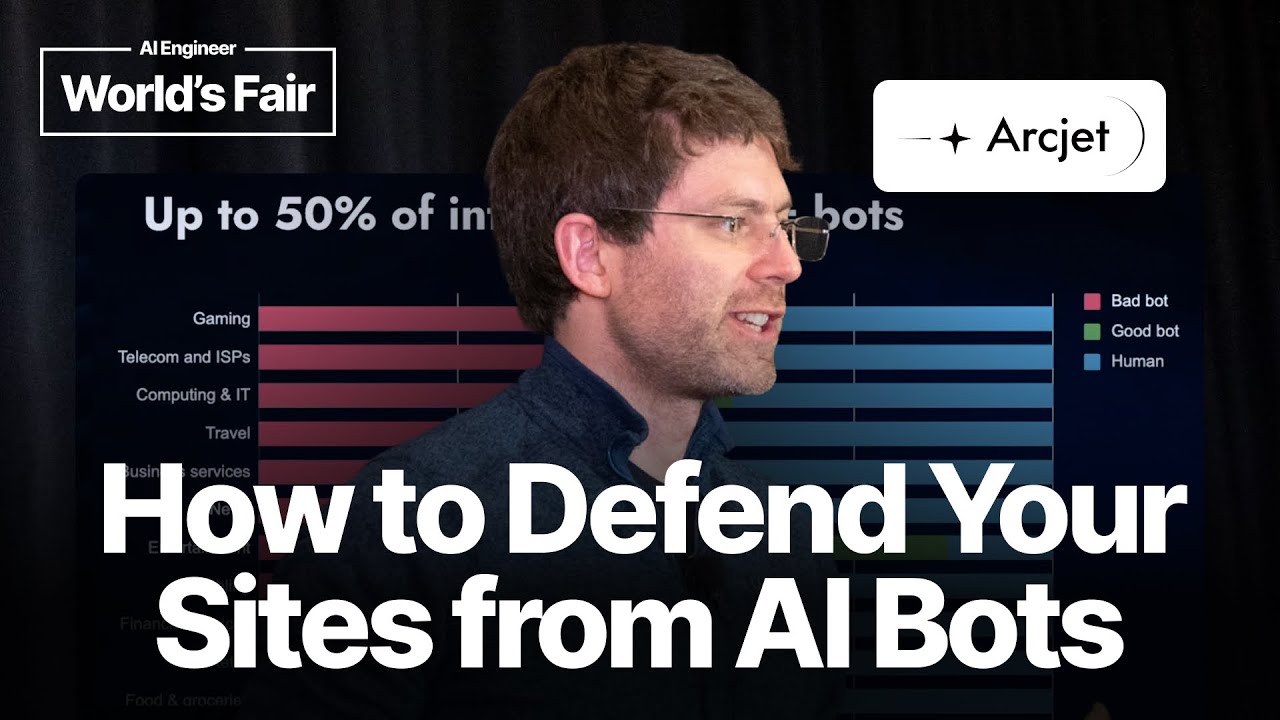
How to defend your sites from AI bots — David Mytton, Arcjet
Jul 30, 2025 · 20:12
David Mytton, founder of Arcjet, explains that nearly 50% of web traffic is now automated, with AI crawlers significantly worsening the problem for site owners. He cites specific cases: Diaspora saw 24% of its traffic from OpenAI's GPTbot, and ReadTheDocs cut bandwidth from 800 GB to 200 GB per day by blocking AI crawlers. Mytton describes the evolving landscape of AI bots—OpenAI alone has at least four types (Search, ChatGPT User, GPTbot, Operator)—and argues that detection requires layered defenses. He walks through eight defenses: robots.txt (voluntary), user agent string verification with reverse DNS, IP reputation (e.g., 12% of bot traffic on Cloudflare comes from AWS), CAPTCHAs (increasingly easy for AI to solve), proof-of-work puzzles (e.g., Anubis proxy), experimental HTTP message signatures (Cloudflare's proposal), fingerprinting via JA4 hash (TLS-level), and rate limiting keyed to fingerprints or session IDs. The practical takeaway is that most sites can manage with user agent verification plus IP checks, but high-value or high-traffic sites need full stacking of these techniques.

Building Code First AI Agents with Azure AI Agent Service — Cedric Vidal, Microsoft
Jun 27, 2025 · 1:54:06
Cedric Vidal, Principal AI Advocate at Microsoft, demonstrates building code-first AI agents with Azure AI Agent Service, using function calling, code interpreter, file search, and Bing grounding for a sales analysis use case. He creates a conversational agent that queries SQLite, generates pie charts from Python code, and blends product PDF data with relational data. The workshop explains stateful agents, tool routing (LLM generates JSON to call functions), and the limits of single-step agents versus multi-agent orchestration with AutoGen. Cedric addresses when to use Agent Service (managed persistence and tools) versus raw LLM endpoints, and covers MCP servers as a tool lifecycle manager. Key insights include using instructions to ground agent behavior and the need for eval frameworks for agent quality.

GitHub Copilot: The World's Most Widely Adopted AI Developer Tool
Feb 6, 2025 · 29:49
GitHub Senior DevOps Advocate Dave Bernason demonstrates how GitHub Copilot has evolved from an AI code generator to a comprehensive developer assistant with chat, enterprise knowledge bases, pull request summaries, and third-party extensions, emphasizing that Copilot keeps developers in flow and requires human oversight. He shows Copilot Chat explaining code, refactoring, debugging, and generating unit tests. Copilot Enterprise adds Bing search, knowledge bases from Markdown files, and repo indexing for accurate answers, exemplified by updating a hard-coded sales tax function to use the Avalara API. Copilot Extensions integrate third-party tools like Octopus Deploy for deployment dashboards within chat. Bernason also covers prompt engineering tips—specificity improves suggestions—and highlights Copilot's support for any language, even COBOL, for modernization.
Powered by PodHood