
Azure AI Search
ProductA product discussed on AI Engineer.
6 episodes

On AI and Knowledge — Pablo Castro, Distinguished Engineer & CVP for AI Knowledge, Microsoft
Jul 17, 2026 · 17:35
Pablo Castro, Distinguished Engineer and CVP for AI Knowledge at Microsoft, argues that AI agents require three knowledge types—intrinsic (model training), extrinsic (RAG and grounding), and learned (optimization loops)—and demonstrates how Microsoft's Foundry IQ, Azure AI Search, and Agent Optimizer deliver them. He shows that combining retrieval methods outperforms individual ones, citing Azure AI Search evaluations where combined methods improve evidence recall and answer completeness. He introduces Foundry IQ as a layered system with agentic retrieval that reflects on data to satisfy information needs before returning results. Castro demonstrates creating a knowledge base that connects unstructured data, structured Parquet tables, and the web, then linking it to an agent via MCP server. He also showcases the Agent Optimizer, which uses hill climbing on baseline evaluations to automatically refine agent instructions, tool definitions, and skills based on runtime traces, enabling continuous learning loops that capture organizational differentiation.
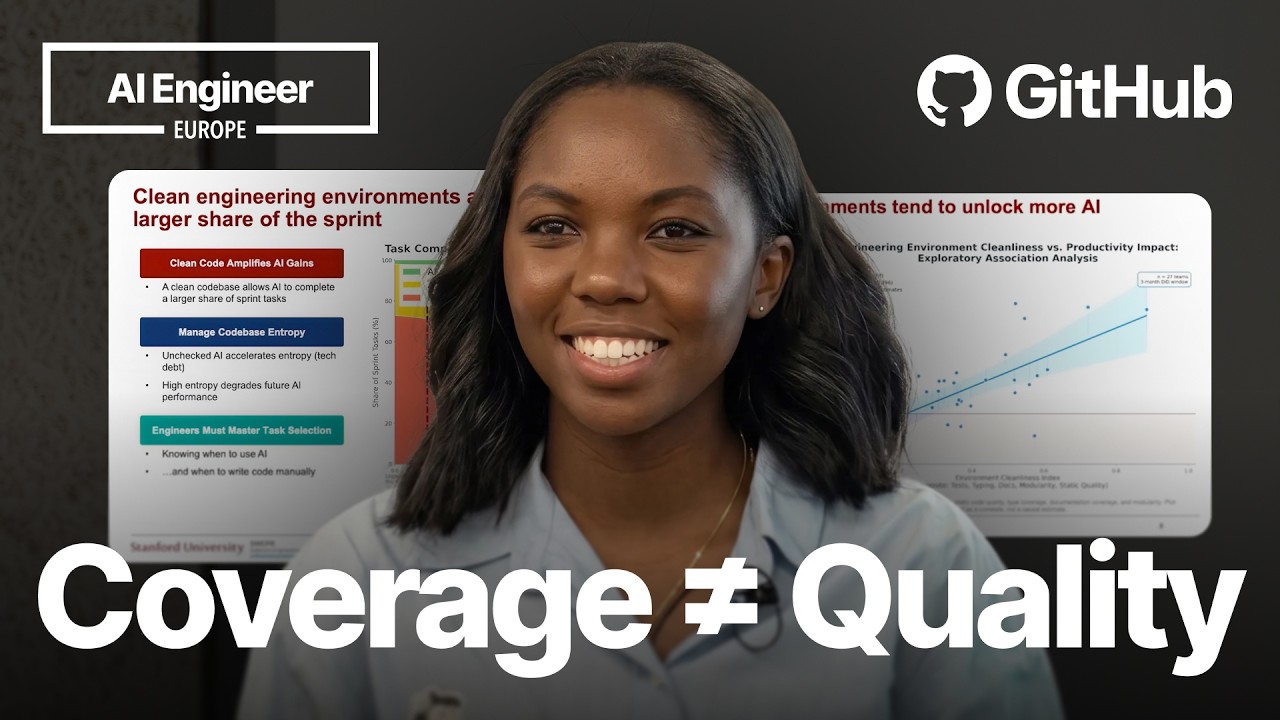
Beyond Code Coverage: Functionality Testing with Playwright MCP — Marlene Mhangami, Microsoft
May 16, 2026 · 19:45
Marlene Mhangami of Microsoft and GitHub argues that AI boosts developer productivity only when paired with clean code practices, citing a Stanford study of 120,000 developers and GitHub Octoverse data showing 275 million weekly commits in 2026 with a growing share co-authored by AI. She advocates test-driven development (TDD) with Playwright for functional testing over unit tests, as AI-generated tests often affirm code behavior rather than user experience. In a live demo, she uses GitHub Copilot CLI and Playwright MCP server to automatically write failing Playwright tests for a toy store's search and filter features, then generate code to pass them. She emphasizes testing one feature per test, capturing screenshots for PRs, and committing code before fixes to preserve context. She closes with advice on using Playwright agents for complex state management and confirming cross-screen-size support.
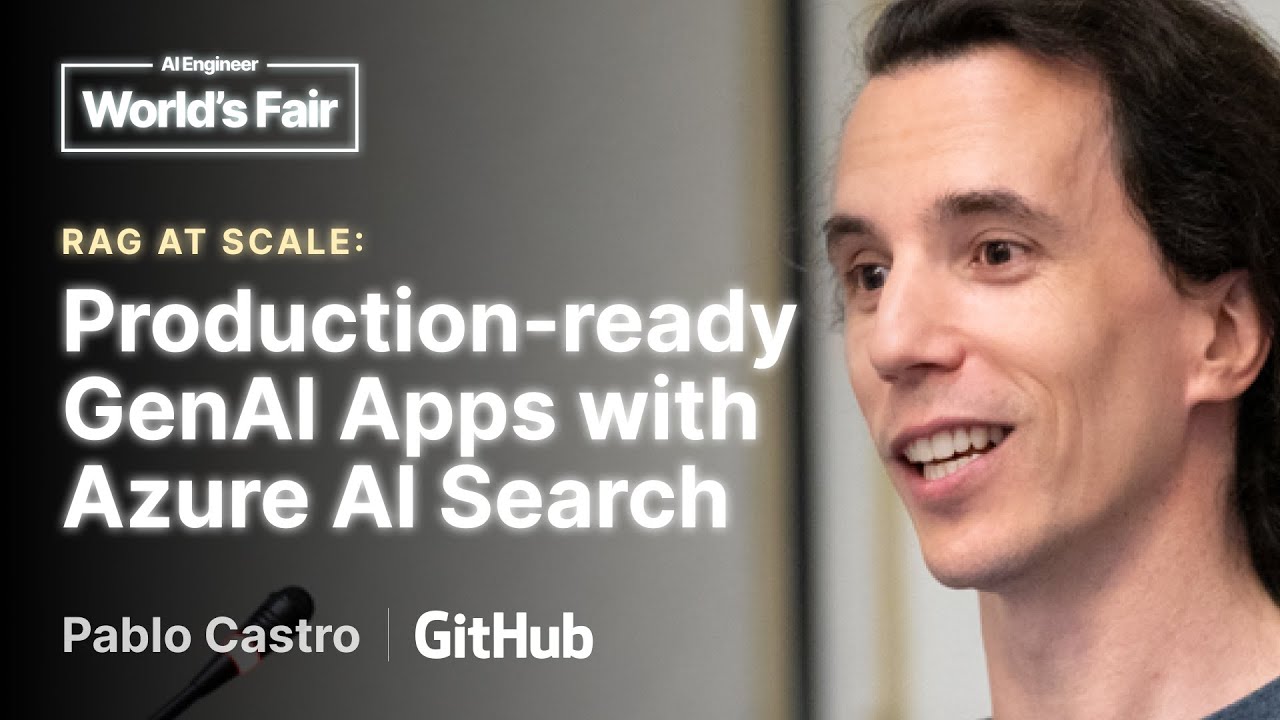
RAG at scale: production ready GenAI apps with Azure AI Search
Feb 13, 2025 · 21:53
Pablo, a Distinguished Engineer at Microsoft, explains how Azure AI Search enables production-grade RAG applications at scale by addressing key scaling challenges: data volume, query load, workflow complexity, and diverse data types. He demonstrates the platform's hybrid retrieval combining vector search (HNSW, exhaustive), keyword search (BM25), and filters, with a two-stage system using cross-encoder re-ranking for improved quality, achieving 100ms re-ranking latency. Azure AI Search supports multi-billion vector indexes through 10–12x storage limit increases and quantization (int8, single-bit) preserving 90–95% precision, with oversampling for full-precision re-ranking. Integrated vectorization automates ingestion from Azure sources (blob, Cosmos DB, OneLake) with change tracking and format handling (PDFs, Office documents, images). OpenAI uses Azure AI Search to back ChatGPT file uploads and the Assistants API, scaling user limits 500x after Microsoft's infrastructure upgrades.

Build, Evaluate and Deploy a RAG-Based Retail Copilot with Azure AI: Cedric Vidal and David Smith
Feb 6, 2025 · 1:57:58
David Smith, Cedric Vidal, and Miguel Martinez lead a hands-on workshop on building a production-level RAG-based retail copilot using Azure AI. They demonstrate how to build a chatbot backend that retrieves product information from Azure AI Search via vector embeddings and customer history from Cosmos DB, then augments the LLM prompt to generate grounded answers. The session covers using Azure AI Studio and Prompt flow to orchestrate the RAG workflow, deploying the flow as a managed endpoint, and evaluating quality with GPT-4 as a judge on metrics like relevance and groundedness. The speakers also explain the LLM Ops lifecycle for iterative improvement and compare Prompt flow with Semantic Kernel and AutoGen.

AI Templates: Gabriela and Aishwarya
Feb 6, 2025 · 1:03:20
Gabriela de Queiroz, Aishwarya, and Pamela from Microsoft present AI templates for rapidly prototyping and deploying generative AI applications, demonstrating how startups can leverage Microsoft for Startups Founders Hub, including up to $150,000 in Azure credits and expert guidance. The workshop covers three templates: a simple chat app using GPT-3.5 Turbo, a Retrieval Augmented Generation (RAG) app on Postgres with hybrid vector and text search, and a RAG app on unstructured documents using Azure AI Search and Document Intelligence. Key insights include the importance of query rewriting, hybrid search over pure vector search, and streaming responses for better user experience. The templates are open source on GitHub and can be deployed via Codespaces, with a proxy provided to bypass Azure OpenAI approval delays.

Running AI Application in Minutes w/ AI Templates: Gabriela de Queiroz, Pamela Fox, Harald Kirschner
Aug 14, 2024 · 1:29:02
In this workshop, Microsoft's Gabriela de Queiroz, Pamela Fox, and Harald Kirschner show how to deploy AI applications in minutes using AI templates, Azure OpenAI proxy, and GitHub Codespaces. They walk through deploying a simple chat app, then two RAG applications: one that queries a Postgres database with SQL filtering, and another that performs RAG on unstructured documents using Azure AI Search. Key decisions include using async frameworks like Quart and FastAPI, token-based chunking, and hybrid retrieval with semantic reranking for best results. They stress the importance of running evaluations with hundreds of samples and share production insights from Copilot Chat, where TFIDF sparse indexing and LLM reranking are used. The session includes free Azure credits and a proxy to bypass Azure OpenAI approval, allowing attendees to deploy everything without spending their own money.
Powered by PodHood