
Azure AI
ProductA product discussed on AI Engineer.
3 episodes

The Unofficial Guide to Apple’s Private Cloud Compute - Jmo, CONFSEC
Jul 30, 2025 · 20:36
Jonathan Mortensen explains Apple's Private Cloud Compute (PCC), a paradigm shift in confidential computing that delivers cryptographically provable privacy for AI inference on remote servers. He details Apple's five requirements—stateless computation, enforceable guarantees, non-targetability, no privileged runtime access, and verifiable transparency—and six technical components, including oblivious HTTP, blind signatures, secure enclave, remote attestation, transparency logs, and secure boot. The talk highlights how remote attestation allows an iPhone to verify server software and tie encryption to that verified state, while the transparency log enables public auditing of all deployed binaries. Mortensen notes trade-offs: complete trust in Apple's supply chain, higher latency and compute costs, and no support for custom models or third-party developers. He points to alternative tools like TPMs, SigStore, and confidential VMs for non-Apple environments, and concludes that Apple's approach is being adopted by Azure AI and Meta.

Multi model multimodal and multi agent innovations in Azure AI: Cedric Vidal
Feb 6, 2025 · 28:56
Cedric Vidal, Principal AI Advocate at Microsoft, demonstrates Azure AI's multi-model, multimodal, and multi-agent capabilities in a session packed with live demos. He shows how GPT-4 Omni mixes text and vision to read handwritten French menus and translate them, and diagnoses infrastructure damage from photos for energy and insurance industries. A new video translation service lets him speak German, Spanish, Italian, and Japanese in his own voice while preserving tone, such as whispering or yelling. The Azure AI model catalog now offers 1,600 models, including serverless deployment options, and Phi-3 Vision, a small 3.8B parameter model running locally in a browser via WebGPU. He also demonstrates code interpreter analyzing a GPX file from a kitesurfing session, plotting a map with turn markers, and GitHub Workspaces preview generating a Java GUI from Python code.
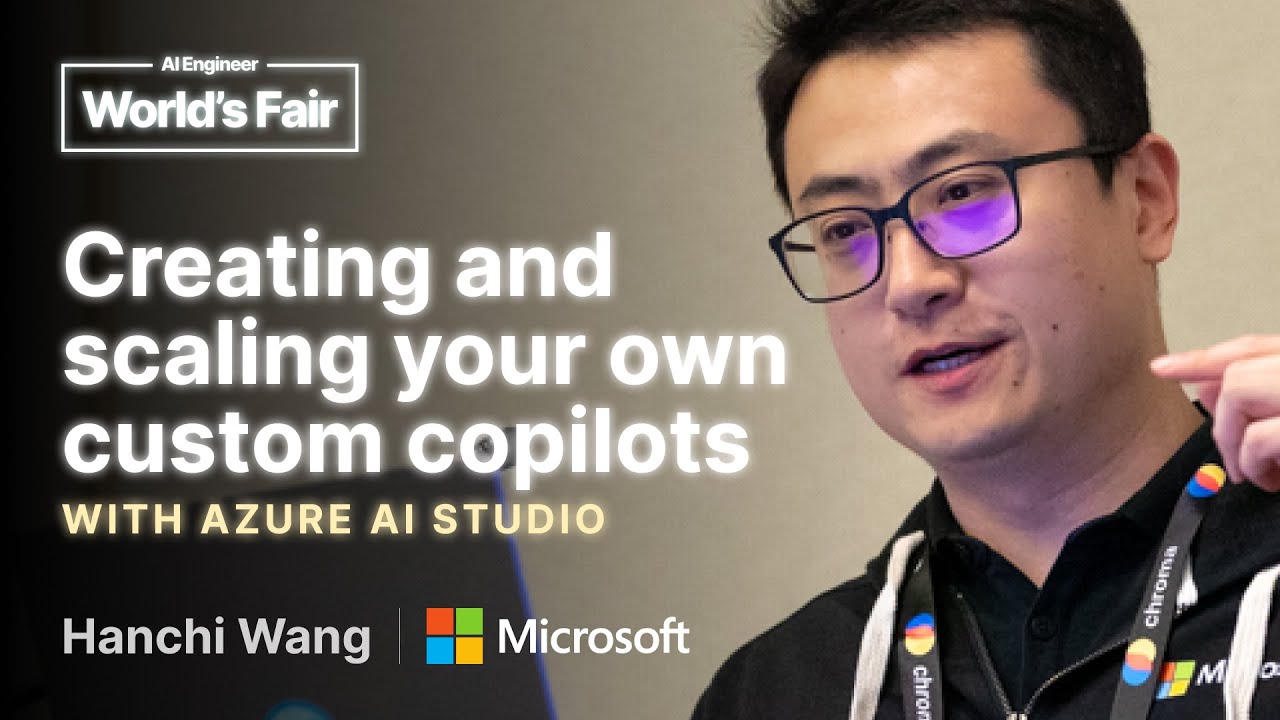
Creating and scaling your own custom copilots with Azure AI Studio: Hanchi Wang
Feb 6, 2025 · 24:21
Hanchi Wang, Software Engineer Lead at Azure AI, introduces Azure AI Studio and Promptflow for creating and scaling custom copilots, focusing on tracing, evaluation, and monitoring. He demonstrates a chatbot app that uses the Assistant API with a sales data insight tool (natural language to SQL) and a code interpreter. With Promptflow's trace decorator, developers capture inputs, outputs, and LLM interactions, viewable in a local UI and shareable via Azure AI Studio. For evaluation, he shows synthetic test data sets, content safety evaluators, and custom evaluators like execution time, error rate, and SQL similarity, comparing models such as GPT-4 Turbo, Mistral large, and Phi-3. In production, monitoring dashboards in Application Insights track model duration, token usage (prompt vs. completion), and failure rates, enabling engineers to optimize performance and cost.
Powered by PodHood