
AWS
ProductA product discussed on AI Engineer.
14 episodes
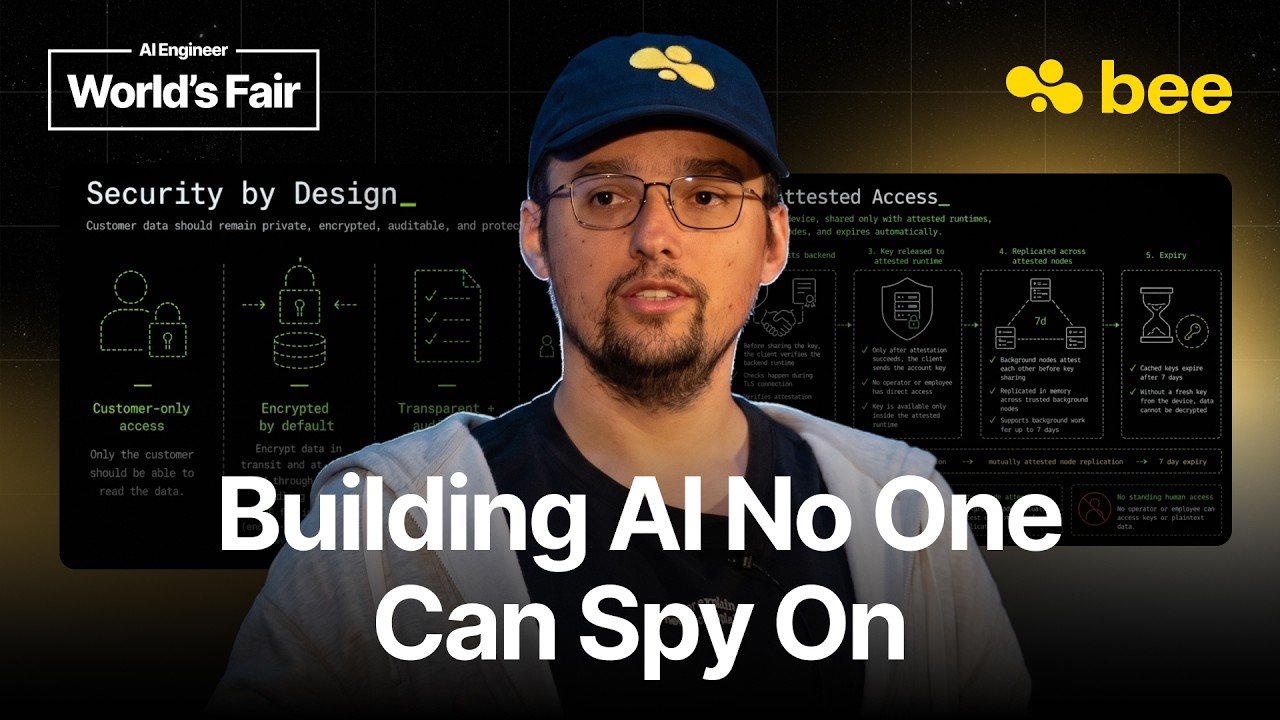
Privacy-Preserving Intelligence — Steve Korshakov, Bee (acq. Amazon)
Jul 20, 2026 · 15:53
Steve Korshakov, founder of Bee (acquired by Amazon), explains how his company built the 'most sensitive capture device on the market' with a guarantee that no one—not even Amazon—can read user data. Bee records everything a user says, generating about 10 million tokens per year, and within a week learns virtually everything about the person. To protect data, the encryption key never leaves the user's phone; the phone runs an attestation pipeline checking workloads against a public transparency log (Sigstore) before sharing the key with backends running in confidential compute. Keys in memory expire after seven days, and a two-tier signing system ensures no insider can ship code unnoticed: a separate Amazon privacy team holds signing keys hardcoded into apps. The entire system is only about 20,000 lines of memory-safe code, most of it verifying attestation, with no homegrown cryptography. Korshakov also discusses the challenges of moving from startup to Amazon, and his view on taming AI agents: sandboxing and not giving them the ability to cause harm.
The Great Loops Debate — Dex Horthy, Geoff Huntley, Ian Livingstone, Greg Pstrucha, @insecure-agents
Jul 17, 2026 · 1:00:16
In the 'Great Loops Debate' hosted by Ali Howe, Geoff Huntley, Ian Livingstone, Dex Horthy, and Greg Pstrucha argue whether there is a delta between the hype behind loops in AI-assisted development and what works in practice. Team No Delta (Ian, Geoff) contends loops are inevitable and already cost-effective at $10.42/hour, with models surpassing average coders. Team Delta (Dex, Greg) counters that hype outruns discipline: loops work only for deterministic tasks, quality remains low, and token spend scales unsustainably. The debate covers loop history, anatomy (verification, context windows), and the feasibility of fully autonomous software factories, concluding that while loops boost productivity 2-3x, the vision of lights-off factories is premature.
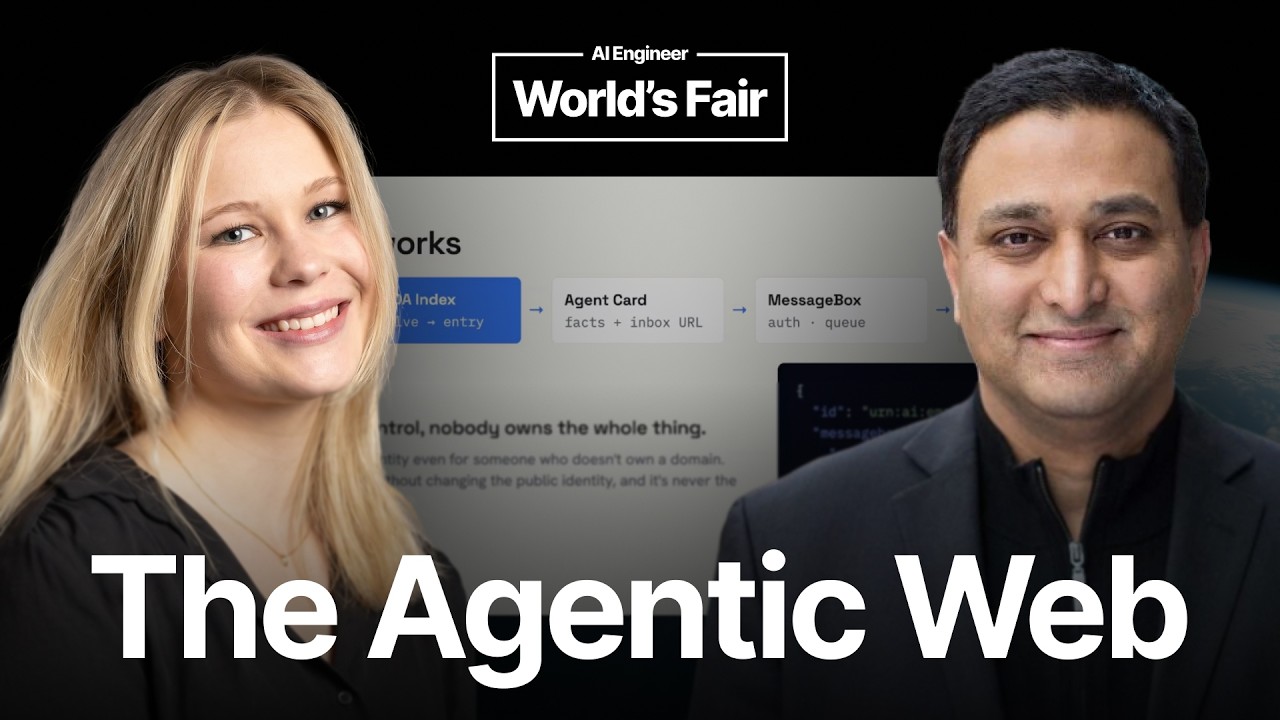
The Agentic Web and the Bazaar Era of AI - Ramesh Raskar, MIT Media Lab
Jul 12, 2026 · 12:11
Ramesh Raskar and Maria from MIT's Project Nanda argue that the emerging web of AI agents requires an open infrastructure for discovery, commerce, and coordination, moving beyond today's walled-garden platforms. They outline three layers: the Discovery Layer (Nanda index for agent identity, trust, and adaptive resolution), the Commerce Layer (knowledge pricing markets for intelligence), and the Bazaar Layer (machine co-learning). The Nanda index enables agents to find each other across vendors via signed agent facts and adaptive routing, while Nanda town simulates the entire agent economy to test protocols at scale. The goal is a permissionless web where any agent can discover, transact, and learn across organizational boundaries, analogous to the transition from AOL to the open web.

Spec-Driven Development: Agentic Coding at FAANG Scale and Quality — Al Harris, Amazon Kiro
Jan 9, 2026 · 1:03:50
Al Harris, principal engineer at Amazon, presents Spec-Driven Development (SDD) with Kiro, an agentic IDE that transforms prompts into structured requirements (EARS format), designs, and property-based tests to ensure code correctness. He argues that upfront specification—augmented by MCP servers for external context—improves reproducibility and quality over pure vibe coding. The talk includes a live demo: building an S3-backed checkpointer for a LangGraph dad joke generator, then discovering Agent Core’s native memory is more idiomatic. Harris contrasts SDD with Cursor’s planning mode, explains how specs evolve as living documentation, and discusses handling session length, context pruning, and brownfield codebases. The result is a claim that spending 5–10 minutes on specs yields higher accuracy and reliable, testable outputs.
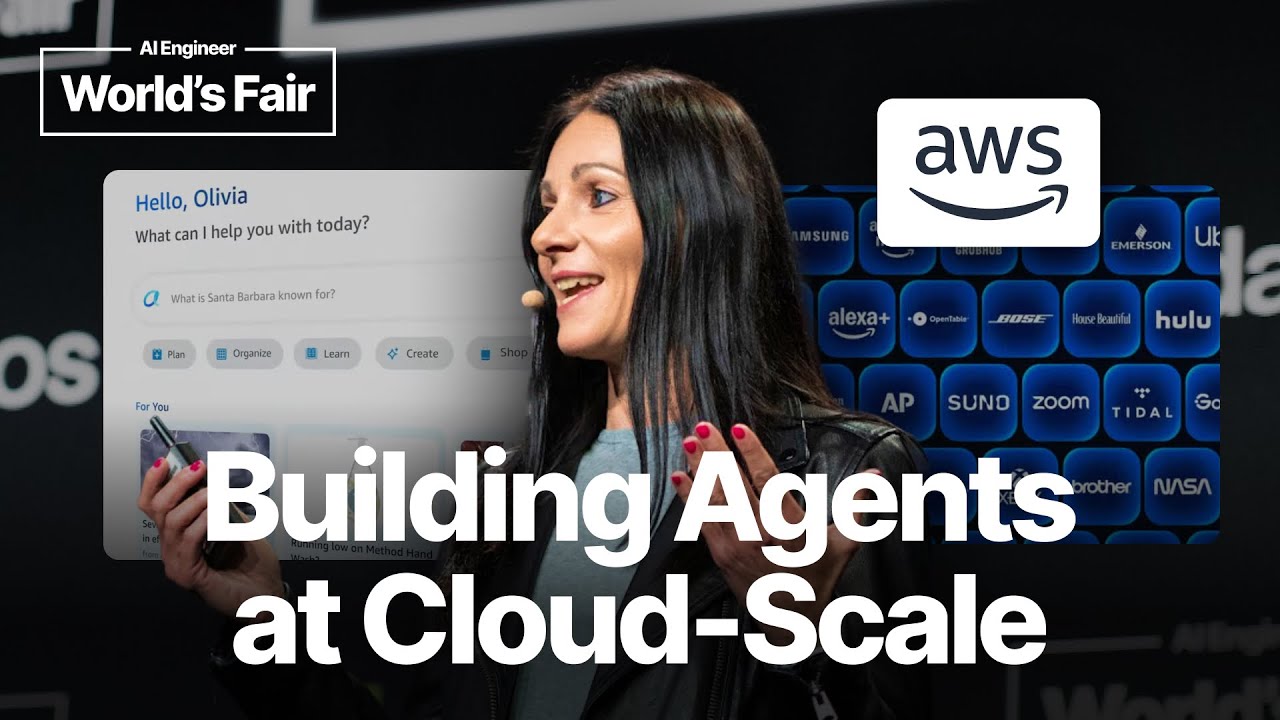
Building Agents at Cloud Scale — Antje Barth, AWS
Aug 2, 2025 · 19:00
AWS Principal Developer Advocate Antje Barth demonstrates how to build and scale AI agents using cloud-native patterns, arguing that specialized agents will reinvent customer experiences. She showcases Alexa Plus, which orchestrates hundreds of expert systems across 600M+ devices and tens of thousands of services, and the Amazon Q Developer CLI agent, shipped in just three weeks. Barth introduces Strands Agents, an open-source Python SDK for building production-ready agents that supports multiple model providers (Claude, Llama, OpenAI) and over 20 prebuilt tools including memory, RAG, and multi-agent workflows. She demonstrates integrating MCP servers via Lambda with DynamoDB for session storage, and previews upcoming A2A protocol support and a future of personal agents connecting to agent stores.
Useful General Intelligence — Danielle Perszyk, Amazon AGI
Aug 2, 2025 · 19:58
Danielle Perszyk, a cognitive scientist at Amazon's AGI SF Lab, argues that general-purpose AI agents like Nova Act must be built to augment human intelligence rather than replace it, drawing parallels to how human cognition relies on controlled hallucinations and social co-evolution. She explains that current agents struggle with basic computer tasks like clicking, typing, and scrolling, so Nova Act combines a specialized version of Amazon Nova trained via RL for UI reliability with an SDK that allows developers to string together atomic actions (act calls) into complex workflows. The lab's vision centers on grounding agents in a shared environment and eventually giving them models of human minds, which requires a common language for humans and agents to reciprocally level up intelligence. Demos with teammates Carolyn (searching apartments) and Fjord (extracting data with Python and parallel browsers) show how Nova Act enables three-line code starts and granular control, positioning the product as a primitive for a cognitive technology that aligns representations and stabilizes human thinking.
How to defend your sites from AI bots — David Mytton, Arcjet
Jul 30, 2025 · 20:12
David Mytton, founder of Arcjet, explains that nearly 50% of web traffic is now automated, with AI crawlers significantly worsening the problem for site owners. He cites specific cases: Diaspora saw 24% of its traffic from OpenAI's GPTbot, and ReadTheDocs cut bandwidth from 800 GB to 200 GB per day by blocking AI crawlers. Mytton describes the evolving landscape of AI bots—OpenAI alone has at least four types (Search, ChatGPT User, GPTbot, Operator)—and argues that detection requires layered defenses. He walks through eight defenses: robots.txt (voluntary), user agent string verification with reverse DNS, IP reputation (e.g., 12% of bot traffic on Cloudflare comes from AWS), CAPTCHAs (increasingly easy for AI to solve), proof-of-work puzzles (e.g., Anubis proxy), experimental HTTP message signatures (Cloudflare's proposal), fingerprinting via JA4 hash (TLS-level), and rate limiting keyed to fingerprints or session IDs. The practical takeaway is that most sites can manage with user agent verification plus IP checks, but high-value or high-traffic sites need full stacking of these techniques.

Why your product needs an AI product manager, and why it should be you — James Lowe, i.AI
Jul 28, 2025 · 18:37
James Lowe, Head of AI Engineering at the UK Government's Incubator for AI, argues that technical expertise makes AI engineers ideal candidates for the critical role of AI Product Manager, which balances business viability, technological feasibility, user desirability, and the core question of possibility. He shares three hard-won lessons from building products like CONSULT, Minute, and Redbox: resolve AI uncertainties early with evaluations and real-user tests (achieving 1,000x faster and 400x cheaper consultation analysis), experiment widely with features then cut back (streamlining a transcription tool from overwhelming options to a focused Justice Transcribe used for Prime Ministerial meetings), and pivot harder than ever as the landscape shifts (Redbox evolved from digitizing ministerial red boxes to a secure LLM chat client, then to an MCP-based tool provider when Microsoft Copilot Chat went free). The episode emphasizes that AI product management is a mindset, not just a title, and that engineers should step into this leadership gap to build impactful AI products.

Software Development Agents: What Works and What Doesn't - Robert Brennan, OpenHands
Jul 25, 2025 · 16:46
Robert Brennan, creator of the open-source coding agent OpenHands (formerly OpenDevin), argues that while coding is going away, software engineering remains about critical thinking, not typing. He explains that agents like OpenHands operate via a loop between an LLM and tools like a diff-based editor, terminal, and web browser, all sandboxed in Docker. Brennan advises starting small with rote tasks like merge conflicts (99% success) or PR feedback, being specific about frameworks and files, and always reviewing AI-generated code to avoid tech debt. He shares that 90% of his code now goes through the agent, with 10% requiring manual intervention, and warns against auto-merging without human accountability—OpenHands now assigns PRs to the human who triggered them. Key use cases include fixing failing tests, infrastructure changes, database migrations, and greenfield internal apps where vibecoding is acceptable.

The Rise of Open Models in the Enterprise — Amir Haghighat, Baseten
Jul 24, 2025 · 16:50
Amir Haghighat, CTO of Baseten, argues that enterprises are increasingly moving from closed frontier models like OpenAI and Anthropic toward open source models, driven by four specific cracks in the assumption that closed models will work indefinitely: quality for specialized tasks (e.g., medical document extraction), latency requirements (especially for voice), unit economics ballooning from agentic use cases where a single user action triggers 50 inference calls, and the desire for competitive differentiation. Drawing on conversations with over 100 enterprises, he explains that while most started with dedicated deployments on Azure/AWS for toying around in 2023, by 2024 about 40-50 had production use cases, and in 2025 the shift accelerated. However, adopting open models forces enterprises to build inference infrastructure, facing challenges like speculative decoding, prefix caching, guaranteeing four-nines reliability with hardware failures and VLM crashes, and scaling replicas—with one Fortune 50 soft drink company reporting an eight-minute spin-up time. Haghighat concludes by contrasting the simple API-call world with the complexities of mission-critical inference, where…
Building agent fleet architectures your CISO doesn't hate — Lou Bichard, Gitpod
Jun 27, 2025 · 13:52
Lou Bichard explains how Gitpod evolved from a managed SaaS to a 'bring your own cloud' architecture that satisfies CISOs in regulated industries by running secure dev environments—and now agent fleets—on customer infrastructure via a simple runner (a single ECS task) instead of complex Kubernetes. The platform, used by banks and healthcare firms for 37 hours per week per developer, reduces operational overhead through a cloud-formation-based setup that takes three minutes. For agents, the same infrastructure provides source code access and audit logging, ensuring privacy and compliance. Bichard argues that vendors should simplify architectures to lower customers' day-two costs, and advises buyers to prioritize security and ownership models when selecting AI tools.

Case Study + Deep Dive: Telemedicine Support Agents with LangGraph/MCP - Dan Mason
Jun 22, 2025 · 1:56:13
Dan Mason of Stride presents a case study on building autonomous agents for telemedicine support, replacing a human-driven button-pushing workflow with LangGraph, Claude, MCP, and a Node.js/React/MongoDB stack, achieving roughly 10X capacity increase. The LLM-driven virtual operations associate ("Ava") assesses patient messages, updates state with anchors and scheduled messages, and passes proposals to an evaluator agent that scores confidence and complexity, escalating to humans below 75% confidence. Mason explains how treatment "blueprints" in Google Docs are read directly by the LLM instead of using RAG, enabling new treatments to be added without writing code. He details the eval system using LLM-as-a-judge via PromptFu and retry logic for tool-calling errors, and discusses trade-offs around confidence scoring, prompt caching, and model selection (Claude for steerability). The team includes two software engineers, one designer, and Mason, who wrote most LangGraph code with AI assistance (Kline).

Decoding Mistral AI's Large Language Models: Devendra Chaplot
Nov 21, 2024 · 18:16
Devendra Singh Chaplot of Mistral AI details the company's open-source large language models, including Mistral 7B, Mixtral 8x7B, Mixtral 8x22B, and CodeStral 22B, arguing that open models complement rather than compete with profit by serving as branding tools and driving customer acquisition for proprietary upgrades. He explains the three-stage LLM training process—pre-training on trillions of tokens, instruction tuning with prompt-response pairs, and learning from human feedback via preference optimization—emphasizing that more data does not guarantee better performance due to noise. The episode highlights Mistral's focus on optimizing the performance-to-cost ratio, with CodeStral 22B outperforming larger models like Code LLaMA 70B while being smaller and multilingual across 80+ programming languages. Practical guidance is given: prototype with high-end commercial models, then fine-tune open models for specific tasks to balance performance and cost.

Building and Scaling an AI Agent Swarm of low latency real time voice bots: Damien Murphy
Oct 8, 2024 · 1:07:23
Damien Murphy, Senior Applied Engineer at Deepgram, demonstrates building and scaling low-latency real-time voice bots using Deepgram's new voice agent API, which wraps speech-to-text, LLM, and text-to-speech into a single streaming endpoint. He shows a drive-thru ordering demo with function calling (add/remove items) using GPT-4o, achieving sub-second latency by co-locating components. Murphy explains scaling to millions of concurrent calls through regional Kubernetes clusters and multi-agent swarms (routing, booking, support agents) to reduce complexity and cost. He addresses endpointing challenges, VAD-based barge-in, and cost/quality trade-offs with hosted vs. self-hosted models, noting Deepgram offers 20x cheaper TTS than ElevenLabs and 50ms STT latency self-hosted. The talk emphasizes keeping agents simple, using smallest capable LLMs, and composability for reuse.
Powered by PodHood