
Asana
ProductA product discussed on AI Engineer.
4 episodes
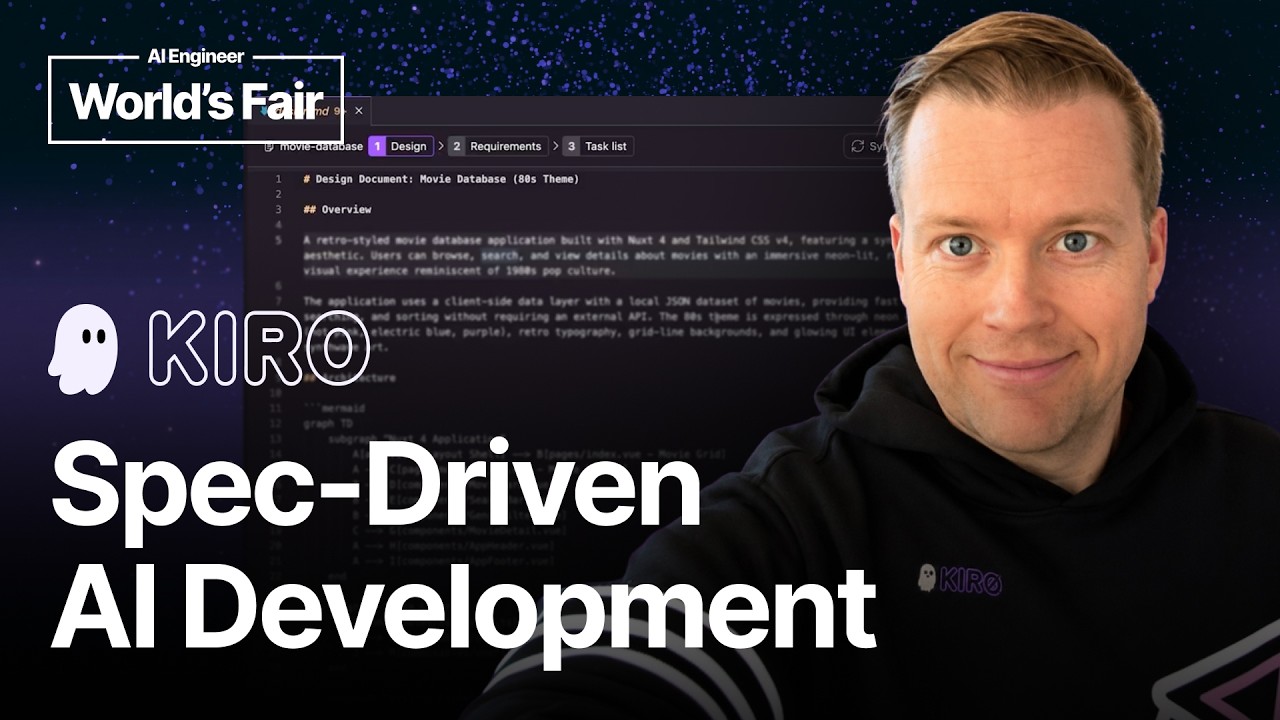
Using Spec-Driven Development for Production Workflows - Erik Hanchett, AWS
Jun 28, 2026 · 17:47
Erik Hanchett (AWS) argues that spec-driven development—writing markdown specification files before any code—produces higher quality code by guiding AI coding assistants, which he compares to 'AI interns' that need explicit direction. He introduces Kiro, AWS’s new AI IDE and CLI, which offers a spec mode that generates requirements documents, design documents with mermaid diagrams, property-based tests using Fastcheck, and a task list. In a demo building a movie website, Kiro created an MVP-focused implementation verified by property tests. Hanchett also highlights integrating external data via the Model Context Protocol (MCP) and stresses the importance of human review. He advises balancing context in steering docs and using on-demand skills to control the workflow.

Spec-Driven Development: Agentic Coding at FAANG Scale and Quality — Al Harris, Amazon Kiro
Jan 9, 2026 · 1:03:50
Al Harris, principal engineer at Amazon, presents Spec-Driven Development (SDD) with Kiro, an agentic IDE that transforms prompts into structured requirements (EARS format), designs, and property-based tests to ensure code correctness. He argues that upfront specification—augmented by MCP servers for external context—improves reproducibility and quality over pure vibe coding. The talk includes a live demo: building an S3-backed checkpointer for a LangGraph dad joke generator, then discovering Agent Core’s native memory is more idiomatic. Harris contrasts SDD with Cursor’s planning mode, explains how specs evolve as living documentation, and discusses handling session length, context pruning, and brownfield codebases. The result is a claim that spending 5–10 minutes on specs yields higher accuracy and reliable, testable outputs.

A2A & MCP Workshop: Automating Business Processes with LLMs — Damien Murphy, Bench
Jul 26, 2025 · 1:23:14
Damien Murphy presents A2A and MCP protocols for building multi-agent systems that automate business processes from webhooks, using a host agent that delegates tasks to sub-agents (Slack, GitHub, Bench) via A2A, with each sub-agent using MCP tools from Zapier or internal APIs. He demonstrates processing a meeting transcript to create a GitHub issue, send a Slack message, and research attendees, emphasizing that A2A handles remote agent discovery and opaqueness while MCP provides standardized third-party tool access. Murphy highlights benefits like context isolation—sub-agents absorb large tool outputs and keep the host's context small—and parallel processing, but notes limitations: A2A's early stage, MCP's silent failures (e.g., Zapier Slack missing channels), the non-determinism of LLM orchestration, and the challenge of prompt caching costs. He argues that A2A is best for third-party agents where complexity is hidden, while MCP is useful for extensible tool integration, but if you control the tools or agents, direct function calls are simpler and more reliable.

Building Agents with Model Context Protocol - Full Workshop with Mahesh Murag of Anthropic
Mar 1, 2025 · 1:44:12
Mahesh Murag of Anthropic presents the Model Context Protocol (MCP) as an open standard that replaces fragmented integrations with a single protocol for connecting AI systems to data sources, enabling context-rich AI applications and agentic experiences. He explains MCP's philosophy, inspired by APIs and LSP, and its three interfaces: tools (model-controlled), resources (application-controlled), and prompts (user-controlled). Murag highlights adoption with over 1,100 community-built servers and official integrations from companies like Cloudflare and Stripe. He demonstrates building agents with MCP using the MCP-Agent framework, showing how agents can use tools dynamically and composably across hierarchical systems. Future plans include remote server support with OAuth 2.0, a centralized registry for discovery and verification, and enabling agents to self-evolve by dynamically finding new capabilities via registry search.
Powered by PodHood