
Apple Intelligence
ProductA product discussed on AI Engineer.
3 episodes

AI Engineering Without Borders — swyx
Oct 30, 2024 · 10:32
In this talk from the AI Engineer World's Fair, host swyx argues that AI inherently disrespects human-made borders—it is naturally multilingual, multimodal, and indifferent to copyright or ground truth. He challenges the field to define its own laws, distinguishing constants (e.g., humans speak at 80 wpm vs. read at 200 wpm) from contingent facts (e.g., Apple Intelligence's 30 tokens/sec baseline). Reflecting on one year of the 'Rise of the AI Engineer,' he notes that the conference tracks—RAG, code gen, agents, multimodality—are arbitrary constructs we created, not natural categories. He proposes that AI Engineering sits between software engineering and real engineering: it must apply natural sciences for humanity's benefit. The talk concludes with a call to 'disagree more'—with your own conclusions, each other, and the status quo—and to transform the Shoggoth of raw AI into mass transit tools for society.
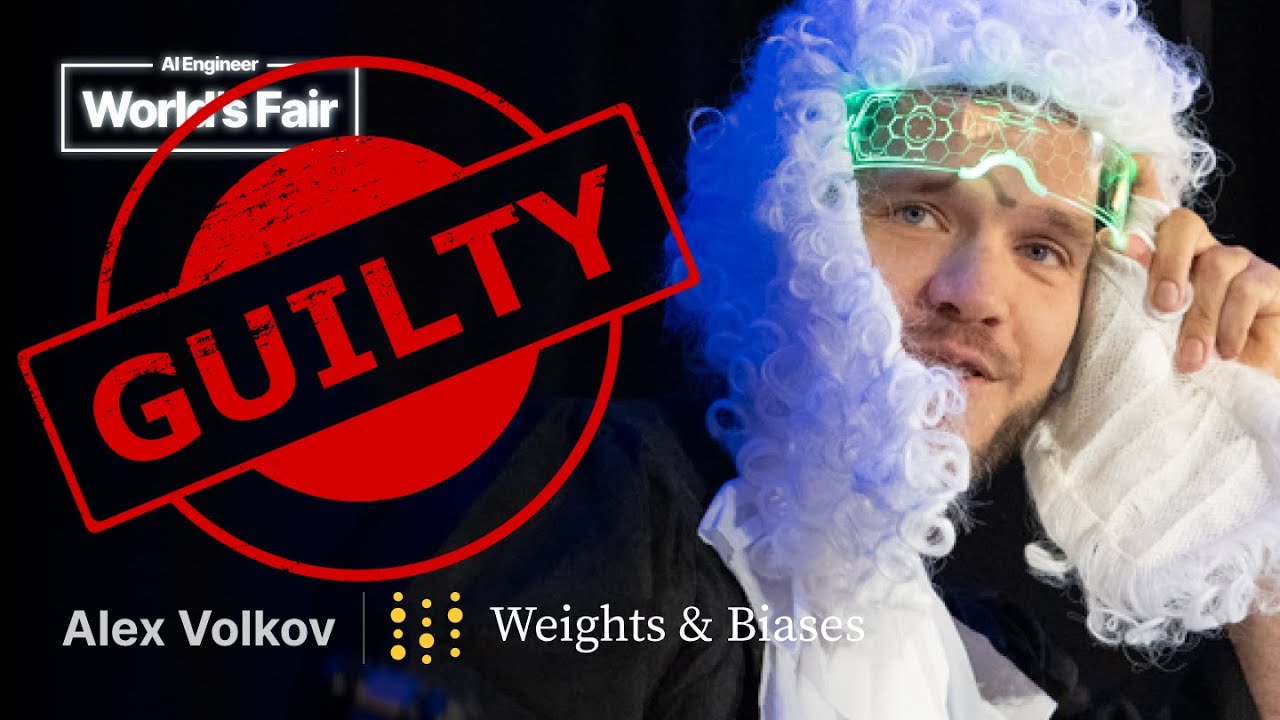
Judging LLMs: Alex Volkov
Sep 9, 2024 · 18:39
Alex Volkov, as an LLM judge from 2034, humorously judges AI engineers on their development practices, emphasizing the importance of tracing, iterative prompt engineering, and robust evaluation pipelines. He finds Daniel guilty of deploying without logging, Sasha guilty of premature fine-tuning without prompt iteration, and Morgan guilty of ignoring AI news—commuted to attending ThursdAI. Francisco’s overreliance on programmatic evals leads to a legal loss, while Maxime is 'awesome' for using Weights & Biases Weave. Alex concludes with a primer on evaluation methods: programmatic, human-in-the-loop, and LLM-as-judge, stressing the need to validate validators and create custom criteria. He promotes Weave for tracing and evals, and ThursdAI for staying updated.

Lessons From A Year Building With LLMs
Jul 19, 2024 · 35:21
The six authors of the O'Reilly article "Lessons From A Year Building With LLMs" — Bryan Bischof, Jason Liu, Hamel Husain, Eugene Yan, Shreya Shankar, and Swix — argue that the model itself is not a moat and that success comes from continuous improvement centered on evals and data. They stress that AI engineers should treat models as SaaS, quickly swapping for better ones, and focus on product and user interactions. The talk warns against toxic practices like prematurely hiring ML engineers without data or blindly adopting tools, advocating instead for deliberate eval practice and data literacy. On tactics, they compare LLM-as-judge (quick to prototype) vs fine-tuned evaluators (more precise and faster), and emphasize looking at real user data regularly with automated guardrails. Ultimately, they conclude that going from demo to production requires sustained investment in infrastructure and evaluation, echoing MLOps lessons from a decade ago.
Powered by PodHood