
ACE
ProductA product discussed on AI Engineer.
4 episodes

Don't Let the LLM Drive - Ornella Bahidika & Joel Allou, Microsoft
Jul 20, 2026 · 6:08
Ornella Bahidika and Joel Allou of Microsoft present their voice tutor Ace, arguing that the LLM should never control the flow in multi-step agents. They built Ace with a state machine that confines the model to narrow contracts per step, letting the harness validate outputs and decide next actions. This design allows them to use a cheaper, faster model (Haiku 4.5) instead of a heavy reasoning model (Opus 4.7 Cloud). They identify three decisions the LLM must never own: when the lesson ends, whether the student answered correctly, and what comes next. By engineering these checks outside the model, Ace achieves reliability in production, avoiding loops and early terminations that plague prompted-only approaches. The pattern applies to any flow agent, including coding agents, runbooks, and onboarding flows.

Your Voice Agent Doesn't Need a Frontier Model - Joel Allou & Ornella Bahidika, Microsoft
Jul 20, 2026 · 5:45
Joel Allou and Ornella Bahidika from Microsoft present ACE, an AI voice tutor that deliberately uses a small model instead of a frontier model, arguing that latency—not intelligence—is the critical constraint in voice applications. They demonstrate that a frontier model's reasoning time of multiple seconds breaks conversational flow, while their system keeps model latency under 950 milliseconds by extracting all logic and planning into a deterministic state machine. This scaffolding handles lesson progression, student mastery tracking, and response generation, leaving the small model (Haiku 4.5) with only the task of speaking. The result: a 900-millisecond response time that feels instantaneous. They acknowledge that scaffolding requires strict rules to prevent drift, but call it a one-time code investment that unlocks cost-effective, real-time performance. The episode’s core lesson: pick the fastest model your latency budget allows, then invest in external scaffolding to make it smart.
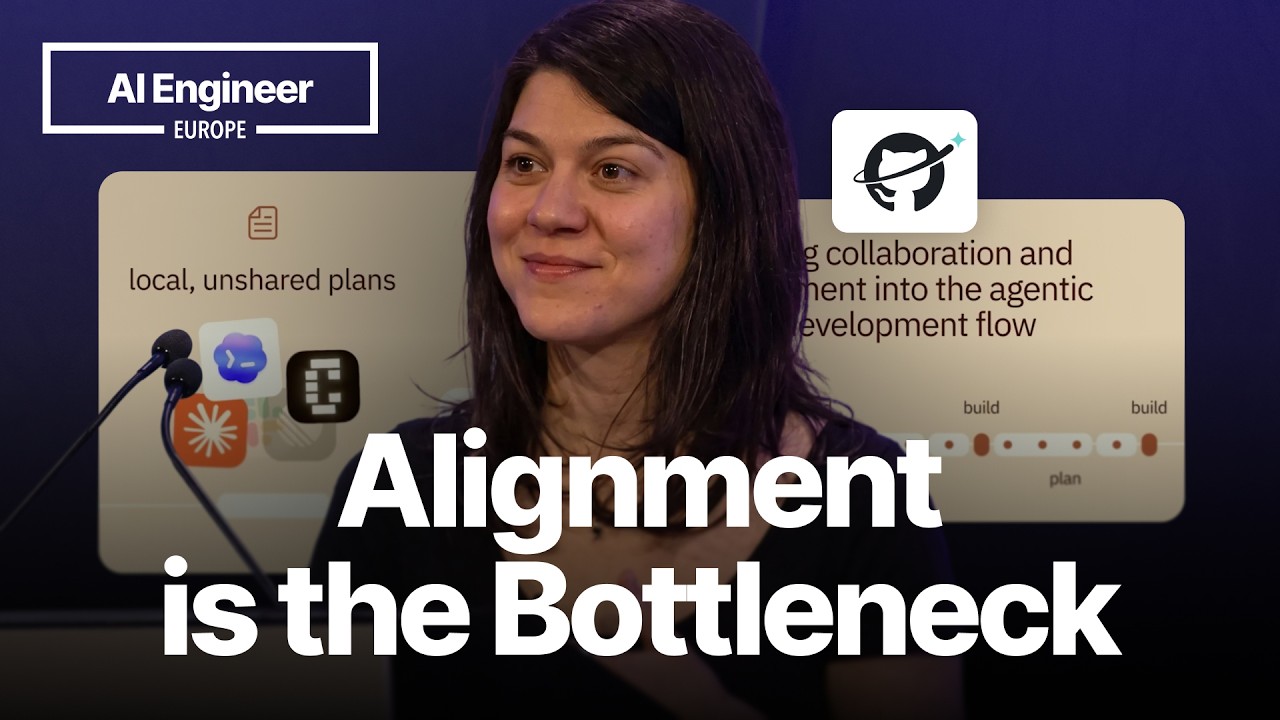
Collaborative AI Engineering: One Dev, Two Dozen Agents, Zero Alignment — Maggie Appleton, GitHub
Apr 26, 2026 · 17:43
Maggie Appleton, a staff research engineer at GitHub Next, argues that the current paradigm of one developer with a fleet of solo agents leads to zero team alignment, making software a team sport that requires shared context. She presents ACE (Agent Collaboration Environment), a multiplayer research prototype that provides shared chat sessions backed by micro VMs and Git branches, enabling real-time collaboration where designers, PMs, and developers can all prompt agents together. The talk emphasizes that implementation is now cheap and fast, so the hard question is "should we build it?" — requiring early, constant alignment to avoid wasted work, coordination debt, and unrequested features. ACE aims to reclaim time for rigorous critical thinking by letting teams plan, build, and review in a single shared space, with proactive agents summarizing team activity and unfinished work. Appleton contends that quality becomes the differentiator in a world of cheap code, and tools like ACE can help teams build a few exceptional things rather than a thousand crappy ones.

The Unbearable Lightness of Agent Optimization — Alberto Romero, Jointly
Nov 24, 2025 · 17:58
Alberto Romero, co-founder and CTO of Jointly, introduces Meta-ACE, a meta-optimization framework that orchestrates multiple adaptation strategies to overcome the limitations of single-dimensional context engineering like ACE. The framework uses a meta-controller to profile task complexity, uncertainty, verifiability, and resource constraints, then allocates strategies across context, compute, verification, memory, and parameter dimensions. Initial results show 8-11% improvement on agent benchmarks, 30-40% reduction in compute costs, and 6-8% gains on domain-specific tasks. Meta-ACE addresses ACE's weak reflector problem with quality gates and multi-signal reflection, feedback brittleness via a hierarchical verification cascade (self-verification, multimodal consensus, execution checks), and task complexity mismatch by dynamically adjusting strategy allocation to save up to 90% compute on simple tasks. Future work includes scaling to multimodal and compound AI systems, with challenges in meta-controller training stability, computational overhead, and verification cascade brittleness.
Powered by PodHood