
A100
ProductA product discussed on AI Engineer.
10 episodes

Sovereign Escape Velocity: Ownership w Open Models — Gus Martins, & Ian Ballantyne, Google DeepMind
Jun 10, 2026 · 20:52
Gus Martins and Ian Ballantyne of Google DeepMind introduce Gemma 4, a family of open-weight models that deliver high quality per parameter, enabling deployment on a single GPU or even a phone. They argue that the models' efficiency — a 31B model rivals those twenty times larger — and the shift to Apache 2.0 licensing remove barriers for sovereign institutions like those in Ukraine, Bulgaria, and Brazil. Ian demonstrates multi-agent translation running locally on an M4 Mac, showcasing ownership and control over agentic workloads.
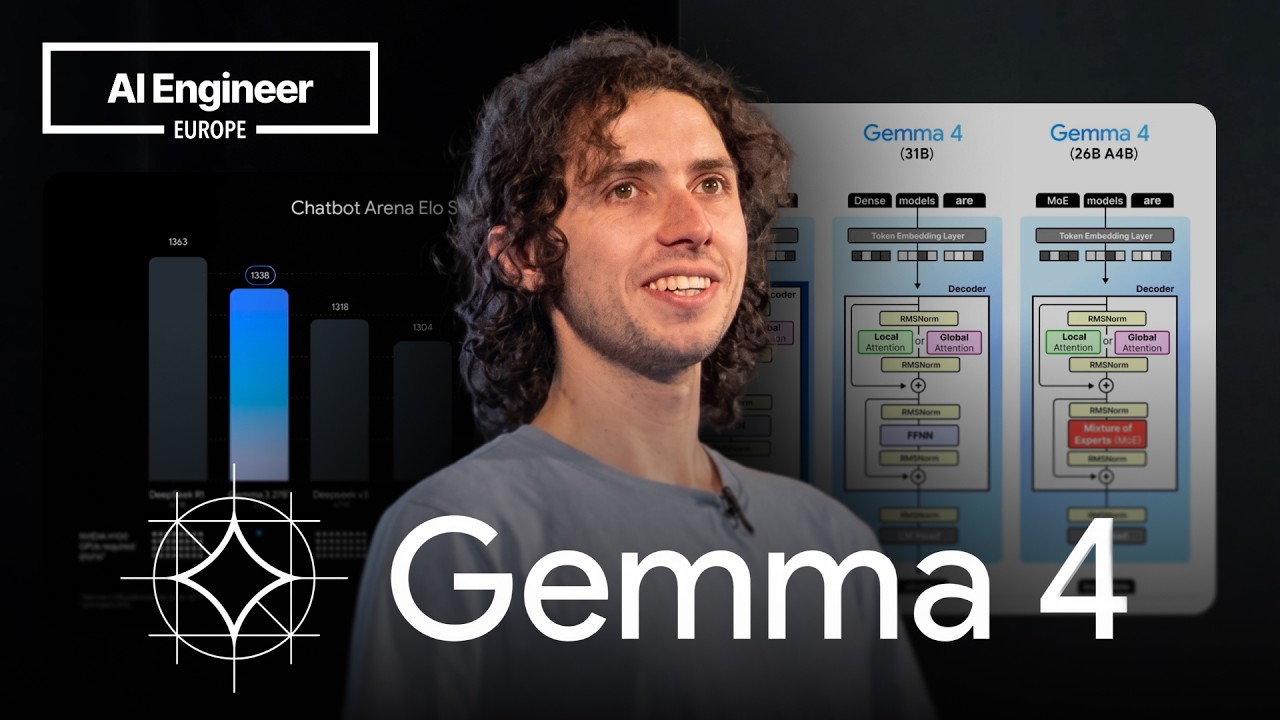
Gemma, DeepMind's Family of Open Models — Omar Sanseviero, Google DeepMind
Apr 20, 2026 · 15:26
Omar Sanseviero presents Gemma 4, Google DeepMind's latest family of open models, which range from 2B to 32B parameters and introduce a novel per-layer embedding (E2B) architecture optimized for on-device inference. The models feature multimodal understanding (images, video, audio), multilingual support across 140+ languages, and are released under an Apache 2 license. Within a week, Gemma 4 reached 10 million downloads, contributing to over 500 million total downloads for the Gemma family and 100,000 community-derived models. Sanseviero highlights official variants like Shield Gemma for content safety and MedGemma for medical tasks, as well as community efforts such as AI Singapore's Southeast Asian language models and Sarvam's sovereign AI initiative for India. He emphasizes real-world applications including cancer therapy pathway discovery and fully offline agentic tasks on phones and Raspberry Pis, arguing that open models are rapidly enabling high-performance, private, and customizable AI across diverse use cases.

Trends Across the AI Frontier — George Cameron, ArtificialAnalysis.ai
Jul 8, 2025 · 17:52
George Cameron of Artificial Analysis presents multiple frontiers—reasoning, open-weights, cost, speed—across the AI stack, arguing that trade-offs between intelligence, latency, and expense are critical for building applications. Reasoning models like O4 mini high use an order of magnitude more output tokens (72M vs GPT-4.1's 7M) and take over 40 seconds per response versus 4.7 seconds, impacting agentic workflows where 30 sequential calls multiply latency. The open-weights gap has nearly closed, with China-based labs like DeepSeek R1 and Alibaba's Qwen 3 leading. O3 cost roughly $2,000 to run the intelligence index, while GPT-4.1 nano is over 500 times cheaper. Output speeds have jumped from GPT-4's 40 tokens/s in 2023 to over 1,000 on a B200 accelerator. Despite efficiency gains, demand for compute will keep rising due to larger models, reasoning’s extra tokens, and multi-step agents.
Lessons from building GenAI based applications — Juan Peredo
Feb 22, 2025 · 33:13
Juan Peredo details the hidden complexities of building GenAI applications, from model hosting and cost control to output validation and observability. He compares local (Ollama) vs cloud hosting (Modal, SkyPilot) and warns that an agent processing 3,000 calls/day with OpenAI O1 costs nearly $300,000/month, while LLaMA 3.3 70B drops that to $50,000/month. He explains techniques to mitigate hallucinations—prompt engineering, guardrails, RAG, and fine-tuning—each with trade-offs like added latency or cost. Peredo advocates externalizing prompts via LangChain Hub for easy iteration and future-proofing, and illustrates agent design with parallel calls to reduce latency. Finally, he stresses observability using tools like LangSmith to debug probabilistic failures, such as an LLM failing on case sensitivity.
Keynote: The AI developer experience doesn't have to suck – why and how we built Modal
Feb 22, 2025 · 21:38
Eric Bernhardson, CEO of Modal, explains why and how his company replaced Kubernetes and Docker with a custom container system to deliver sub-second cold starts for AI developers. Modal turns any Python function into a serverless function with a decorator, runs on thousands of H100s, and fans out to 10,000 parallel calls. To achieve fast startup, Modal built content-addressable storage for deduplication, lazy file loading with prefetching, and uses gVisor for CPU memory snapshotting, cutting Stable Diffusion startup to seconds. The company built its own scheduler and file system, and uses mixed integer programming to manage a global GPU pool across cloud vendors. Customers like Suno use Modal for AI-generated music inference. Modal offers $30/month free credits.

System Design for Next-Gen Frontier Models — Dylan Patel, SemiAnalysis
Feb 11, 2025 · 18:29
Dylan Patel of SemiAnalysis breaks down the inference challenges for next-generation frontier models like GPT-4 (1.8 trillion parameters) and upcoming models trained on 100,000+ GPU clusters. He emphasizes that prefill (prompt processing) is compute-intensive while decode (token generation) is memory bandwidth-intensive, creating a systems problem where serving 64 users at 30 tokens/second requires 60 terabytes/second of memory bandwidth. Patel details engineering strategies such as continuous batching to improve batch utilization by 10-100x, disaggregated prefill to isolate noisy neighbors and maintain time-to-first-token SLAs, and context caching (like Google's) to cache KV cache on CPU/storage instead of GPU memory, dramatically reducing prefill costs. He warns that open-source tools like LLaMA.cpp lack these optimizations, making high-performance serving of models like LLaMA 405b infeasible without libraries like vLLM or TensorRT-LLM. On scaling, Patel notes that 100,000 GPU clusters (e.g., Microsoft's Arizona data center consuming 150 MW) face reliability issues — optical transceivers fail every five minutes — and straggler chips (silicon lottery) can degrade training…

Insights from Snorkel AI running Azure AI Infrastructure: Humza Iqbal and Lachlan Ainley
Feb 8, 2025 · 20:46
Humza Iqbal of Snorkel AI explains how the company uses Azure AI infrastructure powered by NVIDIA GPUs to fine-tune foundation models for enterprise customers, achieving better performance per dollar by switching from A100s to H100s. He details their distributed training stack (PyTorch, Horovod, NFS) and lessons learned such as balancing node count for batch size and monitoring GPU utilization to avoid networking or data-loading bottlenecks. A cost comparison found two H100s outperformed four A100s on both training and inference, enabling faster iteration through more synthetic data. Azure's dedicated VMs, reliable NFS throughput, and flexible capacity allowed Snorkel to scale experiments from single-node to dozens of GPUs. Future work includes programmatic preference signals and multimodal retrieval algorithms, all planned on Azure.
Mastering LLM Inference Optimization From Theory to Cost Effective Deployment: Mark Moyou
Jan 1, 2025 · 33:39
NVIDIA solutions architect Mark Moyou explains that LLM inference differs fundamentally from standard deep learning deployment, requiring careful management of KV Cache, attention mechanisms, and GPU memory to control cost. He details how tokens are processed: prefill computes attention across the entire prompt, then generation produces one token at a time, with KV Cache storing key-value pairs to avoid recomputation. Llama's 32 attention heads and FP8 quantization (halving memory with near-identical accuracy) are cited as key optimizations. Moyou emphasizes measuring time to first token, inter-token latency, and input/output sequence length distributions to size inference engines. He presents NVIDIA's TRT-LLM (model compilation for LLMs) and Triton inference server as tools to maximize throughput, and discusses how query patterns like long-input-short-output or short-input-long-output impact GPU utilization and deployment cost.

From model weights to API endpoint with TensorRT LLM: Philip Kiely and Pankaj Gupta
Sep 13, 2024 · 1:40:01
Philip Kiely and Pankaj Gupta of Baseten lead a workshop on TensorRT-LLM, NVIDIA's high-performance inference framework for LLMs, arguing its use delivers best-in-class throughput and latency on NVIDIA GPUs. They explain that TensorRT-LLM optimizes computational graphs via plugin kernels and in-flight batching, achieving 216 tokens per second and 180ms time to first token on Mistral 7B. The workshop demonstrates building an engine for TinyLlama 1.1B, including FP8 quantization that reduced engine size from 2 GB to 1.2 GB with minimal quality loss. They benchmark a deployed model, showing 7,000 total tokens per second at batch size 64 on an A10G. The presenters compare TensorRT-LLM favorably to VLLM for high-throughput production use and introduce Truss, Baseten's open-source packaging tool, alongside their managed platform for automatic scaling and fast cold starts.

[Workshop] AI Engineering 201: Inference
Nov 7, 2023 · 1:43:16
Charles Frye, instructor of the Full Stack LLM Bootcamp, leads a workshop on AI engineering inference, focusing on the build-versus-buy decision between proprietary and open models. He argues that proprietary models like OpenAI's GPT-4 and Anthropic's Claude are currently more capable but expensive, while open models like LLaMA 2 are less capable but offer hackability, though they may catch up if capabilities requirements saturate. Frye covers inference on end-user devices, noting that running models locally avoids network latency but faces tight memory and power constraints—e.g., a 7B parameter model requires 14 GB, too large for phone RAM. He explains inference-as-a-service (e.g., OpenAI, Replicate) versus self-serving on cloud GPUs or serverless platforms like Modal, highlighting that memory bandwidth is the bottleneck: GPUs have 1.5 TB/s memory bandwidth vs 312 TFLOPS compute, so batching is crucial for throughput. Frye also discusses inference arithmetic, custom silicon like TPUs which offer ~30% better efficiency but not drastic gains, and containerization challenges for GPU workloads.
Powered by PodHood