
4.0
ProductA product discussed on AI Engineer.
3 episodes

The New Code — Sean Grove, OpenAI
Jul 11, 2025 · 21:36
Sean Grove of OpenAI argues that specifications, not code, are becoming the fundamental unit of programming, with the most valuable skill being precise communication of intent. He presents OpenAI's Model Spec—a collection of versioned Markdown files—as a living specification that aligns both humans and models around shared values and intentions. Grove illustrates how the Model Spec served as a trust anchor during the 4.0 sycophancy bug, where shipped behavior contradicted the spec's explicit 'don't be sycophantic' clause, leading to a rollback. He explains deliberative alignment, where the spec is used as training and eval material to embed policy into model weights, moving from inference-time prompting to muscled memory. Drawing parallels to the US Constitution, Grove positions specifications as executable, testable artifacts that compose like code, and suggests future IDEs will become 'integrated thought clarifiers.' He closes by calling for help in aligning agents at scale, noting OpenAI's new agent robustness team.

Buy Now, Maybe Pay Later: Dealing with Prompt-Tax While Staying at the Frontier - Andrew Thomspson
Jun 3, 2025 · 25:09
Andrew Thompson, CTO of Orbital, introduces the concept of Prompt-Tax: the hidden cost of migrating prompts when upgrading AI models. He shares how his agentic product automates real estate due diligence, growing from <1B to 20B monthly tokens and zero to multiple seven-figure ARR over 18 months. Key tactics include optimizing for prompting over fine-tuning, using domain experts (ex-lawyers) to write prompts, and relying on vibes over formal evals. Thompson advocates 'betting on the model'—shipping new frontier models immediately and fixing regressions on the fly using progressive rollouts and rapid feedback loops. A clip from Demis Hassabis underscores the unique challenge of evolving tech stacks. The episode concludes with questions on whether evals or progressive delivery scale to manage Prompt-Tax.
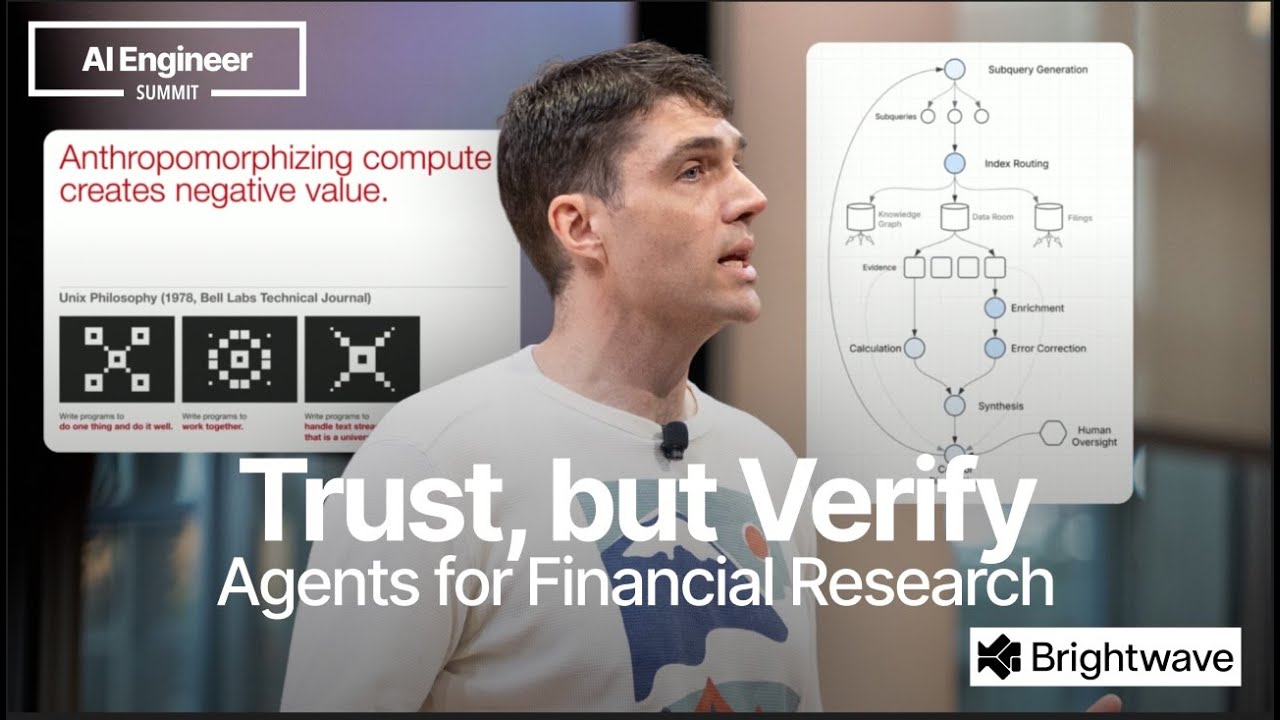
Trust, but Verify: Knowledge Agents for Finance Workflows - Mike Conover
Apr 9, 2025 · 21:10
Mike Conover, CEO of Brightwave, explains how his company builds knowledge agents for financial workflows, digesting thousands of pages of content for due diligence and research. He argues that non-reasoning models perform only local search, so winning systems must use end-to-end reinforcement learning over tool-use calls to achieve globally optimal outputs. Conover describes design patterns like decomposing research into sub-themes, using secondary calls for error correction, and avoiding the latency trap of long feedback loops. He emphasizes that synthesis—weaving facts across documents—remains a hard problem due to limited recombinative reasoning in training data. Brightwave's product reveals its thought process through interactive citations and structured findings, allowing analysts to drill into any passage. The episode also notes the company is hiring, offering a $10,000 referral bonus.
Powered by PodHood