
03
ProductA product discussed on AI Engineer.
3 episodes

Five hard earned lessons about Evals — Ankur Goyal, Braintrust
Aug 23, 2025 · 19:46
Ankur Goyal of Braintrust argues that successful AI applications depend on deliberately engineered evaluations (evals) to reflect real user feedback and drive product improvements. He details three signs of effective evals: launching updates within 24 hours (citing Notion), converting complaints into evals, and using evals offensively to assess use cases before shipping. Evals require custom scorers as specs—not off-the-shelf—and context engineering (optimizing tool definitions and outputs) is the new frontier; shifting outputs from JSON to YAML improves token efficiency. New models can upend everything, as shown by a benchmark that jumped from 10% to viable with Claude 4 Sonnet, so a model-agnostic architecture with proxies is key. Optimize the whole system (data, task, scoring)—Braintrust's Loop auto-optimizes prompts, data, and scorers. In Q&A, he advises human judgment when adding user feedback to evals to avoid overfitting.
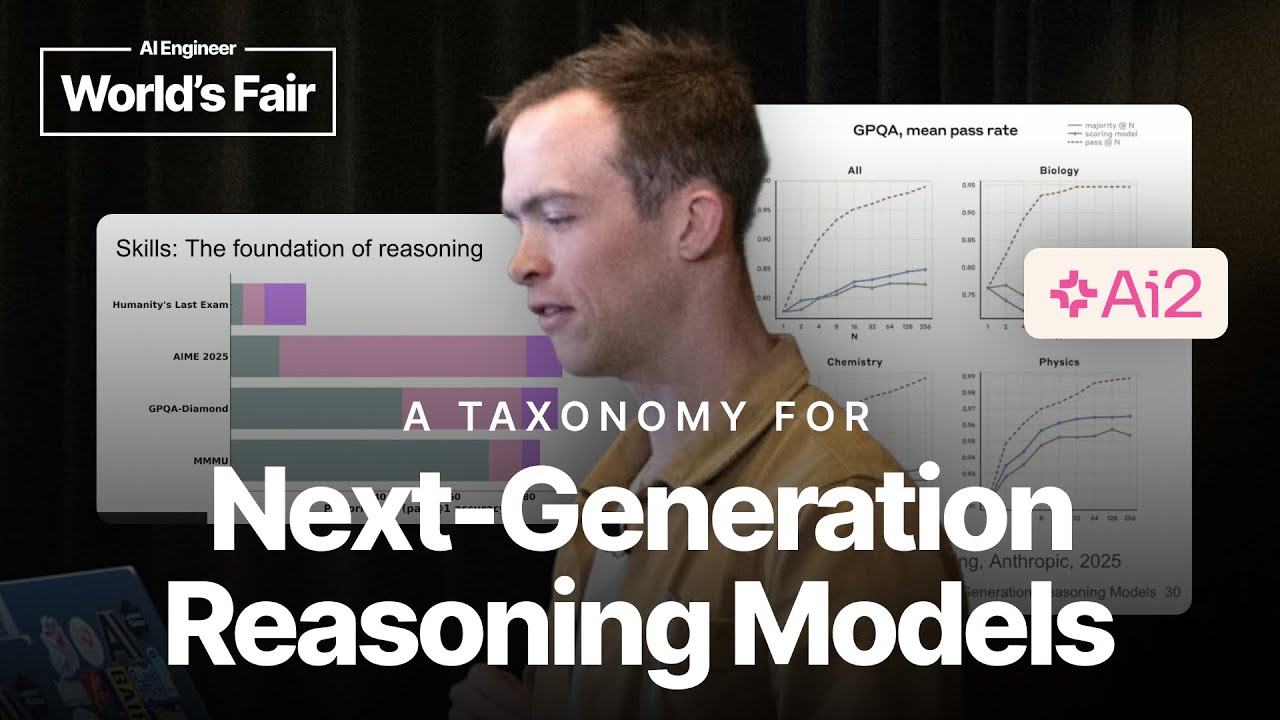
A Taxonomy for Next-gen Reasoning — Nathan Lambert, Allen Institute (AI2) & Interconnects.ai
Jul 19, 2025 · 19:21
Nathan Lambert, senior research scientist at AI2 and founder of Interconnects.ai, argues that next-generation reasoning models require a taxonomy of four traits: skills, calibration, strategy, and abstraction. While current models excel at math and code (skills), they overthink easy problems, wasting tokens and latency—calibration is needed to match output length to task difficulty. The real frontier is planning: models must learn strategy (choosing the right direction) and abstraction (breaking problems into tractable sub-tasks) to enable long-horizon agents like Deep Research and Claude Code. Lambert traces how OpenAI's Q*→Strawberry→o1 took 12–18 months of human data to teach backtracking and verification; planning should be easier because humans can write 5-step plans. He predicts post-training compute could reach parity with pre-training, citing DeepSeek's shift from 0.18% post-training compute in V3 to an estimated 10–20% for R1. The path forward: collect diverse verifiable questions, filter by difficulty, run stable RL—then scale.

Evaluating Domain Specific LLMs for Real World Finance — Waseem Alshikh, Writer
Apr 22, 2025 · 12:01
Writer CTO Waseem Alshikh presents FailSafe, a benchmark for evaluating LLMs in real-world finance, challenging the notion that general-purpose models suffice. Tests on query failures (misspelling, incomplete, out-of-domain) and context failures (missing context, OCR errors, irrelevant context) reveal that reasoning models like o1 and o3 perform 50% to 60% worse on context grounding than smaller domain-specific models, despite higher answerability. Even the best model achieves only 81% combined robustness and grounding, meaning roughly 20% of responses are wrong. Alshikh argues that domain-specific models remain essential, and that full-stack systems—RAG, guardrails, and grounding—are necessary for reliable deployment in high-stakes finance.
Powered by PodHood