
Zach Blumenfeld
GuestGuest on AI Engineer.
4 episodes

Why your agents need decision traces, not just documents — Zach Blumenfeld, Neo4j
May 29, 2026 · 20:12
Zach Blumenfeld from Neo4j argues that context graphs—a graph-based layer storing decision traces, precedence, and causal chains—extend standard RAG to make AI agents more accurate and explainable. A financial analyst agent, for example, can reject or accept a request by retrieving past decision traces and structurally similar precedents via graph embeddings, not just semantic similarity. Neo4j's one-command tool `uvx create-context-graph` scaffolds a full-stack app with backend, frontend, demo data, and MCP server, supporting 22 built-in domains or custom ontology generation. The underlying `neo4j-agent-memory` package handles entity extraction through a spaCy-to-GLiNER-to-LLM pipeline with deduplication and integrates with pydantic AI, LangGraph, Crew, Google ADK, and others. The episode also covers data connectors for GitHub, Notion, Jira, and Slack, and the ability to store and query decision traces with timestamps, though automated trace quality evaluation is still evolving.

Intro to GraphRAG — Zach Blumenfeld
Jun 30, 2025 · 1:18:35
Zach Blumenfeld introduces GraphRAG using Neo4j, showing how to build knowledge graphs from employee and skill data, combine structured and unstructured data, and use graph traversal with vector search for retrieval. The workshop covers Cypher query patterns for multi-hop similarity, entity extraction from resumes via LLMs, and creating semantic similarity relationships. It demonstrates Leiden community detection for skill clustering and builds a LangGraph agent with four custom tools that balance exact skill matches with vector similarity. Blumenfeld argues that knowledge graphs provide controlled, explainable retrieval logic for agentic workflows, enabling developers to decompose data into graph models that expose domain logic for more accurate retrieval than pure vector search.
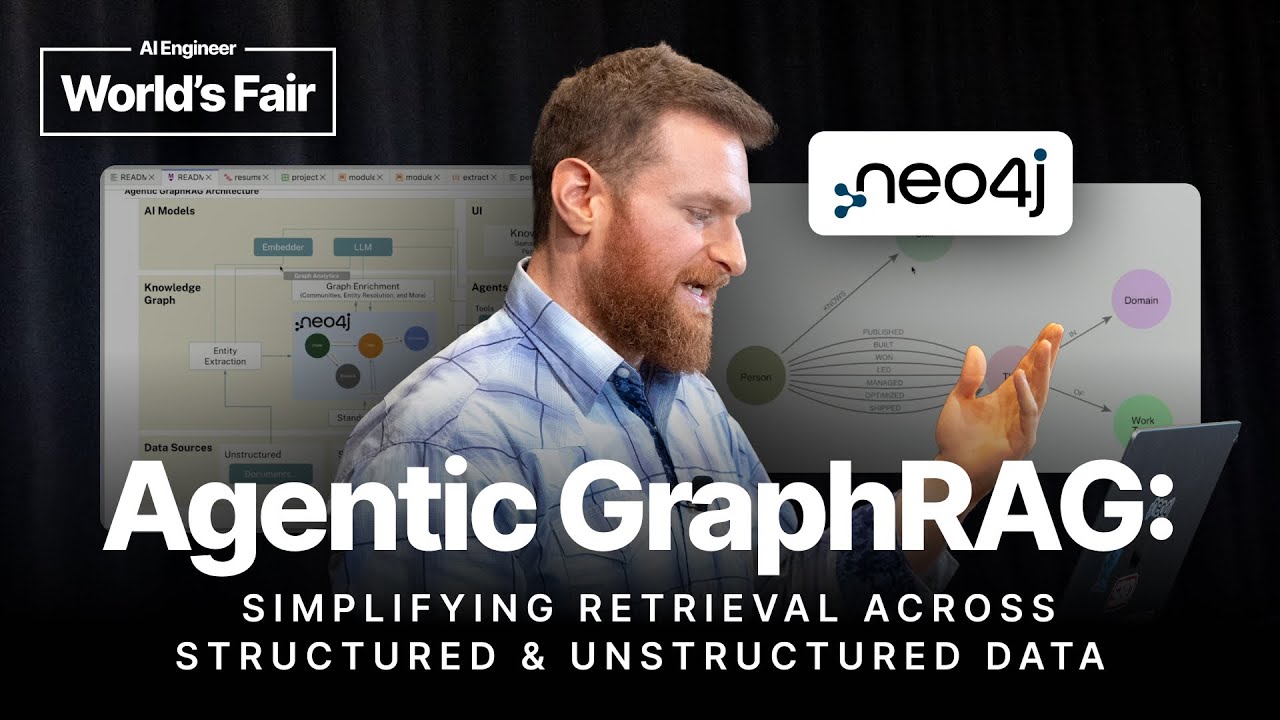
Agentic GraphRAG: Simplifying Retrieval Across Structured & Unstructured Data — Zach Blumenfeld
Jun 27, 2025 · 15:25
Zach Blumenfeld (Neo4j) demonstrates how a knowledge graph simplifies agentic retrieval across structured and unstructured data, using an employee skill graph as an example. He shows that a plain document search fails to answer questions like "how many Python developers" (returns 5 instead of 28) or "who is most similar to Lucas Martinez" — but after extracting entities into a Neo4j graph, the agent can run precise Cypher queries via an MCP server, correctly reporting 28 Python devs and identifying Sarah as the closest match via skill overlap. He also shows how to flexibly add new relationships (e.g., project collaborators from an HR system) without schema changes, enabling questions like "which individuals collaborated most on AI projects" to return exact pairings like Sarah and Amanda. The talk emphasizes accuracy, explainability, and the ability to start with a simple data model and expand as agents ingest more data.
Knowledge Graphs & GraphRAG: Techniques for Building Effective GenAI Applications: Zach Blumenthal
Nov 1, 2024 · 1:39:52
In this workshop, Zach Blumenthal of Neo4j demonstrates how to build a GraphRAG application using Neo4j, OpenAI, and LangChain on an H&M fashion dataset. He argues that combining knowledge graphs with vector search and graph embeddings improves retrieval and personalization for LLMs. The session covers creating a Neo4j sandbox, loading data, performing vector search with OpenAI embeddings, adding collaborative filtering via graph traversal patterns, using graph data science (FastRP) to generate graph embeddings for recommendations, and integrating everything into a LangChain chain that generates personalized marketing emails. Attendees build a Gradio app that, given a customer ID and season, outputs a tailored email with product recommendations, demonstrating how structured graph data enhances RAG systems beyond pure vector search.
Powered by PodHood