
swyx
HostHost of AI Engineer.
10 episodes

Agents for Everything Else — swyx
May 1, 2026 · 14:10
swyx, co-founder of AI Engineer Conferences, details how his team of nine full‑time people uses coding agents like Devin and Town to run the conference, moving from a non‑AI stack to agents that handle everything from Figma‑to‑website conversion and schedule management to buying a lobster for the event. He claims these agents save “yak shaving” and increase human productivity because employees enjoy faster feedback cycles, leading to more work like animations and polish. The team now manages a 1,000‑person conference with plans to handle 6,000 in San Francisco without growing headcount. Swyx also advocates for “agents for everything else,” predicting that the primary user of software will shift from humans to bots, making APIs and MCPs more important than dashboards. He urges attendees to adopt agents and “prescribe” them to skeptical coworkers.
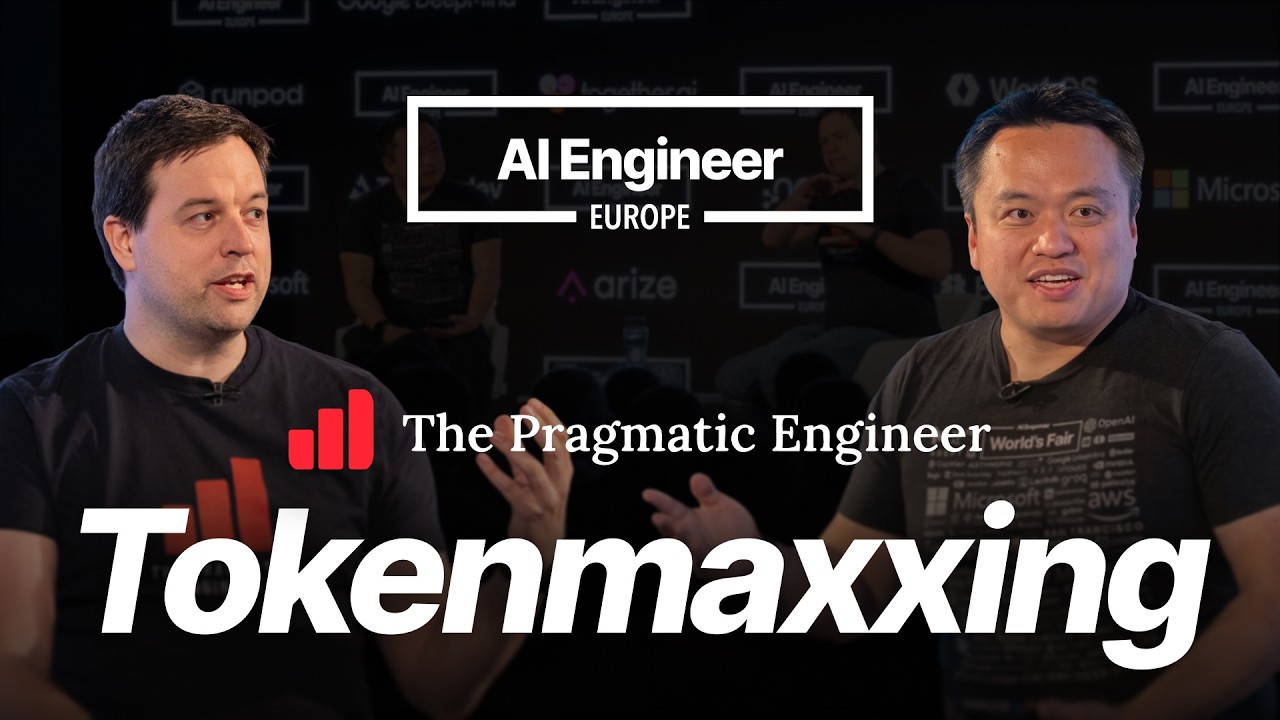
How AI is changing Software Engineering: A Conversation with Gergely Orosz, @pragmaticengineer
Apr 21, 2026 · 26:42
Gergely Orosz explains how AI is reshaping software engineering, from token maxing at Meta, Microsoft, and Salesforce—where engineers use AI tools to inflate token counts out of fear of layoffs and performance reviews—to the broader shift in the engineer's role toward orchestrating agents rather than managing people. He notes that big tech companies like Uber, Airbnb, and Shopify are building custom internal AI infra (MCP gateways, coding agents) to stay ahead, even tolerating high churn for a six-month competitive edge. Shopify secured GitHub Copilot a year early by offering feedback from 3,000 engineers. Gergely also shares how The Pragmatic Engineer hit product-market fit: 100 paid subscribers before publishing, reaching 1,000 in six weeks, and becoming the #1 paid tech newsletter by focusing on two deep-dive articles per week for two years.

State of the Claw — Peter Steinberger
Apr 17, 2026 · 44:12
Peter Steinberger, creator of OpenClaw, presents a five-month update on the world's fastest-growing open-source project. He details the project's staggering growth—30,000 commits, nearly 2,000 contributors—and the immense security burden: 1,142 advisories (16.6 per day) with 99 critical, often AI-generated slop that demands human vetting. Steinberger refutes media fearmongering, citing how researchers ignore security docs to fabricate scary scenarios. He clarifies OpenAI did not buy OpenClaw; he joined the company while establishing the OpenClaw Foundation to remain vendor-neutral. He emphasizes the importance of local models for data sovereignty and describes his coding workflow of running 5-6 agent sessions simultaneously, iterating on taste and personality. Future visions include ubiquitous agents, 'Dreaming' for memory reconciliation, and modular plugins. For engineers, he champions taste, system design, and learning to say no.

No More Slop – swyx
Dec 22, 2025 · 9:15
In this keynote at the AI Engineer Summit, host swyx declares war on slop — low-quality, inauthentic, inaccurate work produced by both humans and AI — arguing that the AI engineering community must elevate taste and accountability. He introduces Swix's law of anti-slop: the taste needed to fight slop scales with the plummeting cost of generating tokens. Swyx demonstrates how to combat slop using AI itself, citing examples like AI News (which tells readers to skip slow days), prompting techniques to avoid slop, and using sub-agents against context rot. He calls for rejecting autonomy without accountability and urges the audience to say "no more slop" to bosses demanding more lines of code, untested releases, and engagement bait.

Designing AI-Intensive Applications - swyx
Aug 9, 2025 · 13:02
In this conference talk, swyx (host) proposes the search for a 'Standard Model' in AI engineering, analogous to physics' Standard Model, to guide practitioners. He examines candidate models: LMOS (LLM Operating System), LMSDLC (AI Software Development Lifecycle), and Anthropic's 'building effective agents' framework. Swyx introduces his own SPADE model (Sync, Plan, Analyze, Deliver, Evaluate), derived from building AI News, a daily tool that scrapes Discord, Reddit, and Twitter with thousands of LLM calls. He argues that the ratio of human input to AI output—ranging from 1:1 in ChatGPT to 0:n in ambient agents—is more useful than debating 'workflow versus agent.' The talk emphasizes that early SDLC stages (LLMs, monitoring, RAG) are becoming commodity, while real value comes from evals, security orchestration, and hard engineering. Swyx encourages attendees to identify and refine their own Standard Models to build products people want.

Function Calling is All You Need — Full Workshop, with Ilan Bigio of OpenAI
Apr 23, 2025 · 1:42:54
Ilan Bigio from OpenAI argues function calling is the essential primitive for building AI agents, demonstrating how to implement memory, delegation, asynchronous task execution, and even self-modifying tools—all using the same loop. Starting from a basic weather tool, he builds an agent that stores user facts in a JSON file, delegates complex requests to o1, runs multiple weather lookups in parallel with asyncio, and creates a Bootstrap agent that writes its own Python functions on the fly. He also shares practical tips from his work on Swarm and the Real-Time API, including a stay-silent function to prevent premature responses and the ability to read scripts with XML tags. The workshop emphasizes that sophisticated agent behaviors emerge from simple function calling patterns without needing heavy frameworks.

Why Agent Engineering — swyx
Mar 24, 2025 · 11:45
Swyx argues that 2025 is the year of agent engineering, pivoting the AI Engineer Summit to focus exclusively on agents and explaining why agents are now viable due to advancements in reasoning, tool use, model diversity, and a 1000x cost reduction in GPT-4-level intelligence over 18 months. He highlights that OpenAI's ChatGPT grew 33% to 400M users in three months after shipping agentic O1 models, and projects it will reach 1B users by year-end. Swyx cites Simon Willison's crowdsourced definitions and OpenAI's new agent definition, while calling for a halt to demos of flight booking agents and Reddit astroturfing. He frames agent engineering as the evolution of AI engineering, distinct from MLE and software engineering, with practical use cases like coding and support agents having clear product-market fit.

AI Engineering Without Borders — swyx
Oct 30, 2024 · 10:32
In this talk from the AI Engineer World's Fair, host swyx argues that AI inherently disrespects human-made borders—it is naturally multilingual, multimodal, and indifferent to copyright or ground truth. He challenges the field to define its own laws, distinguishing constants (e.g., humans speak at 80 wpm vs. read at 200 wpm) from contingent facts (e.g., Apple Intelligence's 30 tokens/sec baseline). Reflecting on one year of the 'Rise of the AI Engineer,' he notes that the conference tracks—RAG, code gen, agents, multimodality—are arbitrary constructs we created, not natural categories. He proposes that AI Engineering sits between software engineering and real engineering: it must apply natural sciences for humanity's benefit. The talk concludes with a call to 'disagree more'—with your own conclusions, each other, and the status quo—and to transform the Shoggoth of raw AI into mass transit tools for society.

120k players in a week: Lessons from the first viral CLIP app: Joseph Nelson
Nov 22, 2023 · 15:59
Joseph Nelson (Roboflow CEO) details building paint.wtf, a viral AI Pictionary game using OpenAI CLIP that attracted 120,000 players in its first week, peaking at 7 submissions per second. The architecture uses GPT-3 to generate prompts, a browser canvas for drawing, and CLIP to judge similarity between text and image embeddings. Key lessons include CLIP's ability to read text, requiring a moderation hack that penalizes images more similar to handwriting than the prompt; CLIP's conservative similarity scores (ranging 8% to 48%); and the necessity of using CLIP itself to block NSFW content. Nelson also live-codes a minimal MVP in under 50 lines of Python using Roboflow's open-source inference server, demonstrating CLIP embedding and cosine similarity. The talk underscores foundation models' new paradigm of open-set understanding.
The 1,000x AI Engineer: Swyx
Oct 23, 2023 · 9:27
Swyx argues that AI engineers are just in time for a 1,000x opportunity, drawing on historical tech cycles and compute scaling laws. He cites Carlota Perez's tech revolution cycles, placing the AI revolution's start at AlexNet in 2012. With compute growing 600x by decade's end, GPT-3 took one person-year of compute, GPT-4 took 100, and GPT-10 will exceed all human compute ever. He defines three AI engineer types: AI Enhanced (Copilot-like), AI Product (Midjourney), and AI Agent (Auto-GPT). To achieve 1,000x, he advises scaling knowledge from O(n) (attending talks) to O(n²) (teaching others) to O(2^n) (building networks).
Powered by PodHood