
Rachel Nabors
GuestGuest on AI Engineer.
2 episodes
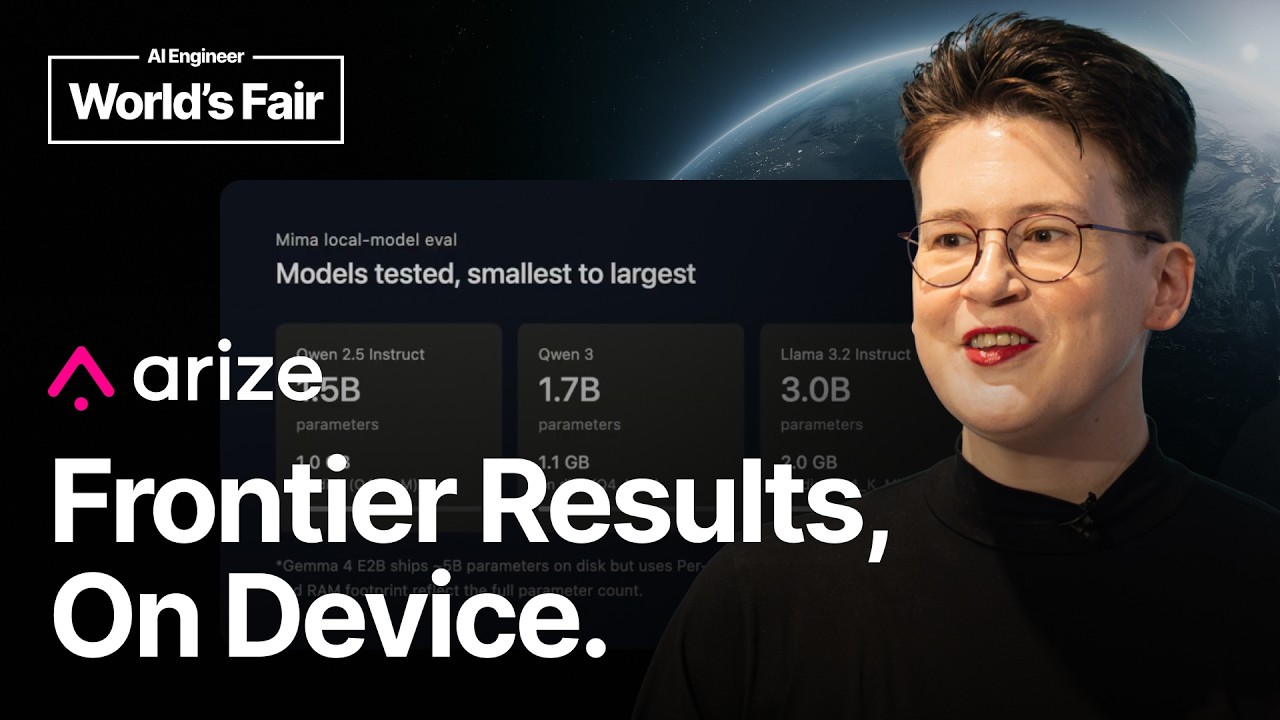
Frontier results, on device - RL Nabors, Arize
Jun 29, 2026 · 30:52
RL Nabors (Arize) argues that most frontier-model calls can be replaced by smaller, local models, saving cost, latency, and energy. She presents a four-step framework: prototype big with a foundation model, collect a golden dataset, run capability evals using Arize's open-source Phoenix, then select the 'sage' (small and good enough) model. Demonstrating with her social app Mima, she tested Qwen 2.5, Qwen 3, LLaMA 3.2, and Gemma 4 against Claude Sonnet on summary accuracy, latency, and cost. LLaMA 3.2 (3B params) won at 90% accuracy and 1-second P50 latency, versus Gemma 4's 8 seconds. Prompt engineering—specifically few-shot prompting—closed the gap further, achieving 92.9% factual consistency and 100% JSON validity. Nabors emphasizes running regression evals to prevent regressions, and notes that on-device inference eliminates data exposure and round-trip latency.

Introducing WebMCP: Agents in the Browser — RL Nabors
May 23, 2026 · 23:08
Rachel Nabors, former web standards contributor and now Principal Developer Experience Engineer at Arise, argues that chat-only agent interfaces (the 'starfish' design) are the CLI of the future and demonstrates how to replace them with rich interactive surfaces using MCP Apps and WebMCP. She explains STDIO vs HTTP transports, shows how MCP Apps bundle HTML, CSS, and JavaScript into single files rendered in agent iframes, and introduces WebMCP, which adds tool attributes to existing page elements so browser agents can call functions without screenshot parsing or DOM traversal. Using her own web comic site as a case study, she builds a comic reader with full panel navigation, transcript mode, and speech synthesis via the Web Speech API, and advocates for better client support of MCP resources to avoid inefficient tool calls for context loading.
Powered by PodHood