
Mike
GuestGuest on AI Engineer.
2 episodes
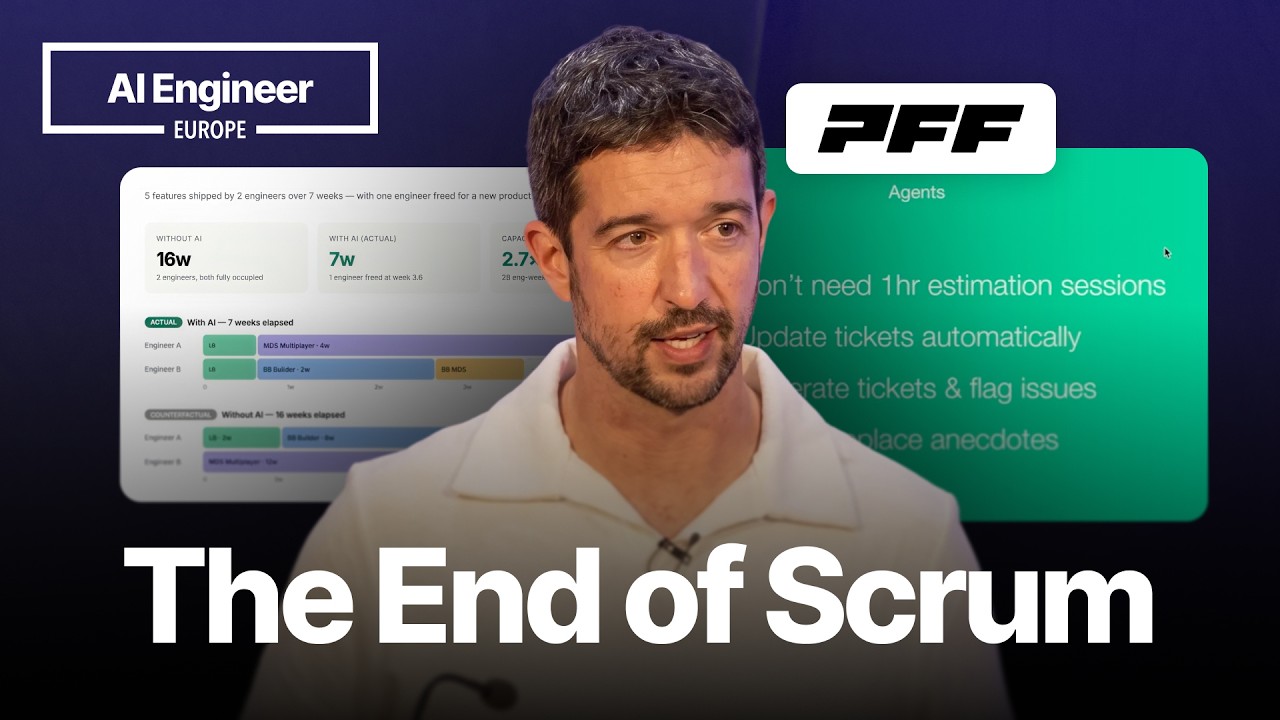
Agents Don't Do Standups: Building the Post-Engineer Engineering Org — Mike Spitz, PFF
May 15, 2026 · 17:50
Mike Spitz, CTO of PFF, details a three-month case study where two engineers using AI agents outperformed a team of ten, achieving 25x more deployments and 10x higher output by ticket complexity. The two engineers deployed five times daily while the ten deployed once every five days; customer satisfaction rose to 8.6 out of 10 from a prior 7–7.5. Scrum practices were eliminated—standups, sprint planning, and retrospectives—replaced by every-other-day huddles. The new workflow moves from a spec to a lightweight design document (LDD) to auto-generated tickets and PRs, with agents handling style and naming in code reviews. A QA agent spins up on staging after each merge to check acceptance criteria against tickets. Spitz advises starting slowly with engineers who have deep system knowledge, encoding engineering culture into composable skills, and treating the development lifecycle like a factory.

Full Walkthrough: Workflow for AI Coding — Matt Pocock
Apr 24, 2026 · 1:36:30
Matt Pocock presents a hands-on workshop on building a full AI-assisted coding workflow, arguing that software engineering fundamentals—not hype—make agents effective. He introduces the 'smart zone' and 'dumb zone' of LLMs (performance drops after ~100k tokens) and the 'Memento problem' (agents forget between sessions). His process starts with a 'Grill Me' skill that relentlessly questions the user until shared understanding is reached, then produces a PRD without reading it, slices work into vertical 'tracer bullet' issues, and runs agents AFK using TDD. He advocates designing codebases with deep, testable modules and shows Sandcastle, a TypeScript library for parallel agent execution with separate implementer (Sonnet) and reviewer (Opus). The workshop transforms ambiguous briefs into shippable features while keeping humans in the loop for QA and taste.
Powered by PodHood