
Maxime Labonne
GuestGuest on AI Engineer.
2 episodes
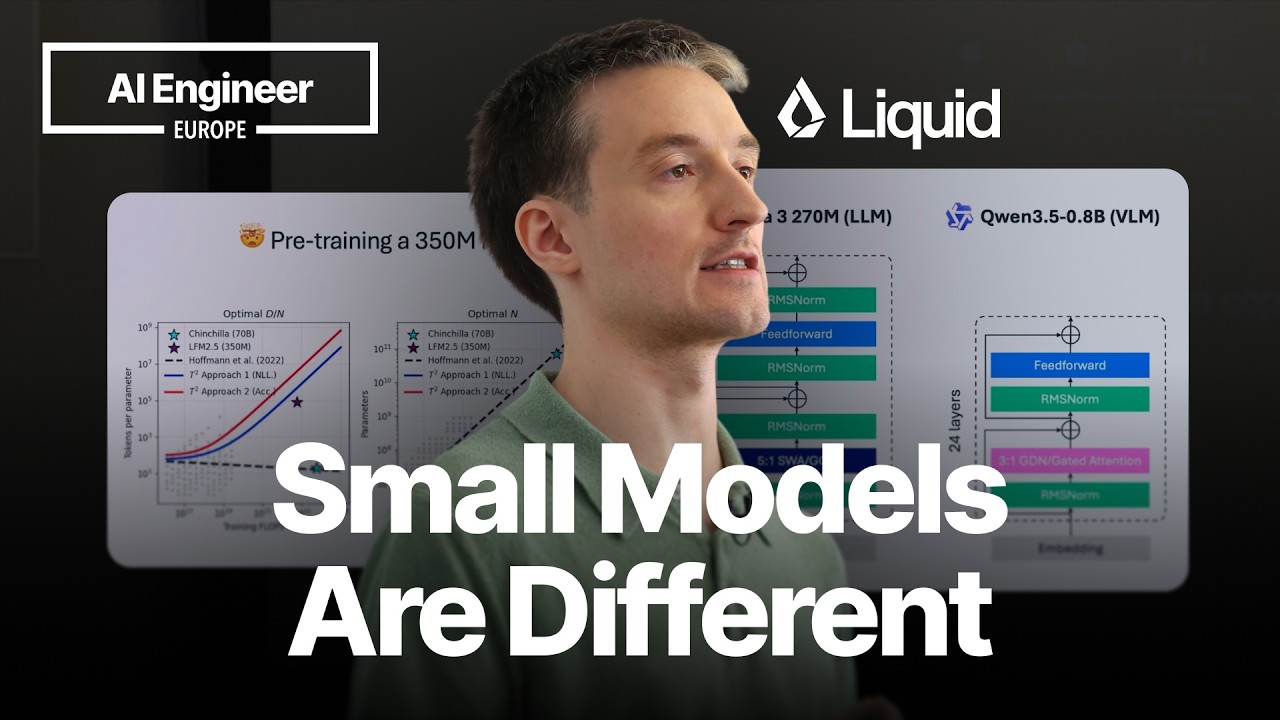
Everything I Learned Training Frontier Small Models — Maxime Labonne, Liquid AI
Apr 29, 2026 · 20:13
Maxime Labonne, head of post-training at Liquid AI, presents the LFM2.5 recipe for training frontier small models, arguing they require specialized approaches distinct from scaled-down big models. He details how Liquid's architecture uses gated short convolutions for latency-sensitive on-device deployment, achieving faster throughput than Gemma 3 or Qwen 3.5. Post-training stages—SFT, on-policy preference alignment, and RL—are tailored for narrow task focus like data extraction and tool use. A key challenge is 'doom loops' (repetition), which reached 15% after mid-training in a 1.2B reasoning model; solutions include preference alignment rejecting looped responses and RL with verifiable rewards and n-gram penalties, nearly eliminating the issue. He advocates combining small models with agentic tools (e.g., web search) to overcome memory limits, as they excel at reasoning and tool use despite lower knowledge capacity. The talk also covers decisions on when to use small vs. large models—latency, privacy, offline use—and notes that distillation alone likely won't fully solve doom loops.

Everything you need to know about Fine-tuning and Merging LLMs: Maxime Labonne
Sep 25, 2024 · 17:52
Maxime Labonne from Liquid AI explains the LLM training lifecycle—pre-training, supervised fine-tuning (SFT), and preference alignment—and when to use fine-tuning over prompt engineering. He details SFT dataset creation (accuracy, diversity, complexity) and techniques like full fine-tuning, LoRA, and QLoRA, with key hyperparameters. The core of the talk is model merging: combining weights of fine-tuned models without GPU, using methods like SLERP (spherical linear interpolation for two models), TIES (pruning redundant parameters to merge many models), pass-through (concatenating layers, e.g., Meta LLaMA 3 120B Instruct by repeating layers gives strong creative writing), and Franken-MoE (extracting FFN layers from domain-specific models with a router). Labonne demonstrates these with his NeuralBeagle and Beyonder models, noting merged models dominate the OpenLLM leaderboard and that TIES merging often outperforms more experimental Mixture of Experts approaches.
Powered by PodHood