
Mark
GuestGuest on AI Engineer.
2 episodes

Building Code First AI Agents with Azure AI Agent Service — Cedric Vidal, Microsoft
Jun 27, 2025 · 1:54:06
Cedric Vidal, Principal AI Advocate at Microsoft, demonstrates building code-first AI agents with Azure AI Agent Service, using function calling, code interpreter, file search, and Bing grounding for a sales analysis use case. He creates a conversational agent that queries SQLite, generates pie charts from Python code, and blends product PDF data with relational data. The workshop explains stateful agents, tool routing (LLM generates JSON to call functions), and the limits of single-step agents versus multi-agent orchestration with AutoGen. Cedric addresses when to use Agent Service (managed persistence and tools) versus raw LLM endpoints, and covers MCP servers as a tool lifecycle manager. Key insights include using instructions to ground agent behavior and the need for eval frameworks for agent quality.
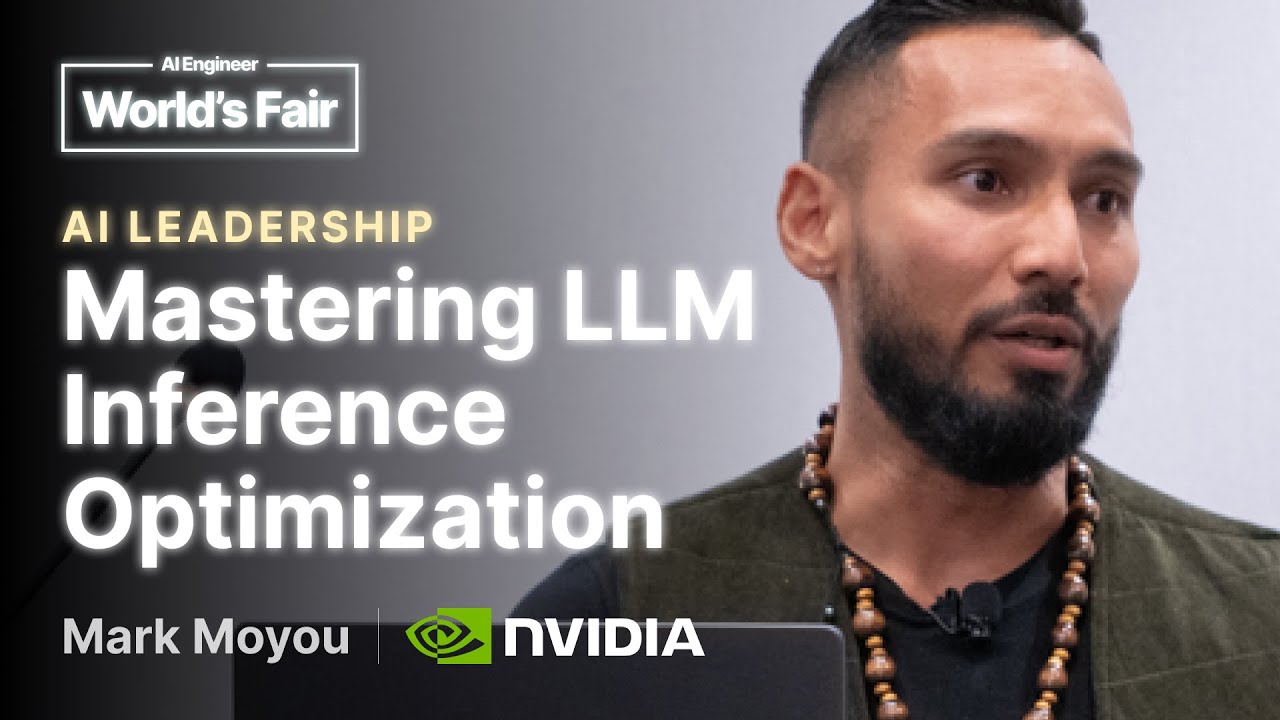
Mastering LLM Inference Optimization From Theory to Cost Effective Deployment: Mark Moyou
Jan 1, 2025 · 33:39
NVIDIA solutions architect Mark Moyou explains that LLM inference differs fundamentally from standard deep learning deployment, requiring careful management of KV Cache, attention mechanisms, and GPU memory to control cost. He details how tokens are processed: prefill computes attention across the entire prompt, then generation produces one token at a time, with KV Cache storing key-value pairs to avoid recomputation. Llama's 32 attention heads and FP8 quantization (halving memory with near-identical accuracy) are cited as key optimizations. Moyou emphasizes measuring time to first token, inter-token latency, and input/output sequence length distributions to size inference engines. He presents NVIDIA's TRT-LLM (model compilation for LLMs) and Triton inference server as tools to maximize throughput, and discusses how query patterns like long-input-short-output or short-input-long-output impact GPU utilization and deployment cost.
Powered by PodHood