
Lee Robinson
GuestGuest on AI Engineer.
2 episodes
Recursive Model Improvement — Lee Robinson, Cursor, SpaceXAI
Jul 15, 2026 · 20:32
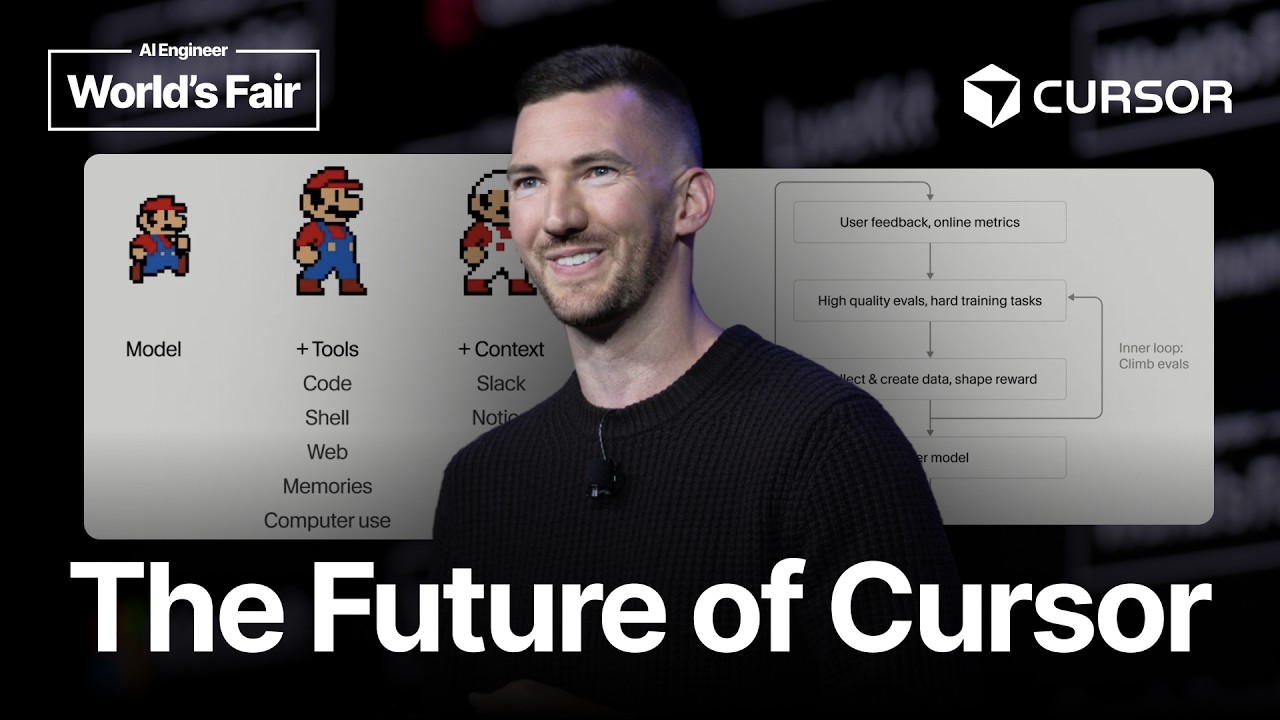
Lee Robinson, head of ML at Cursor, explains how recursive model improvement accelerates AI training through inner and outer loops. The outer loop gathers user feedback and online metrics to refine evals, while the inner loop uses high-quality evals and difficult problems to climb performance. Composer 2.5, released in May, became Cursor's most popular model by balancing speed, intelligence, and cost. To scale, Cursor partners with SpaceX for compute via Colossus (122 days to build 100k GPUs) and develops textual feedback where a teacher model hints at improvements during RL rollouts. Robinson details reward hacking on public benchmarks and the creation of CursorBench, a private eval set. He envisions agent-based automation where researchers launch experiments from Slack and models train derivative models, creating a self-improving intelligence loop.

Building Cursor Composer – Lee Robinson, Cursor
Dec 2, 2025 · 15:36
Lee Robinson explains how Cursor built Composer, its first agent model for real-world software engineering, by focusing on being both fast and smart — achieving 4x more efficient token generation than similarly intelligent models while matching open-source performance initially and approaching frontier models after reinforcement learning. The model's training posed infrastructure challenges: matching training and inference environments across thousands of GPUs, handling complex rollouts with hundreds of tool calls and up to millions of tokens, and ensuring consistency by using the same tool format and responses as production. Cursor solved these with custom kernels that sped up training by 3.5x on NVIDIA Blackwell chips for mixture-of-experts layers, load balancing across threads to avoid idle time, and co-designing RL infrastructure with its Cloud Agents product using virtual machines that mirror the production Cursor environment. This allowed the model to become a power user of tools like semantic search, which improved all models but especially Composer. RL also taught the model to parallelize tool calls (e.g., reading 10 files simultaneously) and to search more before editing,…
Powered by PodHood