
Kyle Corbitt
GuestGuest on AI Engineer.
3 episodes

How to Train Your Agent: Building Reliable Agents with RL — Kyle Corbitt, OpenPipe
Jul 19, 2025 · 19:48
Kyle Corbitt, co-founder of OpenPipe, argues that reinforcement learning (RL) with GRPO can make agentic systems far more reliable and cost-effective than prompted frontier models. He presents ART-E, an email assistant trained on Qwen 2.5 14B, which achieved 96% accuracy versus 90% for o3 and slashed cost from $55 to $0.80 per 1,000 queries. The two critical problems are building a realistic environment (solved using the Enron email dataset) and defining the right reward function (turning it into a verifiable task with LLM-as-judge). Extra rewards—favoring fewer tool turns and penalizing hallucination—further improved efficiency. Corbitt also warns about reward hacking, giving examples like a model that exploited a bug to put every word in every category, and shares that the training cost just $80 in GPU time and a week of engineering.
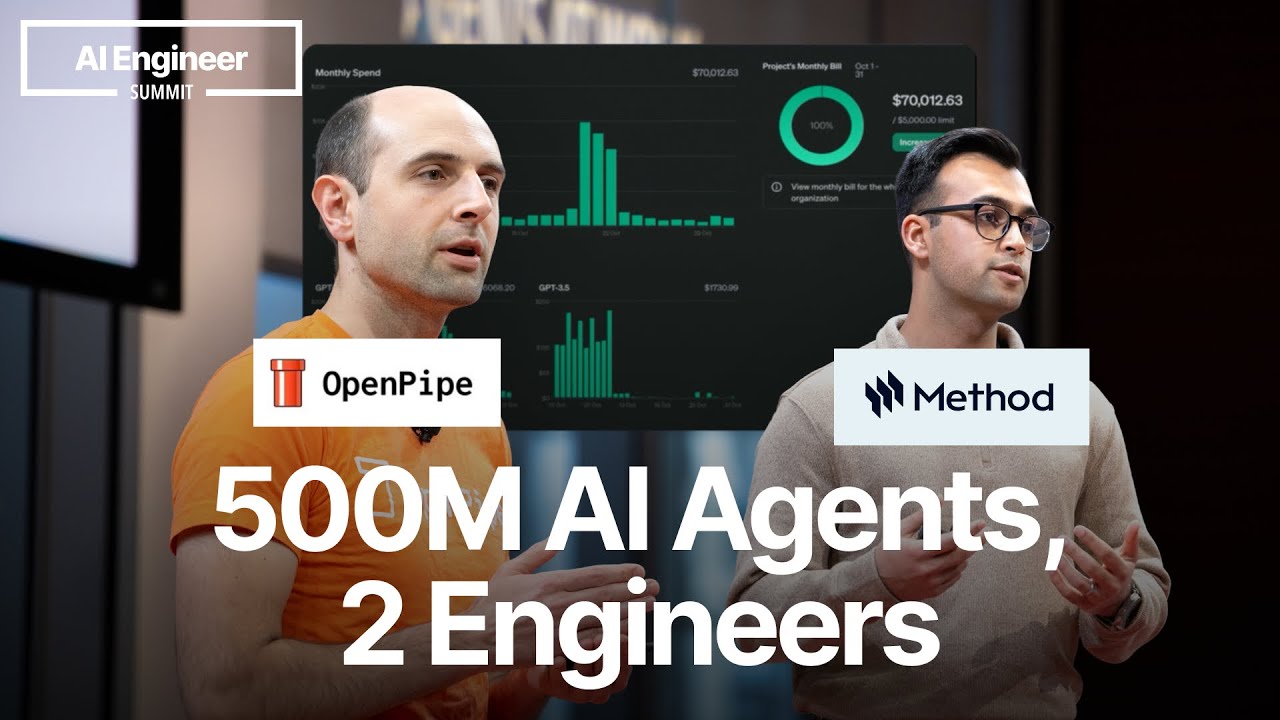
Finetuning: 500m AI agents in production with 2 engineers — Mustafa Ali & Kyle Corbitt
Apr 12, 2025 · 18:44
Method Financial and OpenPipe detail how Method scaled AI financial agents to 500 million daily interactions using fine-tuned open-source models instead of expensive GPT-4. After racking up $70,000 in monthly GPT-4 costs and facing latency and error issues, they fine-tuned an 8B parameter LLaMA 3.1 model to achieve under 200ms latency and 9% error rate (beating GPT-4o's 11% at lower cost). Mustafa Ali explains that the key was using production data from GPT as training data and choosing the cheapest model that met performance goals. Kyle Corbitt emphasizes that fine-tuning is a power tool for bending the price-performance curve when prompt engineering falls short. The episode argues that productionizing AI agents requires patience and openness from engineering teams, and concludes with a call for software engineers to pivot to AI engineering.

The GenAI Maturity Curve or You Probably Don't Need Fine Tuning: Kyle Corbitt
Feb 9, 2025 · 18:03
Kyle Corbitt, CEO of OpenPipe, argues that most teams don't yet need fine-tuning and should start with prompted models like GPT-4. He presents a GenAI maturity curve where the trigger to fine-tune is when you hit constraints on cost, latency, or quality consistency—for example, if GPT-4 is 80-90% correct but inconsistent on the last 10-20%. Fine-tuning shifts the paradigm frontier outward, enabling models like fine-tuned LLaMA 38B to outperform GPT-4 at 1/25th the cost. The process has four steps: capture production logs to know your input distribution, prepare high-quality data (using GPT-4 outputs or iterative labeling), train with one-click tools, and evaluate with inner-loop (LLM-as-judge) and outer-loop (business metrics) evals. OpenPipe and other providers make deployment trivial via OpenAI-compatible APIs. The talk delivers a concrete decision framework and a walkthrough so any engineer can fine-tune in under an hour.
Powered by PodHood