
Joseph Nelson
GuestGuest on AI Engineer.
2 episodes
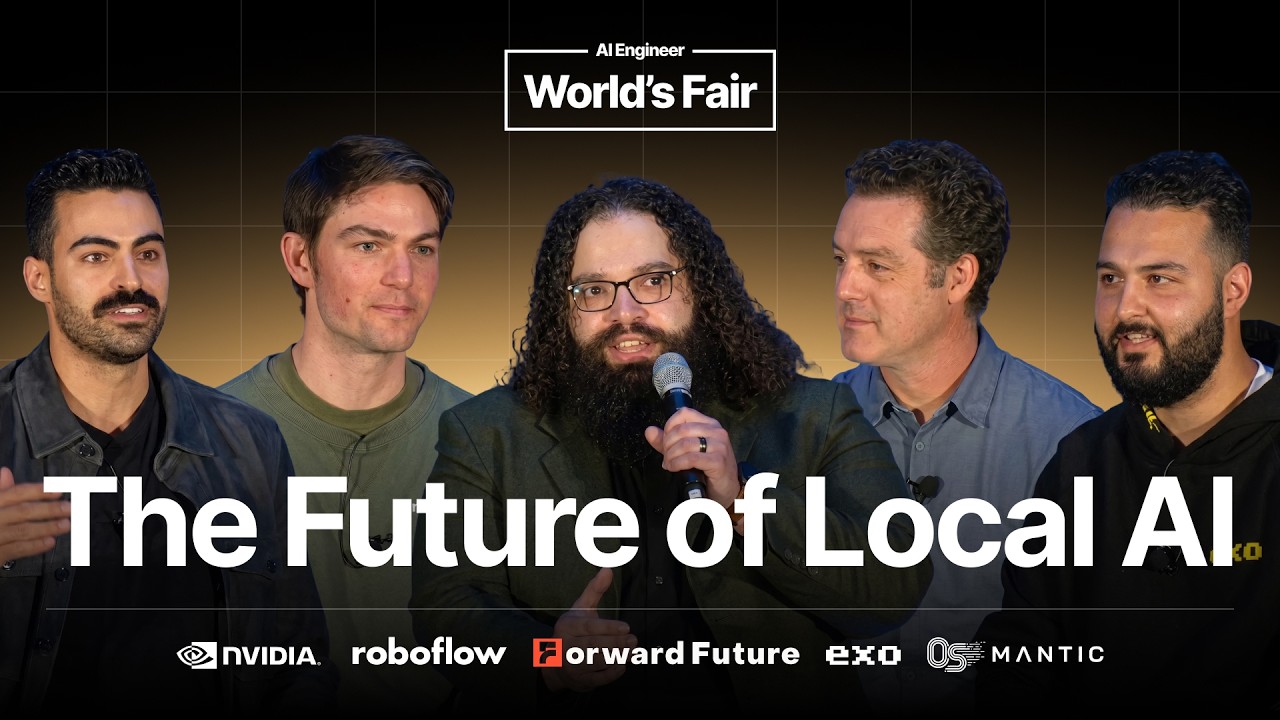
State of the Union: Why Local, Why Now — NVIDIA, Osmantic, Roboflow, EXO Labs, @matthew_berman
Jul 11, 2026 · 44:29
Nader Khalil (NVIDIA), Joseph Nelson (Roboflow), Alex Cheema (Exo Labs), Matthew Berman, and Ahmad Osman (Osmantic, r/LocalLLaMA) argue that local AI is now useful, driven by stronger open models and better hardware. They cite inflection points like Llama 2, DeepSeek v3, and GLM 5.2, which closed the gap with frontier cloud models. Sovereignty and control are key: enterprises need to choose their own model versions and avoid lock-in. Specialized models, such as Roboflow's fine-tuned vision models for deep-sea fish discovery, outperform general ones for specific tasks. Optimization is critical: EXO Labs achieved 10x performance on the DGX Spark by tuning existing NVIDIA kernels. The panel emphasizes that simplicity remains a barrier—most users need point-and-click solutions—and advocates for open-source AI to ensure freedom and innovation.

120k players in a week: Lessons from the first viral CLIP app: Joseph Nelson
Nov 22, 2023 · 15:59
Joseph Nelson (Roboflow CEO) details building paint.wtf, a viral AI Pictionary game using OpenAI CLIP that attracted 120,000 players in its first week, peaking at 7 submissions per second. The architecture uses GPT-3 to generate prompts, a browser canvas for drawing, and CLIP to judge similarity between text and image embeddings. Key lessons include CLIP's ability to read text, requiring a moderation hack that penalizes images more similar to handwriting than the prompt; CLIP's conservative similarity scores (ranging 8% to 48%); and the necessity of using CLIP itself to block NSFW content. Nelson also live-codes a minimal MVP in under 50 lines of Python using Roboflow's open-source inference server, demonstrating CLIP embedding and cosine similarity. The talk underscores foundation models' new paradigm of open-set understanding.
Powered by PodHood