
Andreas Kollegger
GuestGuest on AI Engineer.
3 episodes
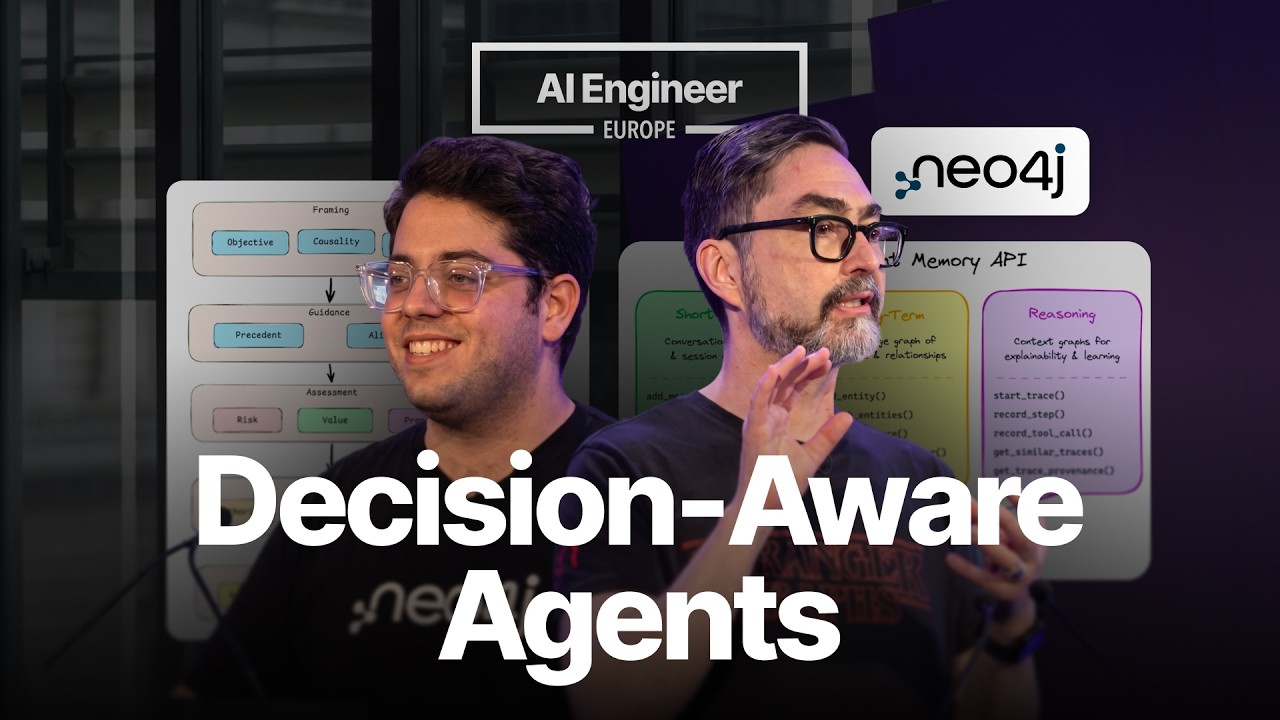
Context Graphs for Explainable, Decision-Aware AI Agents — Andreas Kollegger & Zaid Zaim, Neo4j
May 28, 2026 · 16:39
Andreas Kollegger and Zaid Zaim of Neo4j argue that context graphs transform AI agents from knowledge-driven to decision-aware by providing the "why" behind actions through policies, rules, and precedent. They present a five-stage decision framework: frame the problem with causality and environment, pull global rules and past precedent, run risk value analysis (including reference class validation—e.g., a drug correct 99% of the time may be fatal for the 1%), decide to act or escalate to authority, and write the full reasoning chain into the graph. This last step turns every decision into precedent for future agents. The talk emphasizes explicit risk assessment, such as whether a decision is reversible and what is being maximized, and uses examples like medical prescribing and financial loan eligibility to illustrate how agents must know their reference class before acting.

Top Ten Challenges to Reach AGI — Stephen Chin, Andreas Kollegger
Jul 22, 2025 · 4:23
Stephen Chin and Andreas Kollegger, curators of the GraphRAG track at AI Engineer World's Fair, use ten sci-fi memes to expose top challenges to AGI—from Memento's short-term memory as prompt engineering to Skynet's unintended consequences, the Matrix's agent simulation, Hal's trust issues, emotions as bug/feature, Frankenstein's creator obligations, Terminator's time travel, Star Wars' language nuance, the Borg's assimilation, and Deep Thought's right questions. They argue graphs and graph technology can solve some of these challenges, inviting the audience to the GraphRAG track to learn which ones. The episode delivers a playful yet pointed framework connecting pop culture to core AGI obstacles.

Graph Intelligence: Enhance Reasoning and Retrieval Using Graph Analytics - Alison & Andreas, Neo4j
Jun 27, 2025 · 1:41:16
Alison Cossette and Andreas Kollegger from Neo4j demonstrate how graph data science algorithms enhance GraphRAG systems by connecting, clustering, and curating unstructured data. They walk through running KNN similarity (K=25) on document embeddings, then applying Louvain community detection to identify clusters of near-identical chunks—one community had 49 documents with 0.98 average similarity—which can be collapsed via APOC to improve retrieval efficiency while preserving lineage. Using page rank and betweenness centrality, they show how to surface influential documents and track conversation paths across communities. The session uses a preloaded Neo4j AuraDB database with 17K nodes and 774K relationships from the Agent Neo project, and includes practical cipher queries for projecting graphs and running algorithms. They emphasize using graph analytics to diversify retrieval, manage content hygiene, and build accountable agent systems.
Powered by PodHood