
Alex Volkov
GuestGuest on AI Engineer.
3 episodes
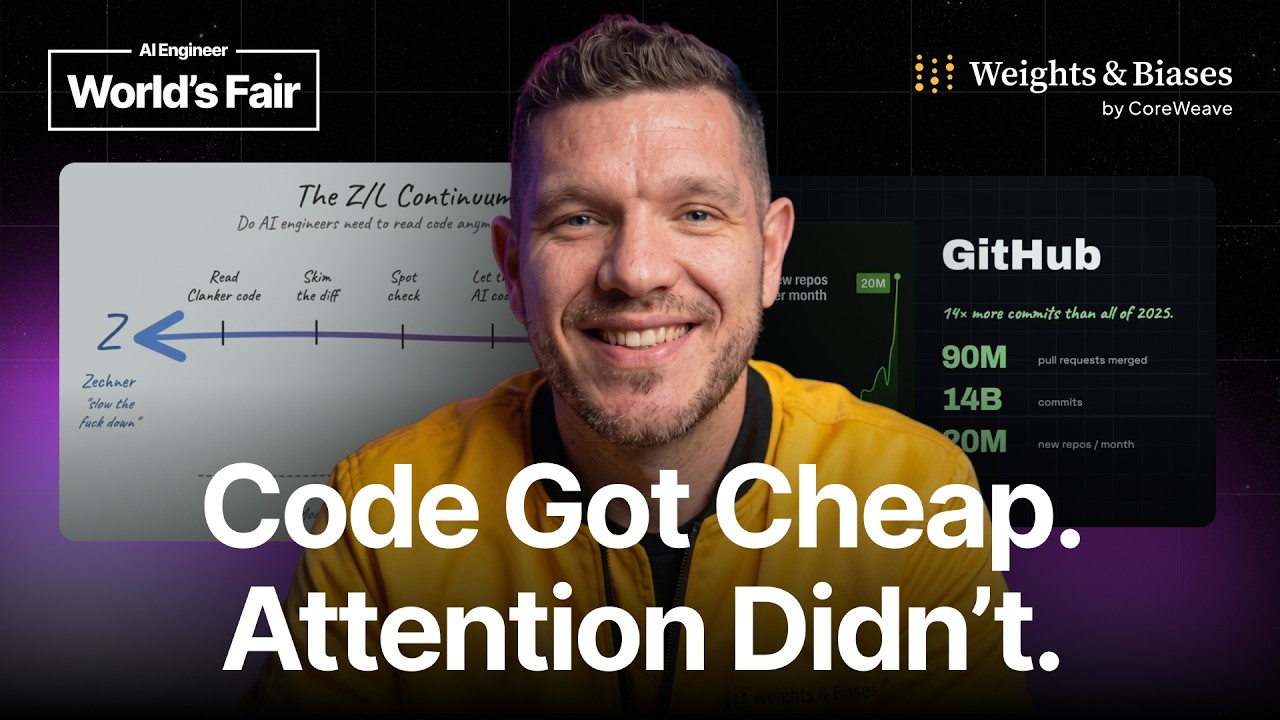
Should AI Engineers Still Read Code in 2026? The Z/L Continuum — Alex Volkov, ThursdAI
Jul 10, 2026 · 21:35
Alex Volkov examines the debate sparked by Ryan Lopopolo's claim that 'code is free' and Mario Zechner's counter that engineers must 'read every fucking line' of critical code, arguing that the Z/L Continuum is about task-level proof rather than personality. Citing a Ferrous AI survey showing an 861% increase in code deletion per PR and a 242% rise in incidents, he notes Anthropic's recursive self-improvement essay admitting human code review is a new bottleneck. Volkov's routing table prescribes reading every line for authentication, money movement, and irreversible data, while letting agents handle less critical changes. He also introduces loops—cron-like agent systems that self-verify—as the next frontier, quoting Adi Osmani that automated loops don't remove judgment. Volkov concludes that capability drift moves where proof belongs, but every system still requires human judgment.

The State of MCP observability: Observable.tools — Alex Volkov and Benjamin Eckel, W&B and Dylibso
Jun 20, 2025 · 16:56
Alex Volkov (Weights & Biases) and Benjamin Eckel (Dylibso) argue that MCP-based AI agents create observability blind spots, and that OpenTelemetry-based distributed tracing, combined with community initiatives like observable.tools, can provide end-to-end visibility. They show how Weave's MCP support and mcp.run's upcoming OTel export enable tracing across client and server, using context propagation via MCP's metadata to stitch traces together. Volkov shares a meta story where Claude Opus 4 used MCP to automatically fix its own observability code, discovering and querying a support bot without human intervention. The episode calls for tool builders to adopt OTel and join semantic conventions efforts for agent observability.

Judging LLMs: Alex Volkov
Sep 9, 2024 · 18:39
Alex Volkov, as an LLM judge from 2034, humorously judges AI engineers on their development practices, emphasizing the importance of tracing, iterative prompt engineering, and robust evaluation pipelines. He finds Daniel guilty of deploying without logging, Sasha guilty of premature fine-tuning without prompt iteration, and Morgan guilty of ignoring AI news—commuted to attending ThursdAI. Francisco’s overreliance on programmatic evals leads to a legal loss, while Maxime is 'awesome' for using Weights & Biases Weave. Alex concludes with a primer on evaluation methods: programmatic, human-in-the-loop, and LLM-as-judge, stressing the need to validate validators and create custom criteria. He promotes Weave for tracing and evals, and ThursdAI for staying updated.
Powered by PodHood