
YC
CompanyA company discussed on AI Engineer.
4 episodes

GTM Is You - Victoria Melnikova, Evil Martians
Jul 7, 2026 · 12:35
Victoria Melnikova argues that a founder's personal brand is the most underrated competitive advantage for developer tool startups in 2026, citing interviews with Sam Lambert (Planet Scale), Zeno Rocha, and David Cramer. She presents the Product-Market Fit Compass, a framework from Evil Martians that analyzed 37 successful DevTools, finding that 9 out of 10 times product signal is stronger than revenue, making distribution the bottleneck. Key tactics include moving to San Francisco for network effects, using banners and billboards to signal credibility (as TypeCents did with hundreds of billboards), hosting events like Supabase's user conference, and embracing failures (Zeno Rocha walked away from 300k ARR to start over). Melnikova emphasizes being unapologetically yourself, as AI can amplify but not replace unique personal brands, and notes that founder-led sales builds trust in early-stage startups.

Paying Engineers like Salespeople – Arman Hezarkhani, Tenex
Dec 19, 2025 · 14:53
Arman Hezarkhani, CTO of Tenex, describes his company's outcome-based compensation model where engineers are paid per story point completed, tying incentives directly to shipped value. He argues that hourly billing and salary with equity fail to motivate engineers to use AI tools effectively, leading to misaligned incentives. Tenex's system involves strategists scoping tickets and engineers receiving a flat base plus quarterly story-point bonuses. Risks like inflated story points, quality drops, and sharp elbows are mitigated by strategist counterbalance, multi-round QA, and a rigorous hiring process. He cites examples: a billboard company's image moderation AI built in two weeks at 96% accuracy, and a retail heat-mapping project with five parallel models. Arman asserts that AI amplifies existing talent, and current compensation must change to unlock potential.
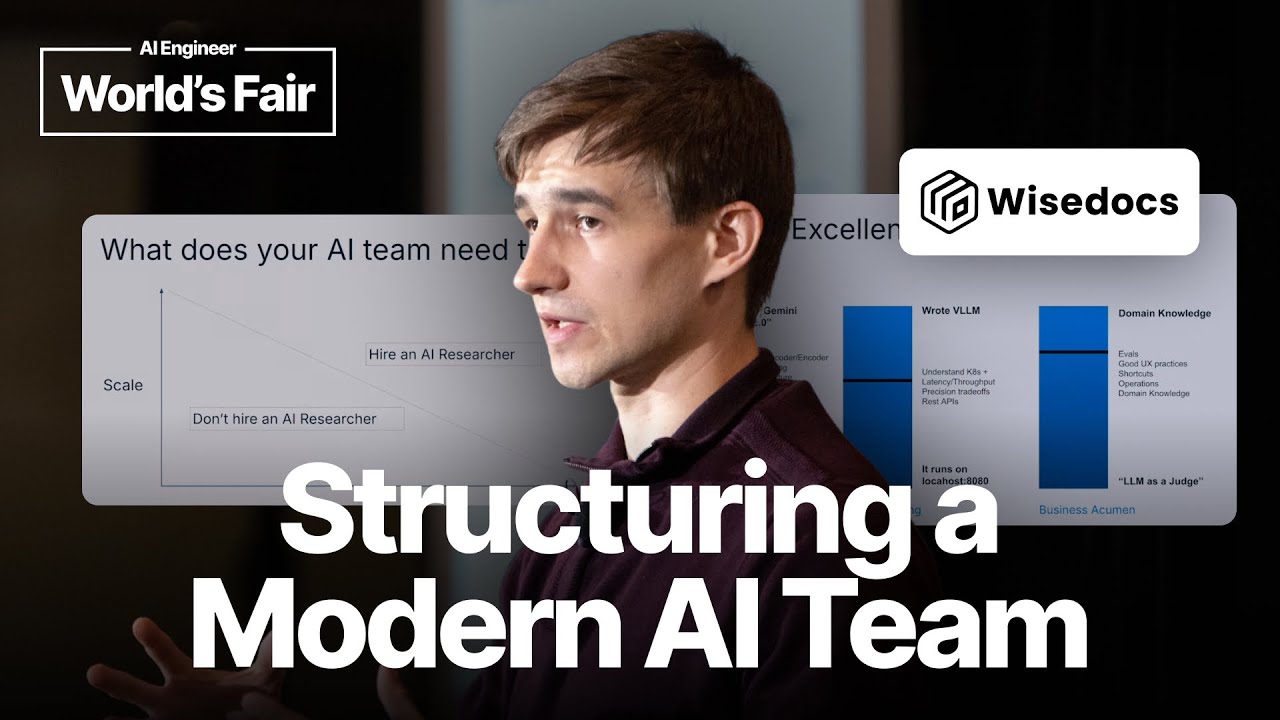
Structuring a modern AI team — Denys Linkov, Wisedocs
Jul 24, 2025 · 17:40
Denys Linkov, who leads ML at Wisedocs, argues that building a modern AI team hinges on identifying your company's bottleneck—shipping features, acquiring users, or scalability—rather than reflexively hiring AI researchers. He introduces Ampere's Wager: trading your entire domain-savvy team for five top-lab researchers is usually a losing bet. For early-stage AI strategy, generalists who blend model training, serving, and business acumen outperform specialists; Linkov lived this in 2021 building a custom MLOps platform for a conversational AI startup and again in 2024 using advanced open-source tools for medical record processing. He stresses reskilling existing teams through weekly learning cadences and moving domain experts from giving feedback to writing evaluations. Hiring should hold context and act on it, verifying trends like 'don't hire juniors' against YC's AI school drawing 2,000 young people.

Building a 10 person unicorn - Max Brodeur-Urbas, Gumloop
Jul 15, 2025 · 12:03
Max Brodeur-Urbas, founder of Gumloop, explains how his company scaled to millions in ARR as a team of two that raised a Series A and grew to only nine people, by being super picky in hiring, using product-led hiring where customers like those from Instacart and Webflow join the team, and requiring work trials such as hacking together in Airbnbs. They eliminate almost all meetings to give engineers deep focus time and automate every internal process with Gumloop itself, from customer research reports to chatbot monitoring. Culture-wise, they balance intense 45-minute shipping challenges with fun retreats and a public company handbook. Brodeur-Urbas argues that every hire must be a no-brainer, and small teams can outpace larger ones by avoiding meetings and leveraging AI tools.
Powered by PodHood