
Y Combinator
CompanyA company discussed on AI Engineer.
5 episodes
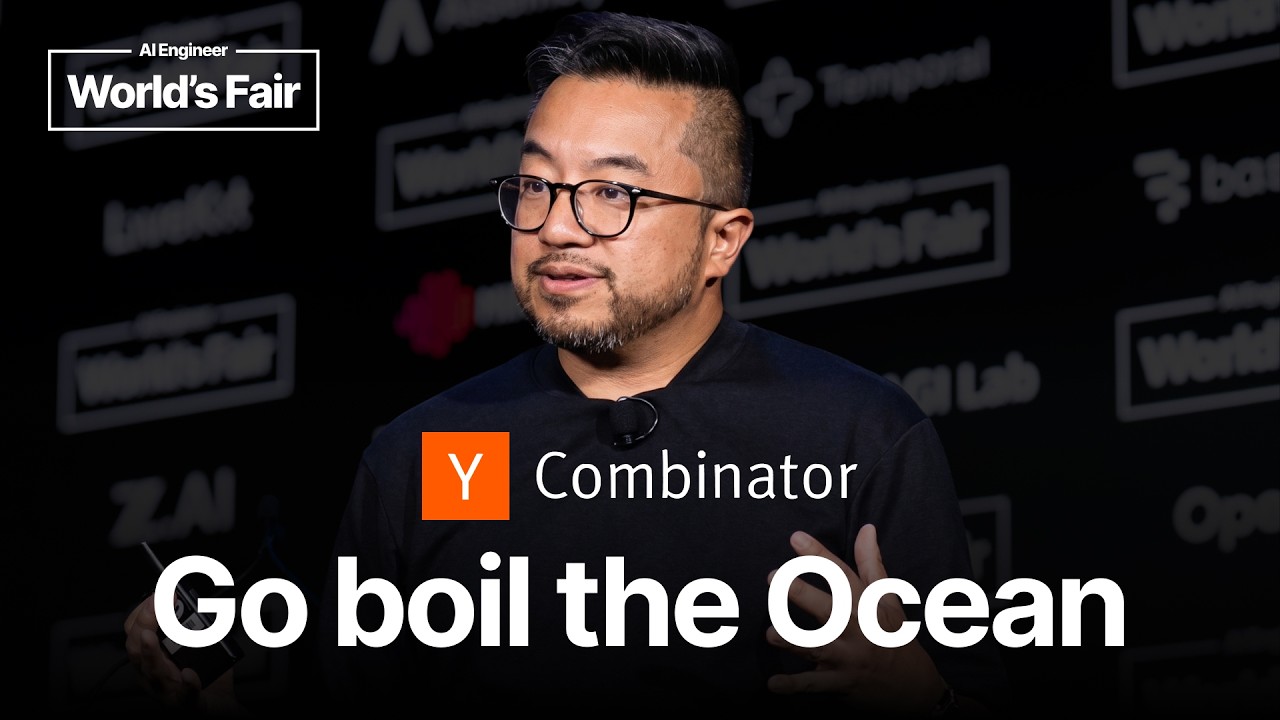
The New Physics of Business — Garry Tan, Y Combinator
Jul 17, 2026 · 21:08
Y Combinator CEO Garry Tan argues founders must build AI-native companies that treat AI as a workforce, not auto-complete, to achieve 400x productivity. He details how skill files (Markdown documents) act as employees, a resolver table as an org chart, and a company brain (like his open-source GBrain) as the memory layer that selects the right context for each task. Tan cites YC's Winter '25 batch where 25% of companies had 95% AI-generated code, and portfolio companies Emergence and Retail reaching $15M ARR with 15 people and $60M with 40 respectively. His core message: never do one-off work—always "skillify" completed tasks into reusable skills, so the organization compounds knowledge daily rather than waking up with amnesia.

Imagination Engineering — Eve Bouffard, Head of Design, Y Combinator
Jul 16, 2026 · 16:04
Eve Bouffard, Head of Design at Y Combinator, introduces 'Imagination Engineering' as the art of stretching the mind to invent what seems impossible, arguing that idea generation is the new bottleneck as AI models become incredibly capable. She shares her experiment in 'thinking in public' with a Slack channel called 'Eve Thoughts,' where she dumps her stream of consciousness, and then used Opus 4.8 to build a personalized website (EveBouffard.com) that aggregates and visualizes those thoughts. The site dynamically surfaces her projects, quotes, tools, and books, and even applies shaders and translations. She also built 'Shape of Minds'—a tool that analyzes commonalities across history's greatest minds, revealing patterns like taking naps and barely eating. Bouffard demonstrates how to spin up agents on demand for learning and productivity, emphasizing that anyone can now create software on the fly from their stream of consciousness.
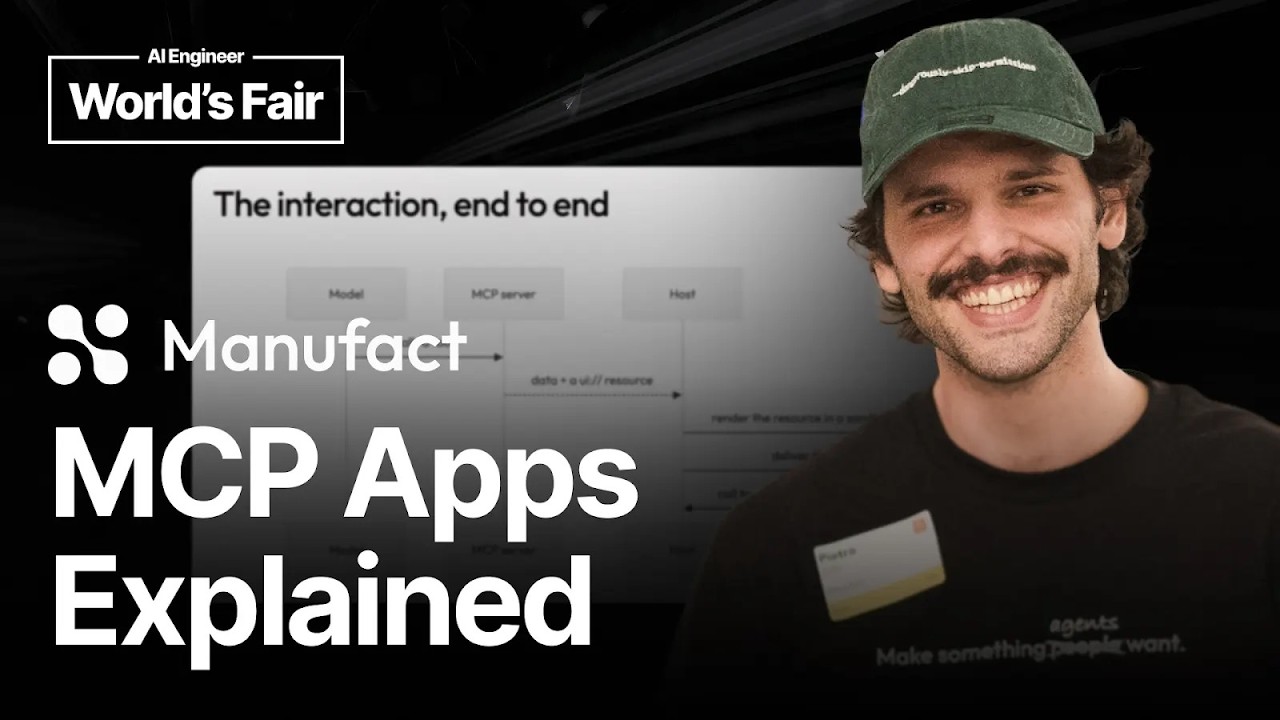
MCP Apps: Primitives, discovery, and the Future of Software - Pietro Zullo, Manufact, Inc
Jul 5, 2026 · 28:54
Pietro Zullo, co-founder of Manufact, explains that MCP Apps are MCP servers that return interactive UI elements in sandboxed iframes, enabling bidirectional communication between the UI and the host. He details primitives like set-model-context and send-message, and shows how apps can stream tool inputs into the UI in real time. The ChatGPT, Claude, and Cursor stores now accept self-serve submissions, and Claude's dynamic discovery matches connectors to user intent. Manufact’s open-source SDK, mcp-use, has 8M+ downloads and provides a cloud platform for building, testing, and submitting MCP Apps.
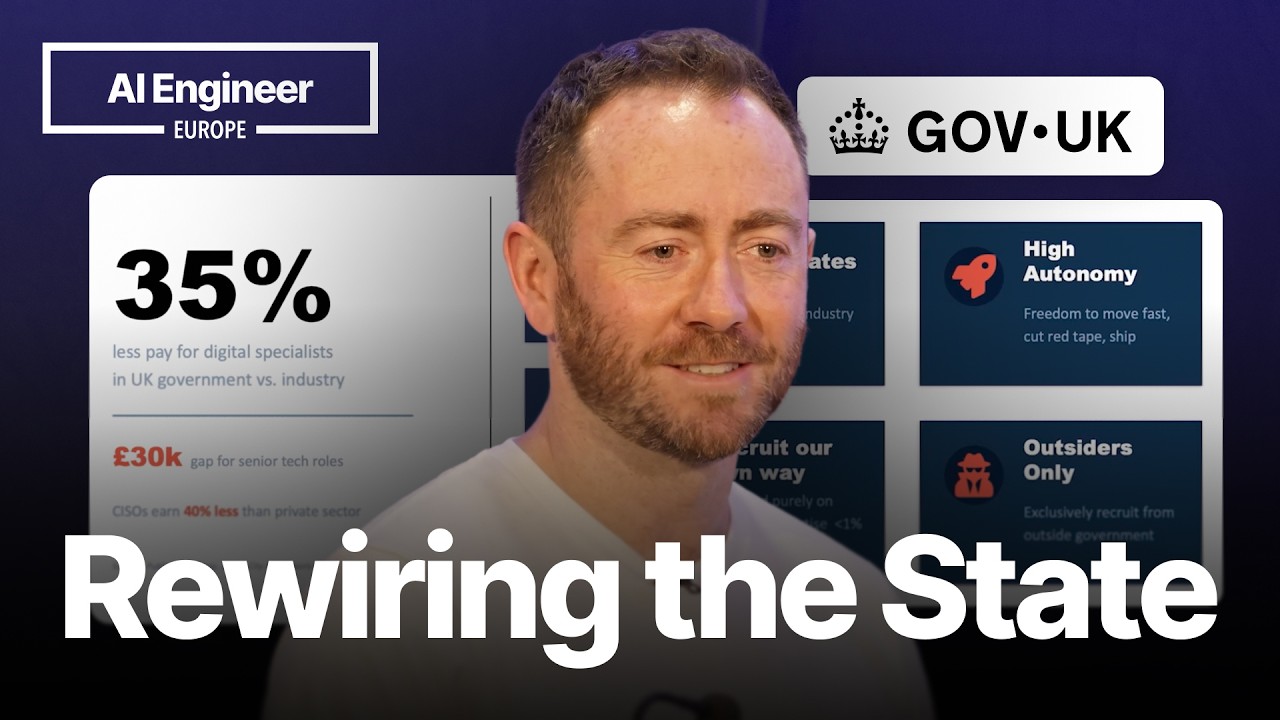
Rewiring the State — Eoin Mulgrew, No. 10 (Downing Street)
May 18, 2026 · 28:18
Eoin Mulgrew, from the Number 10 Data Science team, details how a small insurgent unit at the center of UK government bypasses bureaucracy to rapidly deploy AI. The team recruits exclusively outsiders (0.7% acceptance rate), pays market rates, and ships tools in weeks. Examples include an engineer who saved £1.5M by building a statute-book analysis tool in two weeks, a policy simulation platform for Universal Credit, a delivery red-teaming PMO, and a public service that went from idea to live in two months. The team also placed fellows in the AI Safety Institute, the Incubator for AI (co-creating Xtract with DeepMind to digitize planning applications), and Justice AI, which embeds engineers in prisons. Mulgrew closes with Will, a Y Combinator founder and Harvard dropout, standing outside HMP Wormwood Scrubs with the keys two weeks into the job, urging talented technologists to 'join us, and we'll give you the keys to the state.'

How we hacked YC Spring 2025 batch’s AI agents — Rene Brandel, Casco
Jul 30, 2025 · 17:33
Rene Brandel, CEO of Casco, explains how his team hacked seven of sixteen YC Spring 2025 batch AI agents within 30 minutes each, revealing three critical security flaws: cross-user data access via IDOR, arbitrary code execution through code tools, and server-side request forgery (SSRF) from tool endpoints. They extracted personal data by exploiting missing authorization checks, overwrote security controls by writing malicious files into code sandboxes, and stole Git credentials by manipulating a database-schema tool. Brandel emphasizes that agent security extends beyond LLM prompt injection, advises treating agents as users with proper authentication and authorization, and warns against rolling custom code sandboxes, recommending out-of-the-box solutions like E2B. The talk concludes with a Q&A on extracting system prompts and the dangers of local coding agents.
Powered by PodHood