
WorkOS
CompanyA company discussed on AI Engineer.
9 episodes

Why Can't Anyone Answer Questions About the Business? — Garrett Galow, WorkOS
Jun 11, 2026 · 19:06
Garrett Galow from WorkOS built Studio, an internal workspace where anyone can ask natural language questions against Snowflake, Linear, and Notion, and get reusable widgets instead of filing a request. The LLM generates declarative JavaScript widgets that call data sources directly, making subsequent runs deterministic and cheap. Three techniques made it reliable: preflight sequencing injects schema context only when a tool is invoked, a layering rule tells the model to distrust its own knowledge about WorkOS and use primary sources, and query validation catches valid SQL that returns zero rows before hardcoding it into a widget.

Your Attention Is the Bottleneck, Not Your Agents — Zack Proser, WorkOS
Jun 11, 2026 · 25:17
Zack Proser from WorkOS argues that human attention, not agent speed, is the real bottleneck in AI-assisted coding. He proposes a sustainable stack: signal layers to filter Slack and Linear, voice-first flows at 184 wpm, remote control of agents from a phone to leverage diffuse thinking, and weekly self-improvement passes over JSONL conversation history. He also integrates an Oura ring via MCP so Claude can nudge him about sleep, emphasizing balance over burnout.

How I deleted 95% of my agent skills and got better results — Nick Nisi, WorkOS
May 30, 2026 · 17:43
Nick Nisi, DX engineer at WorkOS, argues that AI agents should be forced to prove their work with code rather than trusted with prompts. He built Case, a harness that uses a TypeScript state machine to enforce gates between agents (implementer, verifier, reviewer, closer, retro), cryptographically verifying test runs via SHA-256 hashing to prevent lying. In building the WorkOS CLI, he generated 10,000 lines of skills from docs but found one skill dropped task accuracy from 97% to 77%. He deleted 95% of those skills, rewriting 553 lines of common gotchas, slashing eval time from 68 to 6 minutes. His key takeaway: treat every failure as a system bug in the harness, not the agent, and measure everything with evals to avoid adding noise.

Full Walkthrough: Writing & Using Skills — Nick Nisi and Zack Proser
May 6, 2026 · 1:21:03
Zack Proser and Nick Nisi, Developer Experience Engineers at WorkOS, teach how to write portable, composable skills — single markdown files with optional scripts — that train AI tools like Claude, Codex, and Cursor to perform specific tasks consistently. They demonstrate building a repo roast skill that uses deterministic Git commands via script interpolation and progressive disclosure to load targeted references only when needed. The workshop covers structuring skills with front matter (name, description for LLM routing), adding confidence scoring and constraints to improve output, and sharing skills as .skill files or through marketplaces. Advanced topics include using skills in non-coding workflows (e.g., Slack–Linear automation) and composing skills in the WorkOS CLI, which uses the Claude Agent SDK to install auth. Attendees learn to iterate skills by reflecting on past conversations and leveraging Claude's built-in skill builder for evaluation.
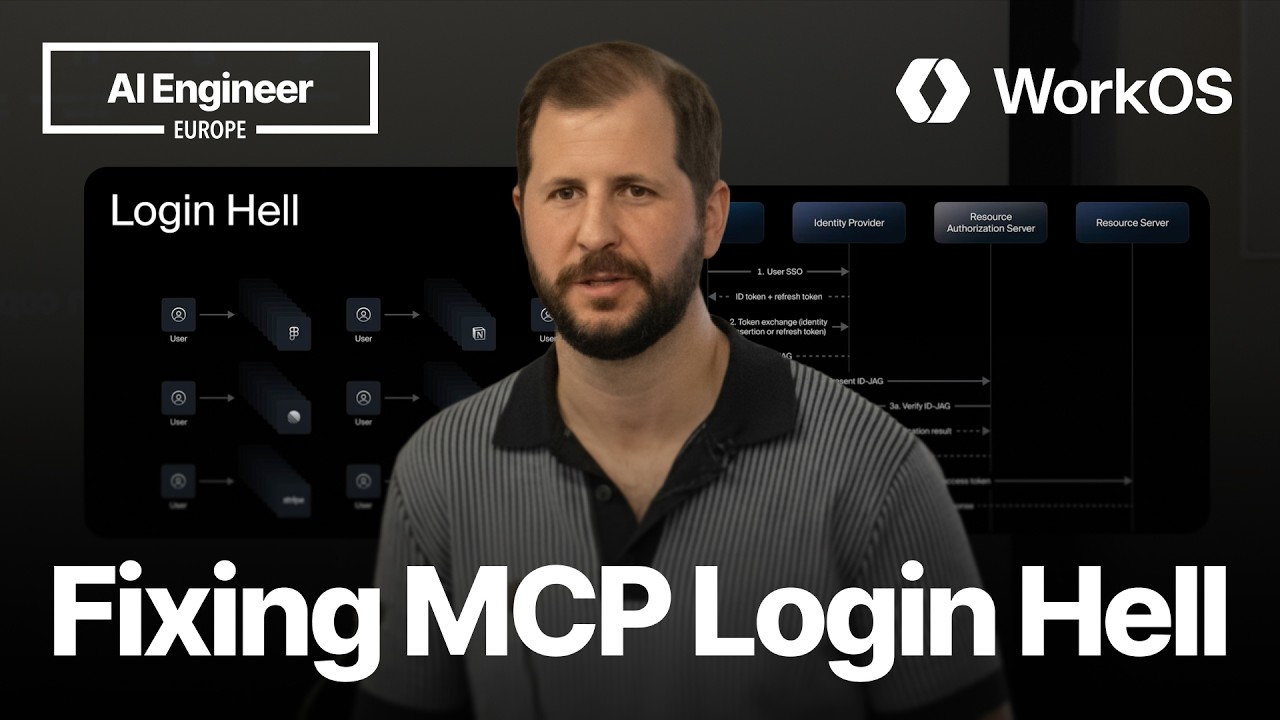
One Login to Rule Them All: Cross-App Access for MCP — Garrett Galow, WorkOS
Apr 28, 2026 · 23:24
Garrett Galow from WorkOS introduces Cross-App Access (XAA) for MCP, solving the problem of repeated OAuth consent screens when connecting agents to multiple services. The flow leverages a three-way trust between the MCP client, server, and an Identity Provider like Okta: a single SSO login issues an IDJag token that is exchanged for short-lived access tokens across all MCP servers without manual intervention. A demo shows Figma automatically connecting after an Okta login. The approach improves security—if the IdP session is revoked, tokens cannot refresh—and requires minimal IT setup: granting permission for the client to request server access. Currently only Okta supports XAA; Azure/Entra does not yet. The session also notes that authorization scopes are not handled by default but are a future consideration.
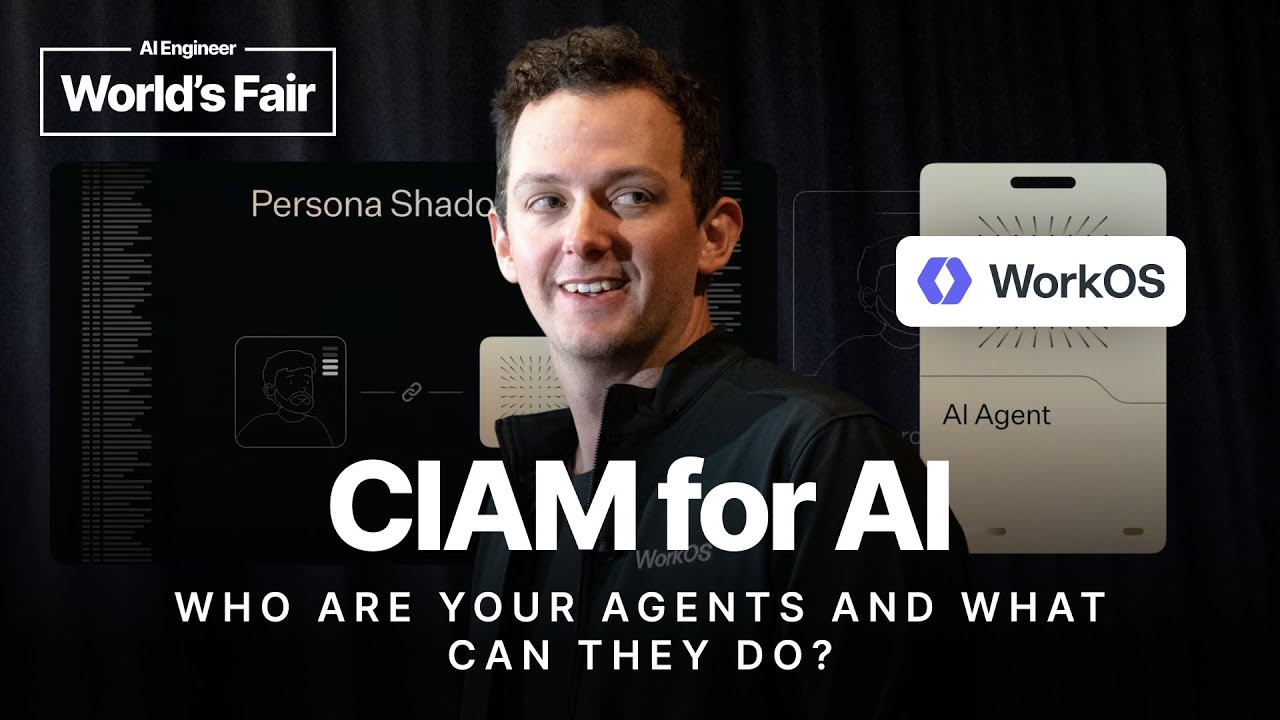
CIAM for AI: Authn/Authz for Agents — Michael Grinich, CEO of WorkOS
Jul 21, 2025 · 20:13
Michael Grinich, CEO of WorkOS, argues that AI agents need first-class identity and access management, distinct from human or machine-to-machine auth. He identifies key challenges: headless login, least privilege for non-deterministic systems, and compliance tracking. Grinich presents four emerging patterns—persona shadowing, delegation chains, capability tokens, and human-in-the-loop escalation—and references standards like OAuth, UMA, GNAP, OIDC for agents, and verifiable credentials. He predicts a shift from 95% human traffic to 95% agent traffic, calling for middleware trust boundaries and urgent collaboration on agent identity standards.

[Workshop] AI Pipelines and Agents in Pure TypeScript with Mastra.ai — Nick Nisi, Zack Proser
Jul 12, 2025 · 1:51:14
This hands-on workshop introduces Mastra.ai, a TypeScript framework for building production AI agents and pipelines, and demonstrates how to build an AI meme generator using composable workflows, tools, and agents. Hosts Nick Nisi and Zack Proser walk through creating a multi-step workflow: extract user frustration, find a base meme via ImageFlip, generate captions, and publish the meme at a stable URL. They show how to chain steps with Zod schema validation for deterministic output, then wrap the workflow in an agent that accepts natural language requests. The workshop also covers MCP (Model Context Protocol) and a live demo of MCP.shop for ordering a shirt, emphasizing local iteration with Mastra's playground, built-in memory, and evaluation tools. Real-world patterns include building internal AI assistants for data cleaning, email drafting, and document summarization with minimal code.
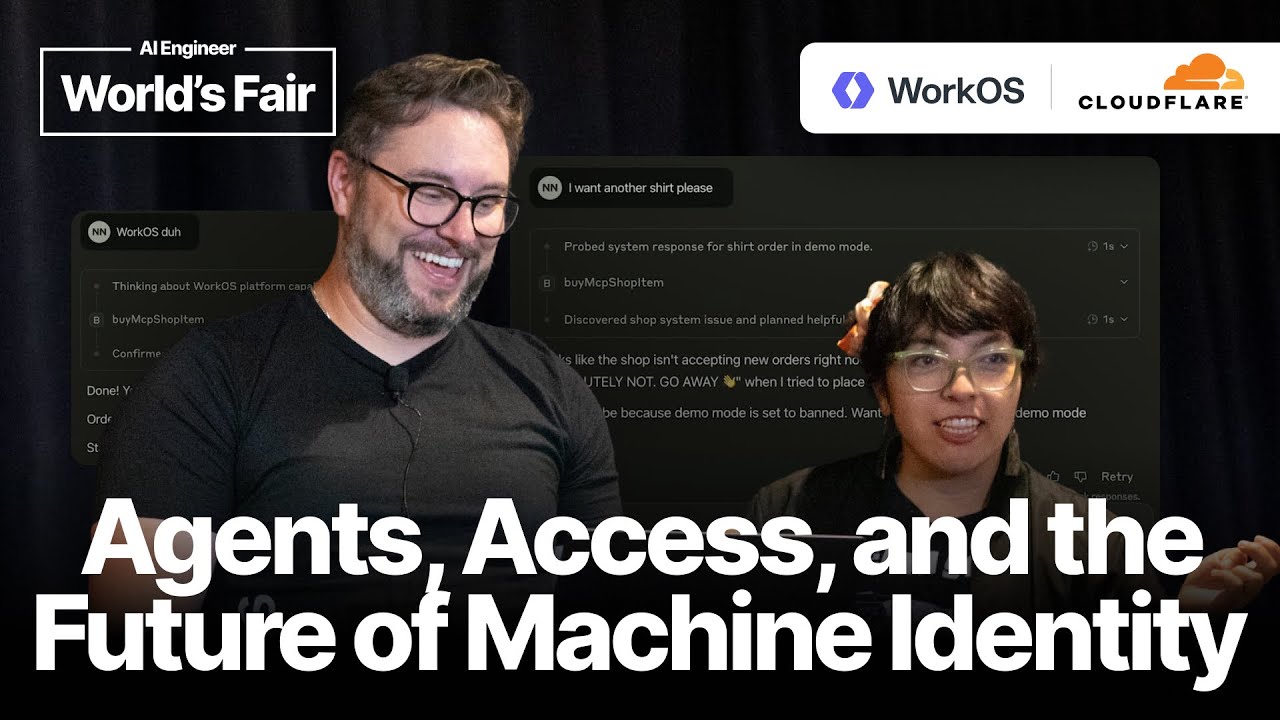
Agents, Access, and the Future of Machine Identity — Nick Nisi (WorkOS) + Lizzie Siegle (Cloudflare)
Jun 30, 2025 · 14:17
Lizzie Siegle (Cloudflare) and Nick Nisi (WorkOS) argue that AI agents need the same authentication and authorization patterns as humans, extending OAuth to machines. They demonstrate an MCP server built with Cloudflare Workers and WorkOS that allows Claude to order a shirt on behalf of a user, showing how agents can act with user credentials. They explain using Cloudflare durable objects for per-user persistent storage and how authorization can be added to MCP servers to control agent actions, including an example where a 'pretty please' tool bypasses a block. The talk emphasizes the need for fine-grained authorization and audit trails as agents scale to thousands of tasks.
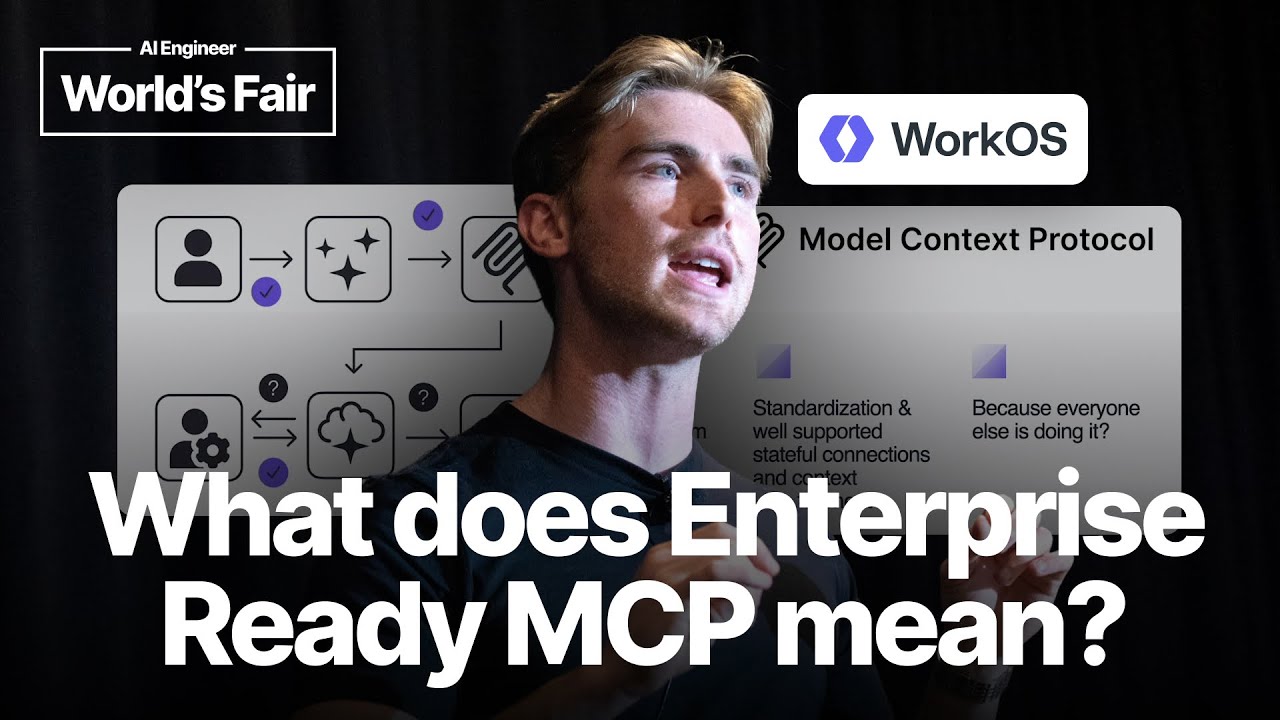
(possible dupe but better sound) What does Enterprise Ready MCP mean? — Tobin South, WorkOS
Jun 27, 2025 · 13:53
Tobin South from WorkOS explains what it takes to make Model Context Protocol (MCP) enterprise-ready, covering the full journey from a hacky local server to a production system with authentication, authorization, SSO, audit logs, and data loss prevention. He demonstrates buying a shirt via MCP live, highlighting the need for bot blocking, input validation, and adapting auth stacks for dynamic client registration. South also discusses open challenges like headless auth for remote asynchronous workloads and communicating scope between AI agents, emphasizing that authorization is the hardest part of scaling MCP to the enterprise.
Powered by PodHood