
Weights and Biases
CompanyA company discussed on AI Engineer.
3 episodes
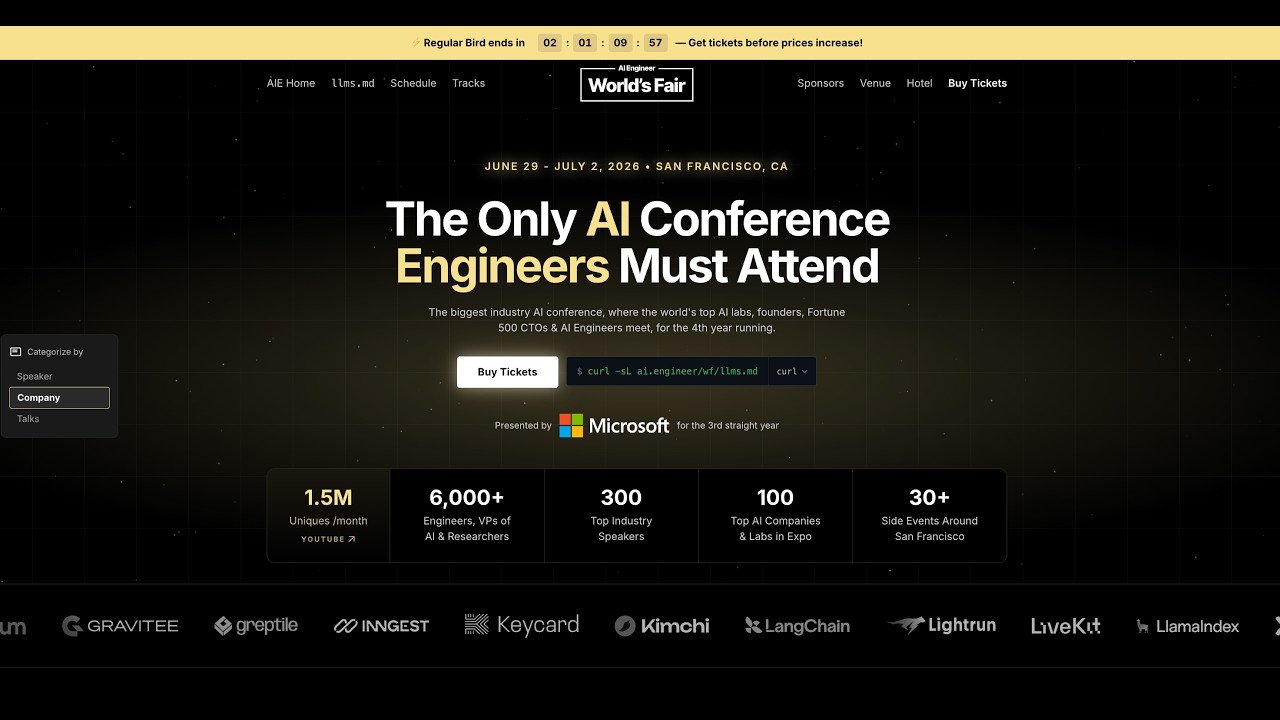
6 Things to Know about AIE World's Fair 2026
Jun 21, 2026 · 17:50
Swix, co-founder of AI Engineer, outlines six key features of the 2026 World's Fair in San Francisco. The event is over 4x larger than 2025, with 50% new topics, an expanded expo floor (4 stages, 4x bigger), and a new research-industry poster session that includes printed tweets. A leadership track on Level 3 features the Token Billionaire lounge for heavy LLM users and off-the-record McKinsey sessions. AI verticals debut in agentic commerce, healthcare, finance, and GTM, with a new AI Engineer New York focused on finance. Side events include a World Cup viewing, New Engineer Orientation (NEO) with 300+ signups, and a kids event; attendees can claim $38,000 in sponsor offers.

Productionizing GenAI Models – Lessons from the world's best AI teams: Lukas Biewald
Oct 23, 2024 · 22:36
Lukas Biewald, founder of Weights and Biases, shares lessons from productionizing GenAI models, emphasizing that while AI is easy to demo, it is hard to productionize. He illustrates this with a personal project building a custom Alexa-like device using LLaMA and Whisper, where accuracy improved from 0% to 98% through prompt engineering, switching to Mistral, and fine-tuning with QLoRA. Biewald argues that tracking experiments (including failures) is critical for reproducibility and collaboration, and that a robust evaluation framework—beyond 'testing by vibes'—is essential for iterating and shipping v2. He notes that 70% of the audience had LLM apps in production, yet many lack solid evaluations, and recommends starting with lightweight prototypes and incorporating end-user feedback.

The AI Pivot: With Chris White of Prefect & Bryan Bischof of Hex
Nov 7, 2023 · 35:16
Chris White (CTO of Prefect) and Bryan Bischof (Head of AI at Hex) detail how their non-AI startups successfully pivoted to integrate AI, arguing that ruthless prioritization and deep product integration are key. White explains Prefect built the open-source Marvin project to learn from LLM experimenters, while adding AI features like error summaries to its core orchestration product, but had to restrain over-enthusiasm from engineers. Bischof describes Hex's Magic feature as an augmentation, not a separate product, and explains they built their own evaluation system but chose not to build a vector database, and killed a promising feature called Crystal Ball to avoid splitting the product experience. They both emphasize machine-to-machine interfaces and typed outputs, and caution that the work is often tedious data engineering. Their hot takes: White says stop building chat interfaces, AI is a tool; Bischof warns that the journey is boring but worth it.
Powered by PodHood