
Voyage AI
CompanyA company discussed on AI Engineer.
4 episodes

AI System Design: From Idea to Production - Apoorva Joshi, MongoDB
Jun 28, 2026 · 28:53
Apoorva Joshi presents a structured framework for designing AI systems from idea to production, arguing that thorough product specification and evaluation are now more critical than coding itself. Using a health insurance claims review system for MDB Health as an example, she walks through four phases: defining business problems with measurable success metrics (e.g., reducing urgent claim processing from 2 days to 1 hour within 90 days), designing data strategy and architecture using patterns like RAG, control flow, and human-in-the-loop, establishing guardrails and evaluation metrics such as faithfulness and cost per recommendation, and optimizing for accuracy, cost, latency, and reliability before shipping. She emphasizes building evaluation in from the start and iterating from the simplest system.
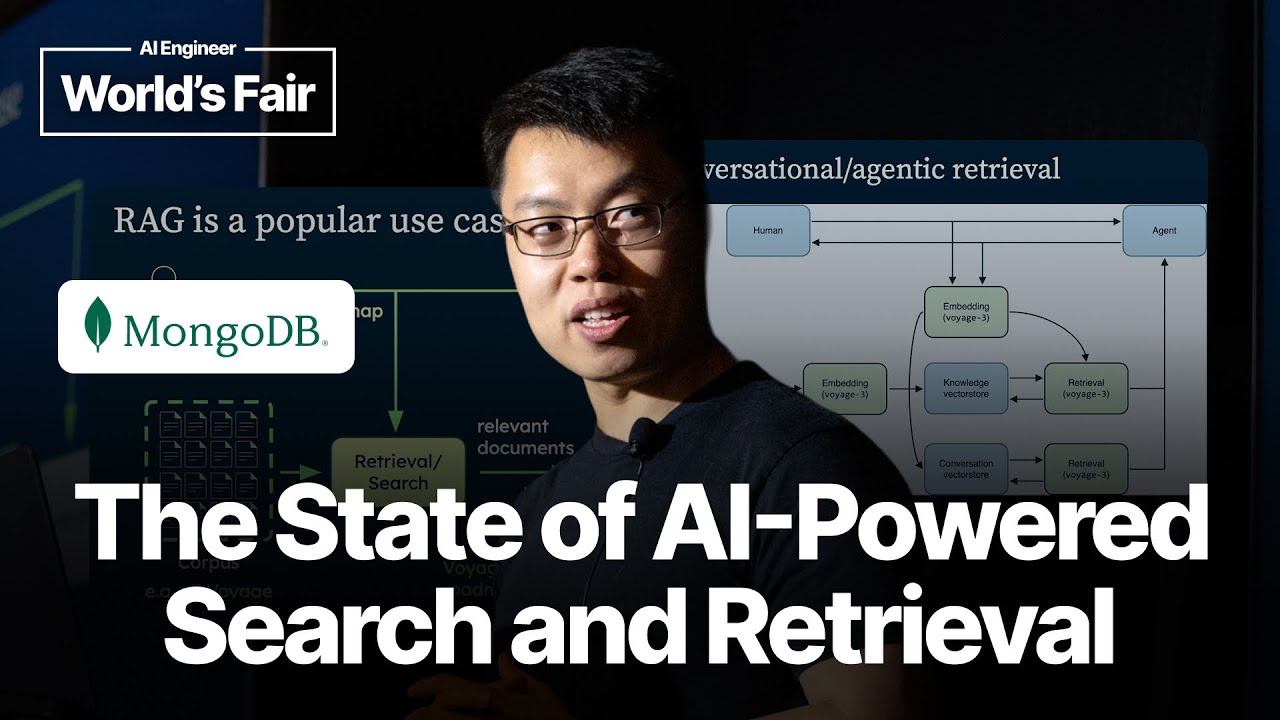
The State of AI Powered Search and Retrieval — Frank Liu, MongoDB (prev Voyage AI)
Jun 27, 2025 · 12:35
Frank Liu from Voyage AI (now part of MongoDB) presents the state of AI-powered search and retrieval, arguing that embedding quality is core but not sufficient—systems must integrate structured data filtering and agentic query decomposition for real-world RAG applications. He details three live use cases: chatting with codebases (where Continue.dev found Voyage Code 3 best, emphasizing domain-specific evaluation), legal document search requiring pre-filtering by metadata, and agentic retrieval where LLMs decompose queries into multiple sub-queries. Looking ahead, Liu predicts three trends: multimodal embeddings that combine text and images (e.g., Voyage Multimodal 3 embedding Claude 3.5 blog posts), instruction tuning to steer embeddings toward specific document aspects, and the rise of agent-native databases (like MongoDB integrating Voyage for embedding, reranking, and query augmentation within a single platform).

Architecting Agent Memory: Principles, Patterns, and Best Practices — Richmond Alake, MongoDB
Jun 27, 2025 · 17:37
Richmond Alake from MongoDB presents memory management as the key pillar for building believable, capable, and reliable AI agents, arguing that agentic systems require structured memory types—persona, toolbox, conversational, workflow, episodic, and entity—to achieve statefulness and reduce reliance on prompt engineering. He introduces MemoRiz, an open-source library implementing these memory design patterns, and positions MongoDB as a flexible memory provider with its document model and hybrid retrieval capabilities (vector, text, graph). Alake details practical patterns: storing tool schemas for scalable tool use, persisting conversation history with timestamps and recall signals, leveraging workflow memory to learn from failures, and using MongoDB's upcoming integration of Voyage AI embedding models to simplify chunking and retrieval. He connects these advances to neuroscience, citing how feline visual cortex research inspired CNNs and noting recent collaborations with neuroscientists to further agent memory research.

Building Multimodal AI Agents From Scratch — Apoorva Joshi, MongoDB
Jun 27, 2025 · 36:58
Apoorva Joshi, an AI developer advocate at MongoDB, leads a hands-on workshop on building multimodal AI agents from scratch. She defines agents as systems using LLMs to reason, plan, and execute tasks with tools, contrasting them with simple prompting and RAG. The workshop focuses on processing mixed-media documents (text and images) by converting each page to a screenshot, embedding it with Voyage AI's multimodal (VLM-based) model to avoid the modality gap of CLIP, and storing embeddings in MongoDB for vector search. The agent uses Google's Gemini 2.0 Flash as the multimodal LLM, implements REACT (reasoning and acting) for planning with feedback, and manages short-term memory via session IDs. Participants build a tool-calling agent that retrieves relevant page screenshots, passes them with conversation history to Gemini, and generates answers for queries like analyzing charts or extracting insights from documents.
Powered by PodHood