
Twilio
CompanyA company discussed on AI Engineer.
8 episodes
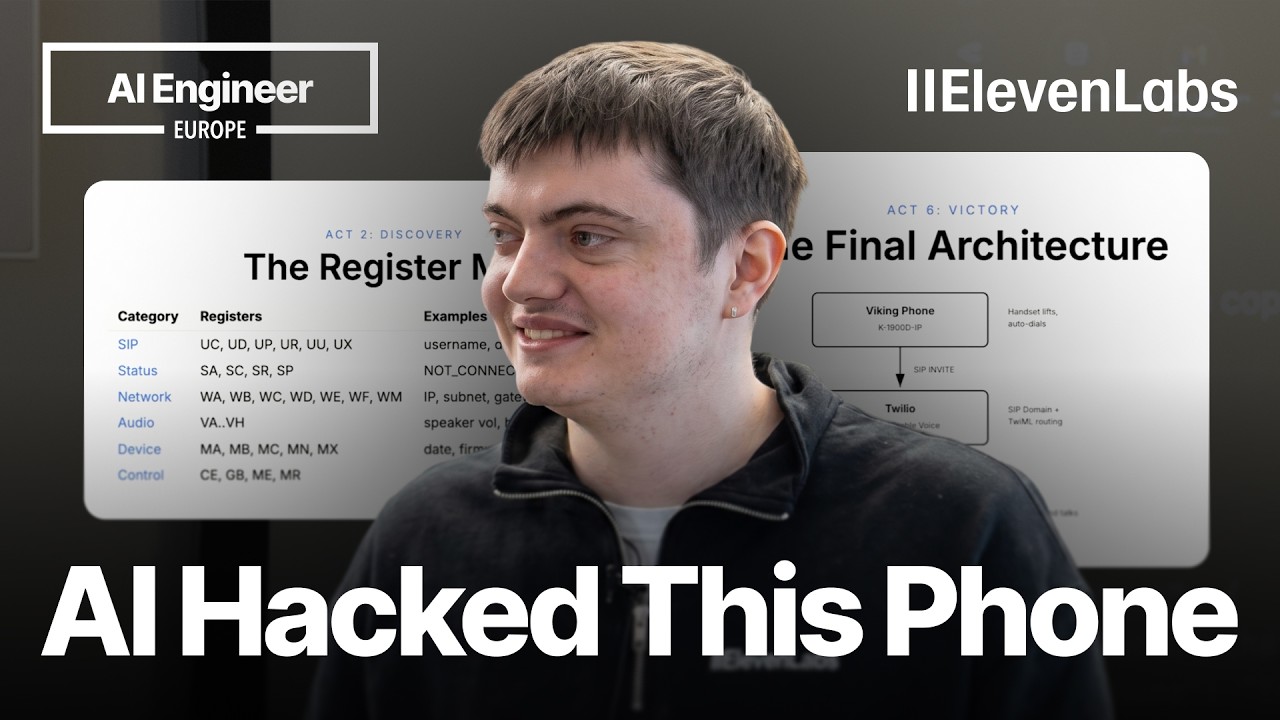
Reverse engineering a Viking VOIP phone protocol with Claude Code — Boris Starkov, Eleven Labs
May 29, 2026 · 20:11
Boris Starkov from ElevenLabs used Claude Code to reverse engineer the undocumented protocol of a Viking VOIP phone that three senior engineers and ChatGPT failed to configure in a year. Claude brute-forced all 676 possible two-letter command combinations, found 80 valid ones, then set up a TCP proxy between a Windows XP virtual machine and the phone to intercept traffic from the proprietary software. The critical missing piece—a one-byte checksum in the persistence command—was deduced by Claude by running known input-output pairs through the derived formula, confirming a simple subtraction. Starkov acted as Claude's hands, physically rebooting the phone and reporting beeps. The protocol is now open-sourced as a Claude Code skill, enabling direct programming without Windows software. The project culminated in a red phone booth at AI Engineer Europe where picking up the receiver connects to a Michael Caine voice agent quizzing attendees on British AI history.

Full Workshop: Realtime Voice AI — Mark Backman, Daily
Aug 3, 2025 · 1:09:41
In this hands-on workshop, Mark Backman and Aleś from Daily demonstrate how to build real-time voice AI agents using Pipecat, their open-source Python framework, and Google's Gemini Multimodal Live API. They explain that Pipecat's modular pipeline orchestrates audio transport, speech-to-text, LLM, and text-to-speech services, allowing developers to plug and play vendors like Deepgram, OpenAI, or Cartesia. The session highlights how speech-to-speech models like Gemini Live simplify architecture by handling transcription, LLM logic, and voice generation in one step, reducing latency to under 800 milliseconds. Key topics include the critical role of voice activity detection (VAD) for natural turn-taking, strategies for managing context windows to maintain accuracy, and the trade-offs between speed and reliability when using tool calls in real-time. Despite conference Wi-Fi issues, the team live-codes a functional bot and demonstrates interruption handling and the Word Wrangler game, showcasing Pipecat's production readiness with hundreds of thousands of daily calls.

Pipecat Cloud: Enterprise Voice Agents Built On Open Source - Kwindla Hultman Kramer, Daily
Jul 31, 2025 · 26:46
Kwindla Hultman Kramer, co-founder of Daily, introduces Pipecat, an open-source, vendor-neutral framework for building voice AI agents, and Pipecat Cloud, a deployment layer optimized for real-time voice. He argues that achieving sub-800-millisecond voice-to-voice response times is critical and that frameworks like Pipecat handle hard problems like turn detection, interruption handling, and context management. Kramer explains that Pipecat supports 60+ models and services, including Gemini and OpenAI, and that Gemini is often 10x cheaper for 30-minute conversations. He notes that while speech-to-speech models like Moshi and Sesame are promising for natural conversation, they currently lag in instruction-following for enterprise use cases. Kramer also addresses global latency challenges, recommending deployment close to inference servers or using open-weight models locally, and highlights Pipecat Cloud's integration with Krisp for background noise reduction and a free open-source smart turn model.

Building voice agents with OpenAI — Dominik Kundel, OpenAI
Jun 29, 2025 · 1:25:35
Dominik Kundel from OpenAI presents the new OpenAI Agents SDK for TypeScript and demonstrates how to build voice agents, arguing that speech-to-speech architectures (using GPT-4 real-time) offer lower latency and more natural interactions than chained approaches that transcribe audio to text. He covers two architectures: chained (speech-to-text, text agent, text-to-speech) versus speech-to-speech (native audio understanding), and recommends starting with a small, clear goal, building evals and guardrails early, and using generative prompts to control tone and personality via openai.fm. In a live coding session, he builds a real-time agent with tools (e.g., getWeather) and handoffs, demonstrates delegation to a smarter model (O4 mini) for complex tasks like refunds, and shows built-in interruption handling, human-in-the-loop approval, tracing for debugging, and output guardrails. The SDK supports WebRTC and WebSocket, handles turn detection automatically, and provides session management with a 30-minute timeout that can be extended by injecting previous context.

The Robots are coming for your job, and that's okay - Elmer Thomas and Maria Bermudez
Jun 3, 2025 · 8:57
Elmer Thomas and Maria Bermudez of Twilio's developer education team explain how they built six single-purpose AI agents to automate repetitive documentation tasks like editing, alt text generation, and jargon simplification, rather than replacing human writers. The agents, powered by GPT-4/01 and validated with tools like Veil Lint and CI tests, reduce hallucinations through layered human review. Maria demos the automated editor, SEO metadata generator, alt text generator, and jargon simplifier. The team’s playbook: identify a pain point, pick a repeatable task, and iterate with weekly user feedback.
Building an AI assistant that makes phone calls [Convex Workshop]
Feb 9, 2025 · 50:53
Tom Redmond, head of DX at Convex, builds Floyd, an AI phone-calling assistant using Convex, GPT-4, Google Cloud speech-to-text, and Twilio. Floyd lets users make voice requests (e.g., calling a school to report a sick child) via a web app; transcription, context retrieval, and real-time conversation with a human on the other end happen through a reactive database architecture. Redmond explains how Convex's WebSocket-based infrastructure solves serverless latency issues, enabling live transcript streaming and status updates without polling. He demonstrates two calls (school absence and flower order), noting that latency (2–5 seconds) comes from OpenAI text-to-speech and growing prompts, with plans to use OpenAI Threads and faster TTS services. The prototype explicitly discloses it's an AI to avoid misrepresentation, and Redmond envisions AI agents efficiently handling service bookings.
Cooking with fire without burning down the kitchen: Dominik Kundel
Dec 31, 2024 · 20:35
Dominik Kundel, who leads product and design for Twilio's Emerging Tech & Innovation team, explains how the company balances disruptive AI innovation with its existing communications and customer data platform businesses. He distinguishes sustaining innovation (e.g., Apple's AI features) from disruptive innovation (e.g., agents not yet enterprise-ready due to quality and cost), arguing that ignoring disruptive AI is increasingly dangerous because quality improves daily. Kundel shares three key lessons from Twilio's AI journey: first, ship early and often—even rough prototypes—to gather real feedback, which led to the Twilio Alpha sub-brand for setting expectations; second, build a curious, problem-owning team rather than requiring existing AI expertise; third, share learnings internally and externally to avoid operating in a silo and to help customers be thought leaders. He recounts how an initial AI personalization engine was too disruptive for mainstream R&D, so the team iterated on an AI Assistance agent builder, using internal hackathons and dogfooding with low-risk use cases like IT helpdesk to improve quality before broader release.

Building and Scaling an AI Agent Swarm of low latency real time voice bots: Damien Murphy
Oct 8, 2024 · 1:07:23
Damien Murphy, Senior Applied Engineer at Deepgram, demonstrates building and scaling low-latency real-time voice bots using Deepgram's new voice agent API, which wraps speech-to-text, LLM, and text-to-speech into a single streaming endpoint. He shows a drive-thru ordering demo with function calling (add/remove items) using GPT-4o, achieving sub-second latency by co-locating components. Murphy explains scaling to millions of concurrent calls through regional Kubernetes clusters and multi-agent swarms (routing, booking, support agents) to reduce complexity and cost. He addresses endpointing challenges, VAD-based barge-in, and cost/quality trade-offs with hosted vs. self-hosted models, noting Deepgram offers 20x cheaper TTS than ElevenLabs and 50ms STT latency self-hosted. The talk emphasizes keeping agents simple, using smallest capable LLMs, and composability for reuse.
Powered by PodHood