
Towards AI
CompanyA company discussed on AI Engineer.
2 episodes

Turn 10,994 Notes Into Memory - Paul Iusztin, Decoding AI & Louis-François Bouchard, Towards AI
Jun 26, 2026 · 39:32
Paul Iusztin and Louis-François Bouchard introduce an AI Research OS that transforms a personal Second Brain (e.g., an Obsidian vault of 5,000+ notes growing by 250 files/month) from a passive archive into a live, queryable memory for AI agents. They argue that bigger context windows aren’t enough; proper memory and context management are needed. The system evolved through three iterations: first a simple deep research loop generating static research Markdown files (used for 35 course lessons), then targeting both the public web and the user’s Second Brain, and finally adding a persistent wiki layer. The architecture uses plain files (Markdown, YAML index) instead of vector databases, with a hierarchy of raw sources, source summaries, and wiki derivatives (concepts, comparisons, entities). The wiki evolves with every question, not just during ingestion. Demos show ingesting Obsidian notes, GitHub repos, and arbitrary links, then querying the wiki to update it dynamically.
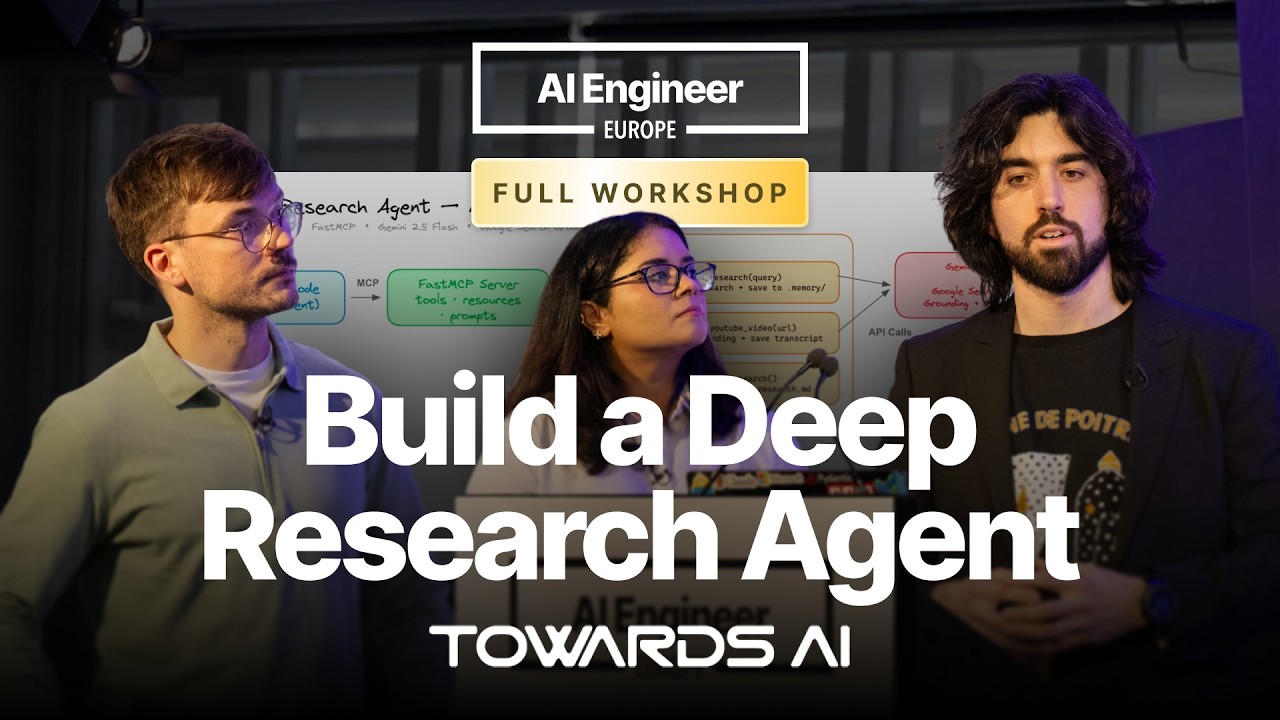
Full Workshop: Build Your Own Deep Research Agents - Louis-François Bouchard, Paul Iusztin, Samridhi
Apr 20, 2026 · 1:57:03
Louis-François Bouchard, Samridhi Vaid, and Paul Iusztin built a combined system of a deep research agent and a deterministic writing workflow to automate high-quality technical content creation, trading flexibility for control. The research agent uses an MCP server (FastMCP) with tools for Google search, YouTube analysis, and report compilation, powered by Gemini and orchestrated by Claude Code. The writing workflow is a static pipeline that loads a user guideline, writing profiles (structure, terminology, character), and few-shot examples into a system prompt, then applies an evaluator-optimizer loop: a reviewer outputs structured pydantic objects with profile/location/comment to flag violations, and the editor applies them in priority order (guideline > research > profile). They stress that research demands autonomy while writing needs constraint, and show how to avoid AI slop by banning specific words and using profiles. For observability, they use Opik to capture all traces, and for evals they built a 20-sample dataset from real LinkedIn posts, split into train/dev/test, to calibrate an LLM judge (binary pass/fail) that they run on dev and test splits to measure F1 and detect…
Powered by PodHood