
Together AI
CompanyA company discussed on AI Engineer.
6 episodes

Road to 5 Million Tokens: Breaking Barriers in Long Context Training — Max Ryabinin, Together AI
Jun 8, 2026 · 15:50
Max Ryabinin from Together AI presents their research on extending transformer context length to 5 million tokens using Untied Ulysses, which cuts activation memory by reusing buffers across attention head iterations. The talk walks through a stack of techniques including fully sharded data parallelism, DeepSpeed Ulysses context parallelism for an 8x activation reduction, activation checkpointing for another 8x, CPU offloading of transformer block inputs, and chunked sequence training. Even with these, training a LLaMA 3B model with 3 million tokens fits on an 8xH100 node, but 5 million requires Untied Ulysses. Instead of allocating one large buffer per attention head group, it chunks heads further and reuses buffers across iterations, cutting activation memory with negligible throughput impact. At both 8B and 32B scale, results match the most memory-optimized transformer training baselines while pushing sequence length 25% further than prior Ulysses implementations.
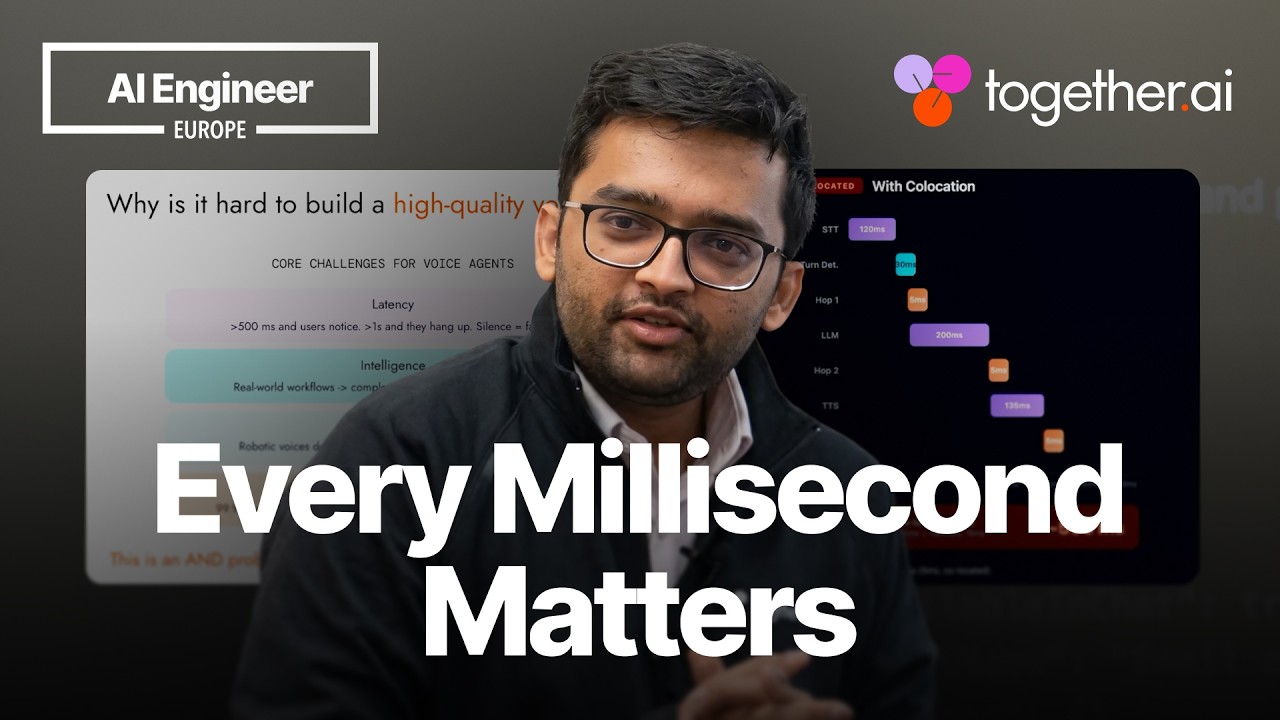
Engineering voice agents: Latency, quality, and scale — Rishabh Bhargava, Together AI
May 31, 2026 · 24:35
Rishabh Bhargava from Together AI outlines engineering voice agents, explaining that pipeline architecture with colocated models can achieve sub-500ms response times critical for user retention. Speech-to-text targets P90 under 100ms and 6% word error rate, while the LLM must stay within 200-300ms time-to-first-token using 8-30B parameter models—larger models blow the budget, smaller ones break tool calling. Network latency from distant data centers adds 75ms (30% overhead) versus 5ms when colocated in the same building. Pure speech-to-speech models are emerging but still struggle with instruction following and tool calling. The thinker-talker pattern uses a small LLM for fast conversational flow and issues a single tool call to a larger model for complex requests.

From Mixture of Experts to Mixture of Agents with Super Fast Inference - Daniel Kim & Daria Soboleva
Jun 27, 2025 · 53:15
Daria Soboleva and Daniel Kim of Cerebras explain how Mixture of Experts (MoE) architectures enable scaling large language models efficiently by replacing monolithic feedforward networks with specialized experts, a technique used by GPT-4 and Claude. They then introduce Mixture of Agents (MoA), which combines multiple LLMs with custom prompts to outperform frontier models like GPT-4o on complex tasks, reducing a 293-second reasoning problem to 7.4 seconds using Cerebras' ultra-fast inference. The workshop guides participants to build their own MoA system, configure agents for bug fixing and performance optimization on a Python function, and achieve scores up to 120/120. Daniel details Cerebras' wafer-scale chip with 900,000 cores and distributed memory that eliminates memory bandwidth bottlenecks, enabling linear scaling and 15.5x faster inference on Llama 3.3-70B versus GPUs. Daria discusses ongoing research in diffusion models and sparsity, while Daniel notes plans for multimodal APIs and LoRA fine-tuning support.
Navigating AI’s Frontier in 2025 - Grace Isford, Lux Capital
Mar 13, 2025 · 17:55
Grace Isford, partner at Lux Capital, argues that while 2025 is a 'perfect storm' for AI agents with reasoning models like O3 and R1, cheaper inference, and billions in infrastructure (e.g., Stargate, DeepSeek), agents still fail due to cumulative errors—decision, implementation, heuristic, and taste—exemplified by OpenAI Operator booking a flight incorrectly. She prescribes five strategies: curating proprietary and agent-generated data, building personalized evals for non-verifiable domains (e.g., seat preference), designing scaffolding that prevents cascading failures (citing Ramp's approach), treating UX as the moat (e.g., Codium, Harvey, TLDraw), and building multimodally with voice, smell via Osmo, and touch for embodiment. The talk, recorded at the AI Engineer Summit 2025 in NYC, closes with a call to reframe perfection through visionary product experiences.

Accelerating Mixture of Experts Training With Rail Optimized InfiniBand Networking in Crusoe Cloud
Feb 12, 2025 · 17:45
Ievgen Bakulenko, product manager at Crusoe Cloud, explains how their rail-optimized InfiniBand networking accelerates training for sparse mixture of experts models. By leveraging NVIDIA's PXN feature, which allows GPUs to communicate across different rails using the internal NVSwitch in a single hop, Crusoe achieves a 50% improvement in synthetic benchmark latency and bandwidth for both small and large messages. In a real-world test fine-tuning the Mixtral model (8 feed-forward blocks, 7 billion parameters) on 240 H100 GPUs, this topology reduced training time by 14%, directly lowering cost and time-to-train. Bakulenko also outlines Crusoe's AI cloud platform, its climate-aligned mission using stranded energy, and its focus on easy-to-use infrastructure for AI engineers.

The GenAI Maturity Curve or You Probably Don't Need Fine Tuning: Kyle Corbitt
Feb 9, 2025 · 18:03
Kyle Corbitt, CEO of OpenPipe, argues that most teams don't yet need fine-tuning and should start with prompted models like GPT-4. He presents a GenAI maturity curve where the trigger to fine-tune is when you hit constraints on cost, latency, or quality consistency—for example, if GPT-4 is 80-90% correct but inconsistent on the last 10-20%. Fine-tuning shifts the paradigm frontier outward, enabling models like fine-tuned LLaMA 38B to outperform GPT-4 at 1/25th the cost. The process has four steps: capture production logs to know your input distribution, prepare high-quality data (using GPT-4 outputs or iterative labeling), train with one-click tools, and evaluate with inner-loop (LLM-as-judge) and outer-loop (business metrics) evals. OpenPipe and other providers make deployment trivial via OpenAI-compatible APIs. The talk delivers a concrete decision framework and a walkthrough so any engineer can fine-tune in under an hour.
Powered by PodHood