
Together
CompanyA company discussed on AI Engineer.
3 episodes
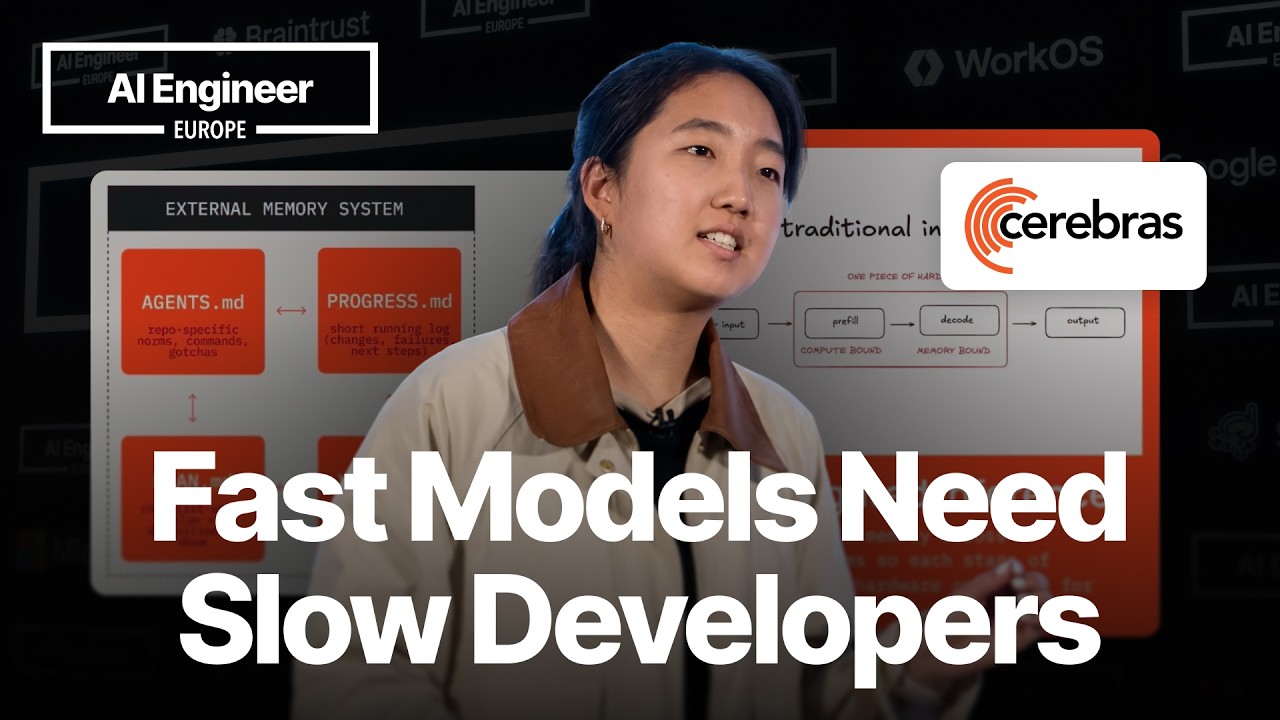
Fast Models Need Slow Developers — Sarah Chieng, Cerebras
May 22, 2026 · 18:02
Sarah Chieng from Cerebras argues that the 20x speed increase of models like Codex Spark (1,200 tokens/sec vs. 40-60 for Sonnet/Opus) forces developers to rethink workflows, or risk generating technical debt at unprecedented scale. She presents a practical playbook: validation and linting become free at every step, so must run continuously; developers can generate 75 component variations across five sub-agents and cherry-pick the best; and with context filling in 30 seconds instead of ten minutes, a four-file external memory system (agents, plan, progress, verify) maintains continuity between sessions. Chieng emphasizes real-time collaboration with the model rather than spawning agents and walking away, and advocates using a slower planner model with a fast executor to orchestrate agents effectively.
Fun stories from building OpenRouter and where all this is going - Alex Atallah, OpenRouter
Jun 25, 2025 · 18:47
Alex Atallah, founder of OpenRouter, tells the story of how he launched the LLM aggregator in early 2023 after observing the open-source race sparked by Meta's Llama 1 and Stanford's Alpaca distillation under $600. He argues the inference market is not winner-take-all, citing OpenRouter's data showing Google Gemini growing from 2-3% to 34-35% of tokens over 12 months. The platform evolved from a simple model collection into a marketplace with over 400 models and 60 providers, solving architecture challenges like 30-millisecond latency, cancelable streams, and a middleware plugin system for web search and PDF parsing. Atallah explains that OpenRouter grew 10-100% month-over-month for two years, and he predicts future additions like transfusion models that generate images and more powerful geographic routing for enterprise optimization.

System Design for Next-Gen Frontier Models — Dylan Patel, SemiAnalysis
Feb 11, 2025 · 18:29
Dylan Patel of SemiAnalysis breaks down the inference challenges for next-generation frontier models like GPT-4 (1.8 trillion parameters) and upcoming models trained on 100,000+ GPU clusters. He emphasizes that prefill (prompt processing) is compute-intensive while decode (token generation) is memory bandwidth-intensive, creating a systems problem where serving 64 users at 30 tokens/second requires 60 terabytes/second of memory bandwidth. Patel details engineering strategies such as continuous batching to improve batch utilization by 10-100x, disaggregated prefill to isolate noisy neighbors and maintain time-to-first-token SLAs, and context caching (like Google's) to cache KV cache on CPU/storage instead of GPU memory, dramatically reducing prefill costs. He warns that open-source tools like LLaMA.cpp lack these optimizations, making high-performance serving of models like LLaMA 405b infeasible without libraries like vLLM or TensorRT-LLM. On scaling, Patel notes that 100,000 GPU clusters (e.g., Microsoft's Arizona data center consuming 150 MW) face reliability issues — optical transceivers fail every five minutes — and straggler chips (silicon lottery) can degrade training…
Powered by PodHood