
Spotify
CompanyA company discussed on AI Engineer.
7 episodes
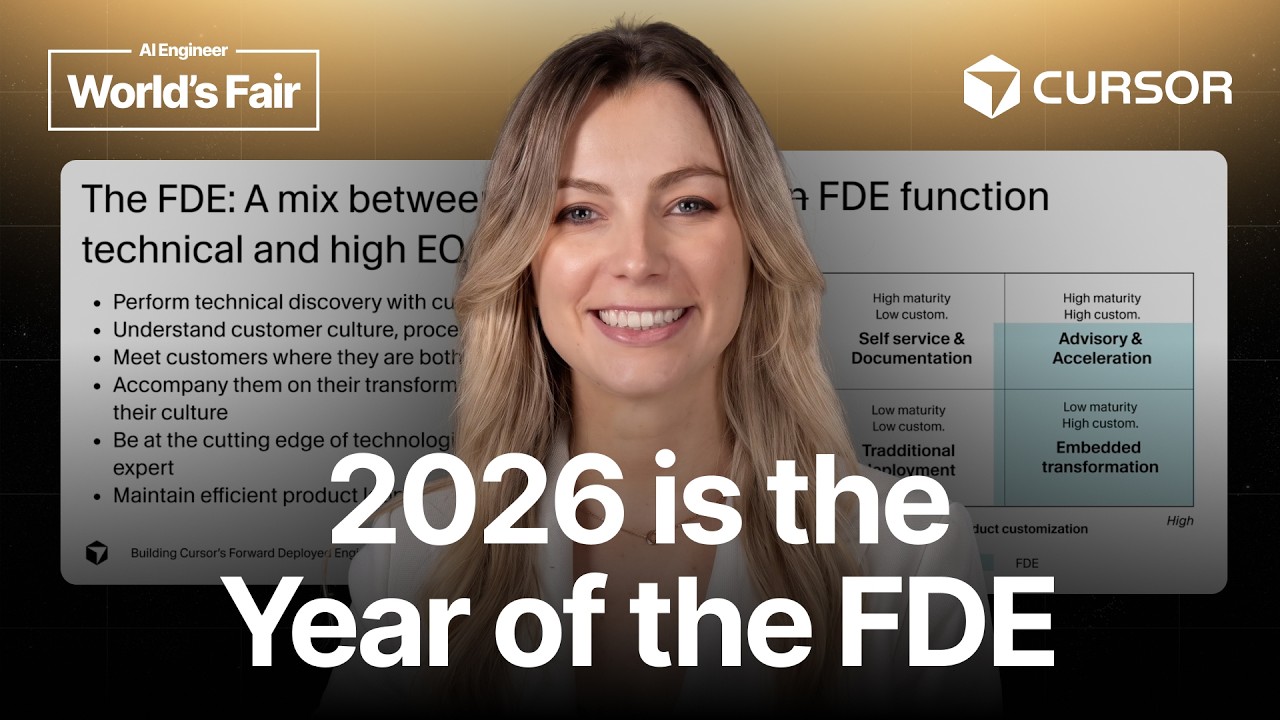
Forward Deployed Engineering at Cursor — Pauline Brunet
Jul 14, 2026 · 20:47
Pauline Brunet, VP of Forward Deployed Engineering at Cursor, explains how to build an effective FDE team by mapping customer digital maturity and product customization to the right engagement model—self-service, traditional SaaS deployment, advisory, or embedded transformation. She defines the ideal FDE as a highly technical engineer with strong customer-facing skills, capable of scoping impactful projects, co-developing with customer teams, and feeding insights back to product. Cursor’s FDE team uses a project-based approach, hires experienced unicorns (5+ year software engineers), and structures around geographies, industries, and product SMEs. Best practices include solving the right problem, defining success metrics upfront, keeping scope directional, involving customers at every step, measuring ROI (revenue, cost, risk), and leaving documentation behind. Brunet advises learning fast, pivoting, partnering with system integrators, and not being afraid to say no to mismatched use cases.

Dark Factory: OpenClaw Ships Faster Than You Can Read the Diff — Vincent Koc, OpenClaw
Jun 5, 2026 · 16:44
Vincent Koc, a core maintainer at OpenClaw, explains how the open-source project ships code faster than humans can read diffs by running 60–70 autonomous coding agents across swim lanes. In a single night, he and Peter Steinberger executed 2,700 commits touching 82% of the core codebase, launching a plugin architecture and changing close to a million lines of code. Koc describes managing agents as managing people: the key skill is reading reasoning tokens to detect when an agent is bullshitting, gained through sheer volume of token maxing. He argues 2025 was about token maxing; 2026 is about not wasting them, with agent-in-the-loop processes and opinionated swim lanes replacing blind Ralph looping. The episode details his agent development environment using .skills files, Git work trees, and a semantic graph for triaging 60K PRs, emphasizing that the bottleneck shifts from engineering to taste and process.

Personalization in the Era of LLMs - Shivam Verma, Spotify
May 19, 2026 · 20:12
Shivam Verma of Spotify's AI foundation explains how Spotify personalizes recommendations using open-weight LLMs, user embeddings from 750 million accounts, and Semantic IDs that compress each of 100 million tracks into six hierarchical tokens, enabling autoregressive next-item prediction. Three components: transformer-based user embeddings, Semantic IDs (e.g., Ariana Grande and Bruno Mars share first two tokens as pop artists), and a soft tokenization layer projecting user vectors into the LLM's token space for personalization without fine-tuning. The system is productionized for podcast next-episode recommendations. Verma also introduces Taste Profile, allowing users to edit their taste profile via natural language for steerable recommendations. This moves from traditional multi-stage pipelines to a unified generative model.

Shipping AI That Works: An Evaluation Framework for PMs – Aman Khan, Arize
Dec 26, 2025 · 1:26:16
Aman Khan, AI PM at Arize, presents a framework for product managers to evaluate LLM-powered products beyond gut-feel 'vibe checks.' He demonstrates building an AI trip planner with multi-agent LangGraph, then using Arize's tracing and prompt playground to iterate on prompts. Khan shows how to create datasets from production traces, run A/B experiments on prompts, and use LLM-as-a-judge evals for friendliness and discount offers, comparing against human labels to refine evaluators. He argues evals are the new requirements docs, enabling PMs to own the product experience by writing acceptance criteria as eval datasets. The talk covers building eval teams, handling variance with temperature settings, and continuously improving golden datasets with hard examples, citing real-world analogies from self-driving cars at Cruise.
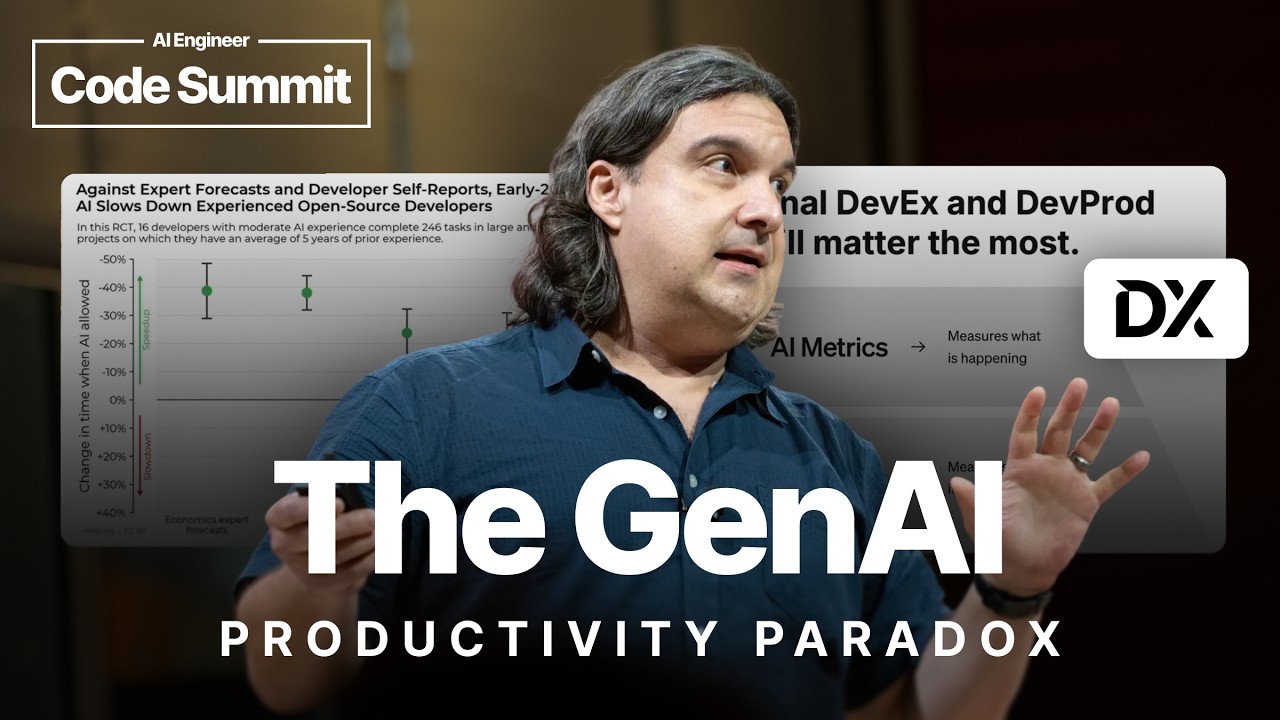
Leadership in AI Assisted Engineering – Justin Reock, DX (acq. Atlassian)
Dec 19, 2025 · 18:11
Justin Reock, Deputy CTO at DX (acquired by Atlassian), argues that AI's impact on engineering productivity varies wildly and that leaders must move beyond top-down mandates to focus on psychological safety, measurement of actual outcomes, and targeted integration across the SDLC. He presents data showing a 2.6% average increase in change confidence but extreme variability across companies, with some seeing 20% drops. Emphasizes that writing code is rarely the bottleneck; instead, leaders should identify and fix bottlenecks like context switching, citing Morgan Stanley's DevGenAI saving 300,000 hours annually by converting legacy code specs and Zapier reducing engineer onboarding to two weeks via AI agents. Introduces DX's AI Measurement Framework covering utilization, impact, and cost, and stresses trust-building through system prompt feedback loops and temperature settings. The episode delivers actionable guidance on measuring AI's true impact and enabling engineers through education, time to learn, and creative unblocking of usage.

Recsys Keynote: Improving Recommendation Systems & Search in the Age of LLMs - Eugene Yan, Amazon
Jul 16, 2025 · 20:54
Eugene Yan's keynote presents three innovations for recommendation systems: Semantic IDs, LLM-augmented data, and unified models. Kuaishou’s trainable multimodal Semantic IDs increased cold-start coverage by 3.6% and velocity by 3.5% by clustering content embeddings. Indeed used GPT-4 fine-tuning and distillation to filter bad job recommendations, reducing bad recs by 20% while boosting application rate 4% and cutting unsubscribes 5%. Spotify’s LLM-generated exploratory search queries drove a 9% increase in exploratory queries for new categories like podcasts. Netflix’s Unicorn unified ranker matched or exceeded specialized models across search and recommendations, while Etsy’s unified embeddings with a quality vector achieved a 2.6% sitewide conversion lift and 5% more search purchases.

From Text to Vision to Voice Exploring Multimodality with Open AI: Romain Huet
Jul 10, 2024 · 23:39
OpenAI's Romain Huet demonstrates GPT-4o's real-time audio, vision, and screen-sharing capabilities at the AI Engineer World's Fair, showing how the omni-model achieves human-like conversational latency, understands emotion, and can be interrupted naturally. He walks through live demos of ChatGPT Desktop recognizing drawings, reading book pages, and pair-coding a responsive travel app using Tailwind CSS. Huet also previews Sora's text-to-video generation and OpenAI's unreleased Voice Engine, which can clone a voice from seconds of audio and translate it into multiple languages while preserving the original speaker's tone. He outlines OpenAI's four focus areas: advancing textual intelligence, faster/cheaper models (GPT-4o is twice as fast as GPT-4 Turbo at half the price), model customization via fine-tuning, and enabling multimodal agents. The talk emphasizes that today's models are the dumbest they'll ever be and urges developers to build for a future where AI works across text, voice, and video.
Powered by PodHood